Martin Austermuhle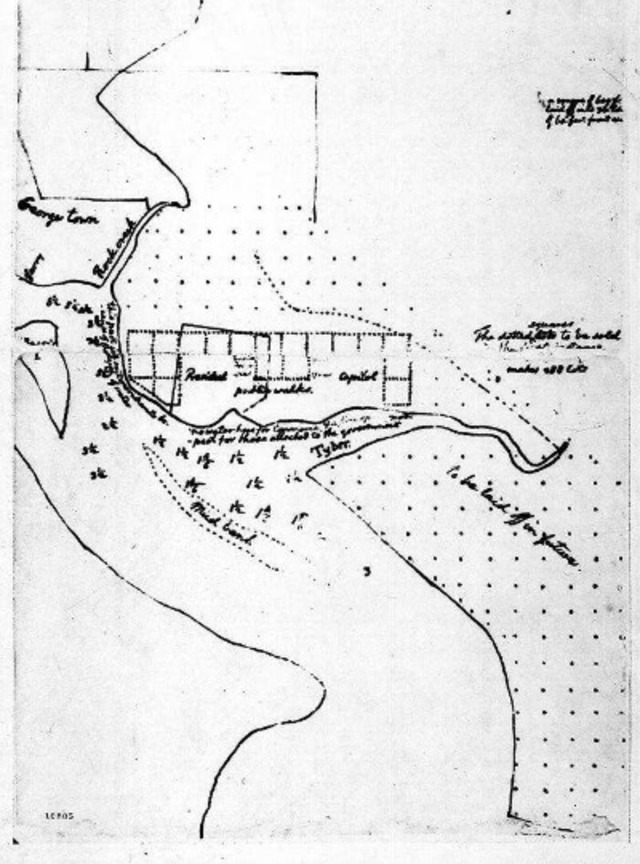
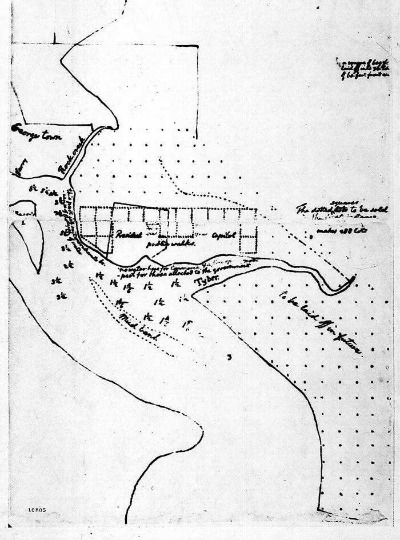 An early sketch of what would become the nation’s capital.
We all but forgot a significant milestone in the history of our fair city yesterday—on July 16, 1790, Congress formally declared Washington the country’s capital city.
As part of the Residence Act of 1790, Congress allowed President George Washington to identify a ten-mile-square plot of land somewhere along the Potomac River, though the exact location was largely left up to him—he was only told that it has to be between the Eastern Branch (now known as the Anacostia River) and Williamsport, Maryland.
Why was Congress so intent on finding a place to settle? Because the country’s new legislators were chased out of Philadelphia by a band of angry soldiers in 1783, forcing them to meet in Princeton, Annapolis, Trenton, and New York. Divisions between the north and south led to a short-lived plan to have two capitals—one in Georgetown, the other along the Delaware River in Pennsylvania—but it never came to pass.
After the constitutional convention of 1787, a compromise was crafted and the site along the Potomac River became the winning contender. But due to continuing fears that Congress could be chased out of a new capital once again, the founding fathers including a provision in the constitution making the new capital a federal district under Congress’ control. We’re still feeling the effect of that decision today—that we’re treated like a step-child of Congress is because we were initially meant to be one.
Of course, it took a while before Washington became, well, Washington. In 1791 it was officially named after the man who selected it, and it wasn’t until November 1800 that Congress first convened here.