Martin Austermuhle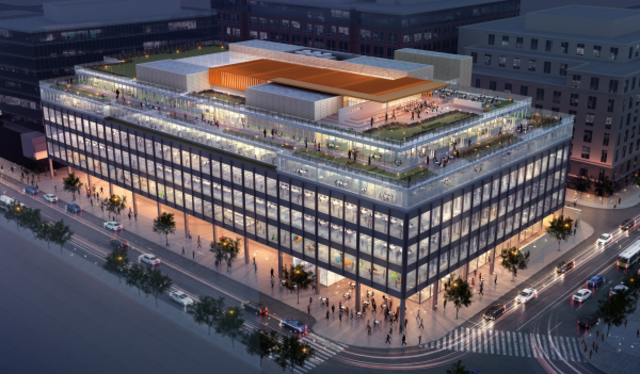
If the architects tasked with re-imagining the Martin Luther King Jr. Memorial Library were unencumbered by budgets or political realities, they’d cut a big hole in the middle of the boxy Mies van der Rohe-designed building, letting light filter down into to the library’s Great Hall through an atrium stretching up four stories. Two floors would be tacked onto the existing structure, offering space for an additional tenant. A roof garden and ground-level café would provide amenities to draw in readers and passersby alike.
Those ideas were presented yesterday to the D.C. Library Board of Trustees as part of a long-running discussion over what to do with the central library, which turned 40 in August. Late last year a panel of experts debated a number of alternatives, from selling the building altogether to just keeping it as is and only doing the most necessary repairs and upgrades. Ultimately, the panel split the difference—keep the library in the historic building, but expand the building and offer the new space to a second tenant that could help cover the costs of a broader modernization.
At yesterday’s meeting, D.C. Librarian Ginnie Cooper explained that she had asked the Freelon Group—the central library’s architect of record since 2010—to come up with a “knock your socks off” proposal for the building. Councilmember Tommy Wells (D-Ward 6), who oversees the city’s libraries from the D.C. Council, similarly said that he hoped that the trustees and the public at the meeting would set aside concerns over cost and complexity and instead focus on the larger vision. “Don’t short-sell the greatest city on the planet,” he said, challenging the trustees to think big.
Big thinking certainly wasn’t spared, as architect Phil Freelon dissected his proposal for opening up the library while maintaining the integrity of van der Rohe’s original design. Given that the building has more space that the library actually uses, he said, it could afford to cut out a large chunk in the middle that would allow light to flow down from the roof and make the transitions and sightlines from floor to floor more seamless. And since van der Rohe’s design allows for flexibility, he argued, adding two floors to the top—whether in the same style as the rest of the building or set back from the existing top floor—could be easily accomplished.
Vision isn’t cheap, though, and those at the meeting could have been forgiven for wondering what such a project would cost. Developer Jair Lynch broke down the costs for two options—keeping things as are or doing a full renovation—and detailed how they could be paid for.
Leaving the library as is and doing only the basic repairs would cost between $5 and 10 million a year, he said, given the amount of deferred maintenance on the aging building. Earlier, Cooper said that when she asked her head of maintenance to come up with a list of needed fixes, he came up with $18 million worth in just 24 hours. Replacing the single-pane windows would run $12 million, while repainting the building would cost $3 million, she added.
The full renovation envisioned by Freelon would cost somewhere between $175 and 250 million, Lynch said, saddling D.C. with between $9 and 13 million per year in debt service. The first challenge of this idea, he noted, was that D.C. is too close to its legal debt cap to borrow the money necessary to fully fund such an ambitious project.
That’s where adding two floors to the top of the building could help, he said, likely bringing in between $16 and 18 million if sold. He also said that the library could seek historic tax credits or federal tax credits for developing areas, or lease out a below-ground parking lot that’s currently used for 100 cars. In a worst-case scenario, the building could be sold for anywhere from $75 to 90 million.
Despite those financial realities, the board seemed pleased with the vision of what the library could become. And in a telling sign, even library advocates that have clashed with Cooper in the past over library modernization plans were surprised. “I’ve had my socks knocked off for sure,” said Robin Diener of the D.C. Library Renaissance Project, calling the proposed design “extraordinary.”
Still, Freelon and Cooper’s vision has a number of obstacles to overcome, including getting the board’s approval and the council’s go-ahead. (Wells has called a public roundtable on the library’s future next Thursday.) And even after those are done, warned Lynch, the work would take between four and five years to complete.