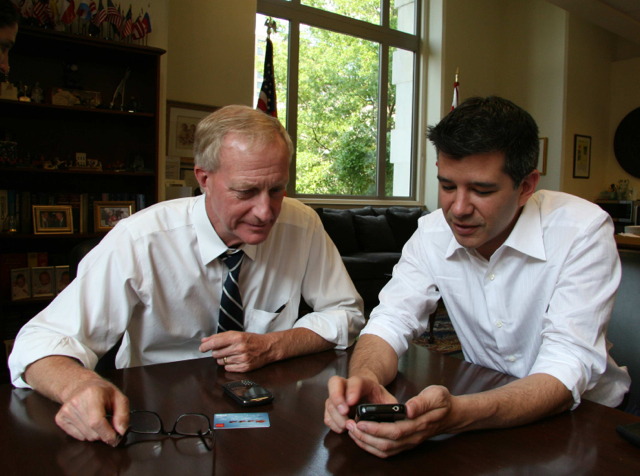
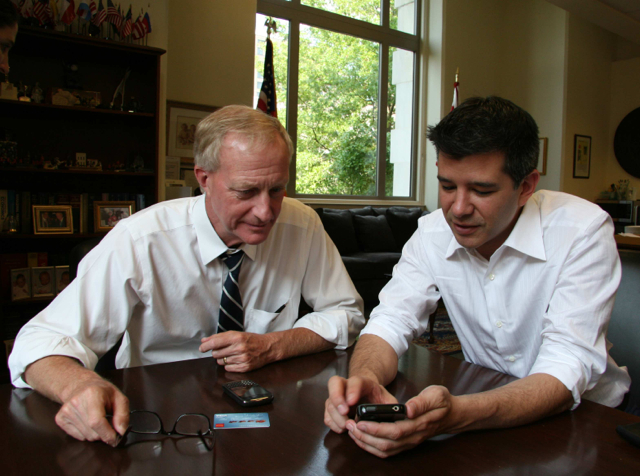
 Uber CEO Travis Kalanick, right, shows his company’s smartphone application to Councilmember Jack Evans (D-Ward 2).
The exemption from regulation that the sedan-by-smartphone company Uber currently enjoys in D.C. is set to run out at the end of the year. But a D.C. Council bill proposed yesterday by Councilmember Jack Evans (D-Ward 2), would grant Uber that free pass for good.
Last week, the members of the Council’s transportation committee argued for hours over the future of livery sedan service in D.C., including the future of Uber. While the San Francisco-based company maintains a relatively high mark of customer satisfaction, it has nonetheless had a famously rocky experience with D.C. officials.
But rather than see Uber fall under a new wave of sedan regulations that the company argues would end its business in the District, Evans is once again coming to its aid. During the full Council’s legislative session yesterday, Evans introduced an amendment that would follow on the measure he proposed in July, after Uber and its customers rebelled against an amendment that would have set a price floor for sedan services hailed by a mobile application.
Evans’ amendment does not specify Uber by name, though it exempts from the D.C. Taxicab Commission’s oversight any business that connects customers to sedan drivers on-demand and:
- provides estimated fares to customers upon booking a ride
- shows customers the method by which prices are calculated
- gives customers a receipt upon arrival at their destination.
Currently, there is one company operating in D.C that operates that way: Uber.
Councilmember Mary Cheh (D-Ward 3) briefly complained that Evans’ amendment is a facsimile of a measure of the same title she proposed last weekin July that would have established regulations defining sedan service but exempt Uber and other companies that connect customers and drivers through smartphone applications. Like Evans’ bill, Cheh’s version contains language exempting pricing models from regulation in addition to a company’s other operations.
After a flood of angry phone calls and emails from Uber customers in July, the Council quickly shelved Cheh’s price-floor amendment and instead adopted Evans’, giving Uber a free pass through December 31. Now Evans wants to make it permanent.
Uber Legislation Marked Version