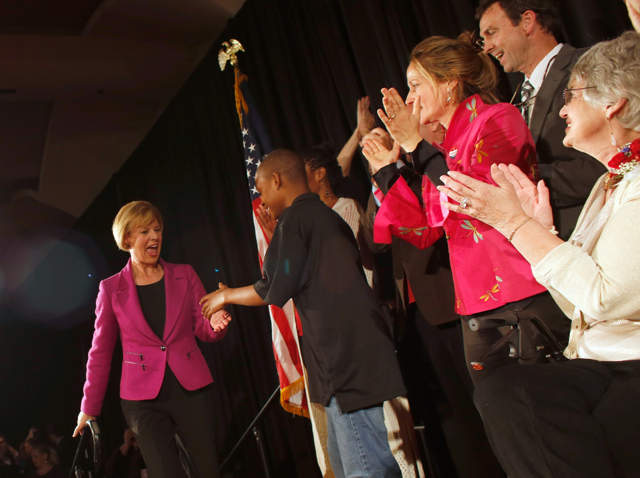
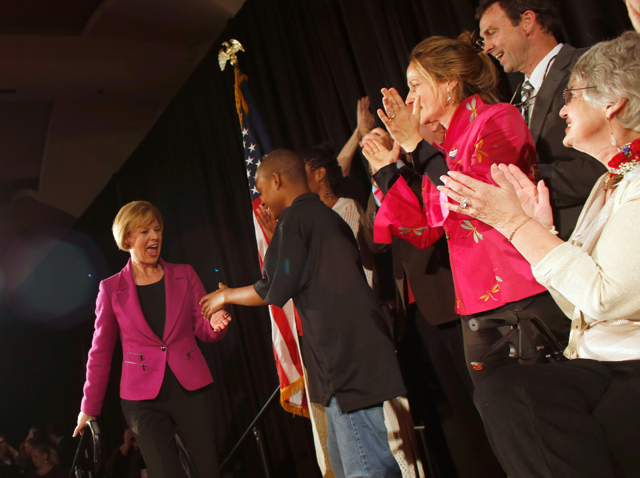
 Rep. Tammy Baldwin (D-Wis.) was the first openly gay person to be elected to the U.S. Senate. (Darren Hauck/Getty Images)
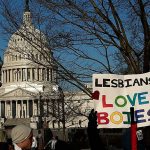
Before last night, voters in more than 30 consecutive statewide elections across the United States approved bans on same-sex marriage. On Tuesday, three states broke the trend—with a fourth still counting its votes—in what some advocates and organizations are calling the most successful election for gay rights ever.
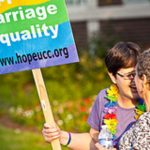
“There is clear mandate in this country for equality,” Chad Griffin, president of the Human Rights Campaign, said on a conference call with reporters today. Griffin was referring to same-sex marriage laws upheld by voters in Maryland and Maine and the defeat of an amendment to the Minnesota state constitution that would have restricted marriage to heterosexual couples. Officials in Washington State are also still counting votes from last night on a referendum that would uphold a marriage equality law there; Griffin said he is “cautiously optimistic” about the final tally.
Along with the marriage victories, results across the country spelled out significant gains for gay, lesbian, bisexual and transgender Americans, starting at the top of the ballot, Griffin said: “Obama is the most pro-LGBT equality president in the history of this country He’s also the first president to then be elected after having announced that position.”
President Obama announced his personal support for marriage equality in May, a few days after Vice President Joe Biden said in a television interview that he supports same-sex marriages.
“When the president announced his support for equality, there were many pundits and activists who announced this would bring about doom and gloom for our movement and this president,” Griffin said. “The opposite turned out to be true.”
Nationally, five percent of all voters identified as gay, lesbian or bisexual in exit polling.
In Wisconsin, Democratic Rep. Tammy Baldwin defeated former Gov. Tommy Thompson for a U.S. Senate seat, and will become the first openly gay member of the upper chamber when she is sworn in next January. Baldwin won with 51 percent of the vote to Thompson’s 46 percent, a victory Griffin called “truly, truly historic.”
Along with results in other states, Griffin said the 113th Congress could contain as many as seven openly gay members. He also cited victories in Connecticut, Massachusetts, Maine, Hawaii and New Mexico by senators-elect who support marriage equality.
But it was the statewide referenda where Human Rights Campaign and other gay-rights activists saw the greatest victory. “Winning one of these four states would be historic,” Griffin said, considering an opposition campaign that frequently cited marriage equality’s losing streak at the ballot box. “This is a turning point and a landslide for marriage equality in this country.”
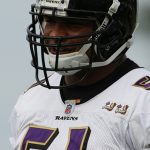
The approval of same-sex marriage in Maryland was a big victory for Gov. Martin O’Malley, who criss-crossed the state on behalf of Marylanders for Marriage Equality, an organization that campaigned to uphold the law by sending 2,000 volunteers into the field on Election Day. “By this vote, the people of our state affirmed that we are one Maryland and that we’re all in this together,” O’Malley tweeted last night. Baltimore Ravens linebacker Brendon Ayanbadejo was also a leading supporter of the same-sex marriage law, even becoming the public target of a state delegate who asked the Ravens to quash his advocacy. When the results were official last night, Ayanbadejo was unabashed in his enthusiasm.
“I am so happy tonight I could cry,” he wrote on Twitter. “My kids will grow up in the age of equality for all and a great role model as president.”
Marylanders upheld the law by a margin of 52 percent to 48 percent. In Maine, the spread was 53.4 percent approving to 46.6 percent voting against.
“The opposition is calling some of the states some of the ‘lefty-liberal states,’ ” Griffin said on the conference call. “I’ll remind everyone that Maine is a state with mostly Republican elected officials.”
In Minnesota, voters defeated the restrictive amendment 51 percent to 48 percent. Minnesota Vikings punter Chris Kluwe, who also dived into the fray in Maryland after Ayanbadejo was called out by Del. Emmet C. Burns Jr., was just as enthusiastic as his gridiron colleague in a column on Slate:
Together, we made a statement that America is tired of division. America is tired of discrimination, of exclusion, and of unthinking oppression—the belief that people have to live their lives according to someone else’s views rather than their own free will.
Of course, the victories yesterday for gay rights weren’t possible without a significant financial advantage. Griffin said that according to campaign disclosure reports collected from the four states where residents voted on marriage equality, pro-LGBT organizations and individuals raised $32.7 million, with $8 million coming from Human Rights Campaign. Opposition groups, such as the National Organization for Marriage and the Maryland Marriage Alliance netted a collective $11 million.
Griffin said that all the electoral results he praised today should provide “significant momentum.” He said that Human Rights Campaign is looking at state legislatures around the country for openings to pass marriage quality legislatively, which he hinted is preferable to a public ballot.
“The majority should never be voting on the rights of the minority,” Griffin said. Still, the victories he talked about provided renewed optimism. “Americans are fundamentally fair-minded people. When we tell our stories, they side with us.”
UPDATE, 3:10 p.m.: Voters in Washington have upheld a law authorizing same-sex couples to marry. Along with the District of Columbia, nine states now offer full marital rights to all couples regardless of sexual orientation. In a news release, Griffin said the Washington result completed a “landslide sweep” of the four marriage referenda that were on statewide ballots yesterday.