 Photo by philliefan99
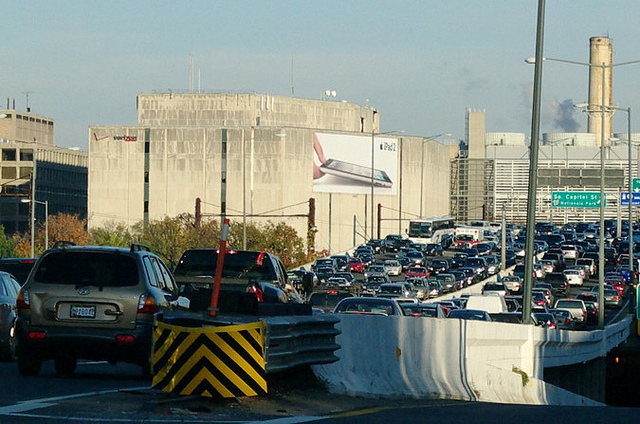
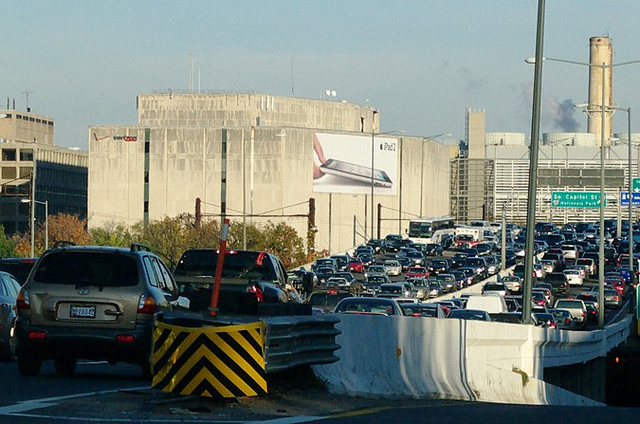
Few would argue that traffic—really bad traffic—is one of the hallmarks of the greater D.C. area. It’s the third-worst in the United States, in fact, according to one survey last year. But officials from the Metropolitan Washington Council of Governments will discuss potential remedies to the everlasting gridlock later today.
A report released this morning compiled by the council and researchers from the Brookings Institution analyzes the feasibility and public reception of three congestion pricing models that—if implemented—would replenish transportation funding and possibly make those morning commutes a little less nightmarish. And though the year-and-half-long study found some support for a few proposals, whether they would actually be successful in thinning traffic patterns is a bit murkier.
The research process involved five public forums held around the region between spring 2011 and fall 2012. The 300 participants from the District, Maryland and Virginia were asked for their feedback on three very different schemes, some of which have found success elsewhere.
The first proposal would implement at least one toll lane on every major highway in the D.C. area. Currently, there is the Inter-County Connecter between Prince George’s and Montgomery counties and a tolled express lane on Interstate 495 in Northern Virginia, but region’s other highways are free to access. By the end of the public forums, this plan was supported by 60 percent of participants. However, highway tolling found more support as a revenue generator for transportation funding than as an actual traffic salve; though many drivers said they would likely use a tolled lane if it offered a speedier route to work, the study reports there could be a considerable amount of shunpiking that would only worsen congestion on surface roads. Similarly, many who participated in the forums said the toll lanes would make it easier for drivers of greater financial means to drive their commutes, while other drivers would face the choice of continuing to sit in traffic or adding a potentially unaffordable cost. “There is already enough division in this country,” one participant said in the report.
The second proposal would involve charging all drivers within designated zones per mile driven, tracked by global positioning system devices, and collecting the fares in monthly billing cycles. This was soundly rejected as an invasion of privacy, even though the study’s authors said the collections would be made by a third-party, non-governmental organization. “You might as well strap on an ankle bracelet,” one survey participant said in the final report. Eighty-six percent of respondents said they “somewhat” or “strongly” opposed this plan.
Finally, the Council of Governments floated the notion of daily congestion charges for driving into or within designated areas—the study names D.C.’s central business district, Tysons Corner and downtown Silver Spring. The scheme would be similar to one used in London, where drivers inside the heart of the British capital pay a daily rate of £10, or about $16, to operate their cars. London’s congestion charge has been in place since 2003, though the affected area is almost entirely commercial with just 136,000 full-time residents. Similar plans have been unsuccessfully proposed in other U.S. cities, though, notably New York, where a 2008 proposal by Mayor Mike Bloomberg to charge for driving in designated parts of Manhattan never got off the page. While the daily charge suggested for the D.C. region found a bit of support, it was also criticized for only focusing on a few select areas and potentially encouraging businesses to locate outside the affected zones, as well as worsening road congestion just outside those zones. Suburban drivers would also be largely unaffected by this plan. Still it garnered more support than opposition, with 50 percent approving and 34 percent rejecting it.
But the addition of toll lanes remained by far the most popular option, even though many who participated in the survey were skeptical that converting parts of every major highway to paid-access routes would actually cut down on those nasty traffic grids.
The 65-page report will be formally proposed later today at a meeting of Metropolitan Washington Council of Governments’ Transportation Planning Board.