Martin Austermuhle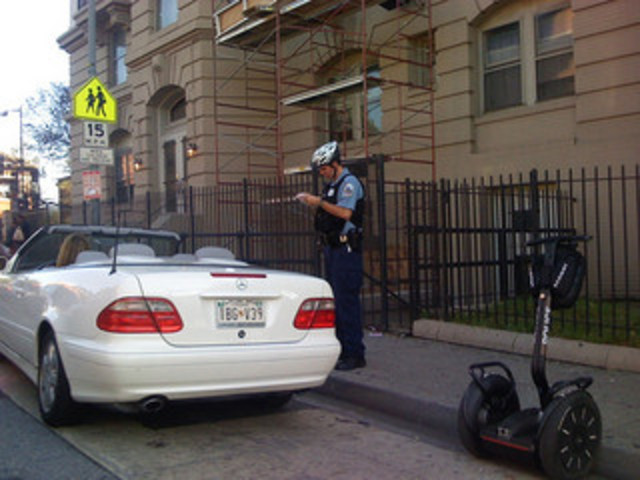
 Photo by sciascia
It’s as predictable as the change of the seasons: around this time every year the American Automobile Association publishes statistics the number of tickets D.C. handed out the year prior. In 2012 it was close to 1.9 million tickets, down slightly from the year prior.
The numbers aren’t merely put out there for their informational value; AAA usually uses them as a means to complain about the city’s ongoing “war on cars.” Here’s what AAA John B. Townsend II, AAA Mid-Atlantic’s manager of public and government affairs, said to WTOP:
>> “It’s a war on the 400,000 drivers who come into the city every day and desperately need parking. The District thinks it’s winning this war, but it’s not.”
>> “This is pure unadulterated exploitation of motorists. D.C. couldn’t get the commuter tax it wanted. So it makes it exceedingly hard to find parking, then you fine them for overstaying at the meter.”
>> “You’re taxing the guy living who is the tourist, bringing in millions for the city. You’re also taxing people coming into the city to work, to dine, to shop and to worship. That’ll ultimately just drive people out of D.C.”
And this is what he told the Post:
>> “Parking is a big business in the District. The District makes $100 million from speed and red-light cameras and $90 million from parking tickets. When you count in parking permits, registrations, licensing fees and the rest, I’ll bet the city makes close to a billion dollars a year off cars.”
>> “Day in and day out, drivers engage in the relentless competition to find just one of the city’s coveted 17,000 open on-street metered parking spots.”
If the cognitive dissonance isn’t obvious enough, let us point us it out: Townsend complains that D.C. charges too much for parking and enforces too aggressively, but at the same time motorists aimlessly circle the block looking for parking. In AAA’s ideal world, parking would be (all but) free and enforcement (all but) nonexistent, which would obviously resolve the city’s on-street parking woes by…allowing drivers to park all day and without paying a dime?
As we wrote last week, D.C. officials are working on a broader reform of the city’s parking rules, including how Residential Parking Permits are used and how and where visitors should be able to park. Part of this will include expanding Performance Parking Zones, the areas where parking rates go up based on demand. The zones are currently in use around Nationals Park, in Columbia Heights and along a portion of H Street NE. The Department of Transportation is considering 10 more of these zones.
Transit advocates point out that parking will get better in the most popular parts of town when D.C. does exactly the opposite of what Townsend wants: encourages turnover by making the price of on-street parking more closely approximate the cost of providing it. Or, you know, D.C. could just do this again.