 Rachel Sadon
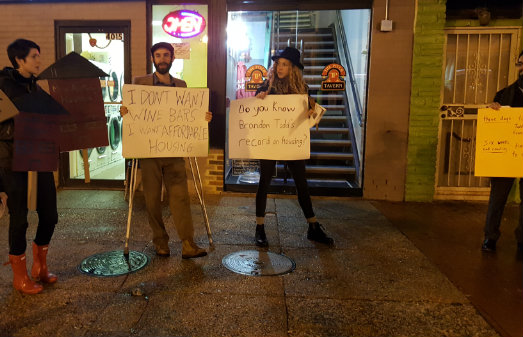
Inside Petworth’s year-old Pitch Tavern earlier this month, the third-floor bar buzzed with the chatter of more than 100 people attending a “young professionals happy hour” sponsored by Ward 4 Councilmember Brandon Todd. Outside, about 15 sign-wielding young professionals tried to draw their attention to the future of a property at the very edge of Todd’s purview: the one-time Hebrew Home for the Aged.
“Who are we for? Just the rich, or also the poor?” they chanted. “Do you like affordable housing?” members of the group inquired of people as they headed up to the happy hour.
Once the site of a Jewish retirement home, the imposing building has lain vacant for six years on Spring Road NW, right where it abuts 11th Street at the northern end of Columbia Heights, as city leaders have struggled to agree on its future. Now, they appear to be at another crossroads, with the city government quietly transferring the project to the Office of the Deputy Mayor for Planning and Economic Development as activists press them to stick to a plan for 90 percent affordable housing that the city presented last year after a flurry of community meetings.
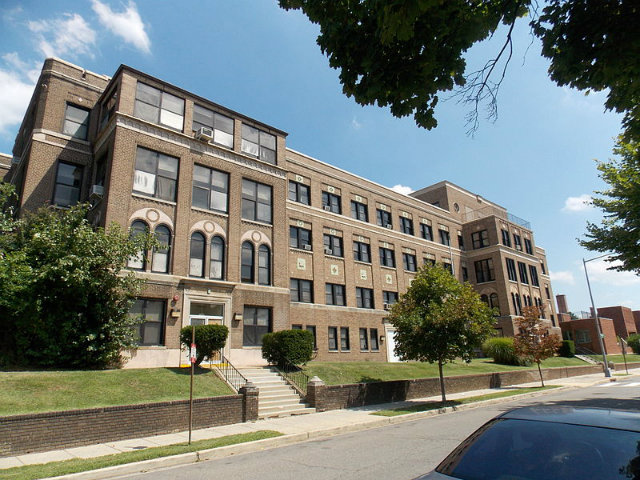 Photo by Farragutful (via Wikipedia)
The Hebrew Home was built in 1925 to serve the elderly residents (many of them poor immigrants) of the sizable Jewish community that lived in Columbia Heights, Petworth, and Park View at the time. After thirty years, and with a growing need for expanded services, a group of organizations came together to purchase land for a bigger facility in Rockville, which opened in 1969 (the Jewish Historical Society of Greater Washington has a more detailed history here).
After leaders decided to move the Hebrew Home, the District of Columbia purchased the building for $13 million. It spent the next four decades as a health center for the homeless before closing in 2009.
Since then, it has sat unused. A Washington City Paper reporter stumbled onto an unlocked door a few years ago and explored the interior, publishing a series of photos of the crumbling conditions inside. Still, the Hebrew Home is listed on the National Register of Historic Places, and is one of only two buildings known to be associated with the area’s Jewish community, according to the National Park Service.
With homelessness on the rise, the head of the Department of Human Services proposed turning it into a shelter in 2010, but the plan fell apart amid resistance from neighbors who argued that area has enough shelters and group homes already. Other ideas for senior housing or homeless services also went nowhere.
Finally, after a survey and a series of oftentimes boisterous community meetings last year, which were well-documented on ANC commissioner Kent Boese’s Park View, D.C. blog, it seemed that the city was on track to return the building to usefulness.
Nearly 80 percent of residents who responded to the online survey from the Department of General Services said they wanted some mix of affordable housing to go on the site. But there wasn’t a broad consensus on exactly how much; 28 percent said it should be 10 percent affordable, 22 percent said it should be 60 percent affordable, 11 percent said it should be 80 percent affordable, and 16 percent said it should be 100 percent affordable. Another 21 percent said it should be market rate or something besides housing entirely. Meanwhile, many neighbors and activists packed the meetings and asked for as much affordable housing as possible.
After considerable input, the Housing Authority and Department of General Services announced a plan at a meeting last September that would entail a mix of 200 units of varying levels of affordability—only 10 percent of which would be at market rate—between the former Hebrew Home and a building on the adjacent site of the onetime Paul Robeson School.
DCHA Spring Road Re-Use Project Presentation 9-10-14
Affordable housing advocates cheered the decision to have 90 percent of the apartments go to low-income tenants. The City Paper’s headline blared YIMBY: ANC Votes Unanimously to Support Hebrew Home Plan.
And then? Not much else—at least publicly.
The Housing Authority and DGS proposal was far from a deal, the Washington City Paper reported at the time.
Nothing, however, is set in stone. For one thing, there’s the question of city subsidy. The Housing Authority estimates that the total development cost will be around $50 million, $18 million to $20 million of which would have to be covered by the city.
Support from the D.C. Council isn’t assured. Ward 4 Councilmember and Democratic mayoral nominee Muriel Bowser, in whose ward the Hebrew Home is located, has been wary of a Spring Road redevelopment dominated by affordable housing, saying at last month’s meeting that she wants “a continuum of housing.” And while many neighbors have pushed for affordable housing, others are wary of what a concentration of it would do to their property values or neighborhood well-being.
Since the flurry of activity last summer and fall, then-Ward 4 Councilmember Muriel Bowser (who facilitated many of the discussions around the Hebrew Home proposal) became mayor, and public updates about the building’s future basically dried up. The September 2014 presentation is the most recent update to the project page.
More than a year later, Bowser was asked about the project at a recent crime-focused discussion in Park View. Residents who are opposed to plans to turn the temporary Bruce Monroe Community Park into a mixed-income development asked why the Hebrew Home site wasn’t considered for the project, which will include housing for those displaced from public housing at Park Morton.
Bowser was dismissive of the question, says Marcus Hedrick, the vice president of the Park View United Neighborhood Coalition, which sponsored the meeting. She said the site wasn’t designated for public housing, and they are scratching the plan the Housing Authority presented at last year’s meeting in favor of putting out “our RFP,” according to Hendrick.
And that’s what brought the sign-wielding group to Brandon Todd’s happy hour.
 (Photo by Rachel Sadon)
“We were involved in a public process that happened last year in which the city said 90 percent of housing at the Hebrew Home would be affordable. I’m deeply concerned because apparently that plan has been scrapped,” said Katie Ashmore, who came out to Todd’s happy hour after hearing about Bowser’s comments.
“I’m one of the people that the city has made space for,” says Ashmore, who moved to D.C. in 2011. “I don’t want to see our neighbors pushed out.”
Inside, many people said they were also concerned about affordable housing but that they didn’t know much, if anything, about the Hebrew Home.
“Of course there’s a need for a need for affordable housing, but there may be some issues that we’re not privy to. I tend to give Bowser the benefit of the doubt—and Brandon too,” said Robbin Smith, a Todd supporter who has lived in Ward 4 for 50 years, before expressing concerns about developers displacing residents in Ivy City.
Still, the group has gotten more than 250 signatures on a petition calling on Bowser, Todd, and Deputy Mayor Brian Kenner to ensure the site helps address “the critical lack of affordable housing in our community.” They write:
Given the city’s rapidly disappearing stock of low-cost housing units, we need to make sure that we use all available resources to create more housing options for people at risk of being displaced. But far too often, DC has given away public land to for-profit developers who do little or nothing to address the housing crisis. It’s time for a change. In a rapidly gentrifying neighborhood, Hebrew Home site presents an opportunity for development that will serve the urgent needs of our community…
We want to ensure that the city honors its specific promises to build affordable housing at the Hebrew Home site.
Joaquin McPeek, a spokesman for the Deputy Mayor of Planning and Economic Development, confirmed that the Department of General Services was transferring the project to their office at the request of the mayor.
“It will be redeveloped in a manner that involves the community. We’ll continue to have meetings over the next few months,” McPeek said, adding that DMPED will also look at the “extensive community feedback” that was generated last year before issuing a Request for Proposal. “We anticipate it will feature mixed housing with some level of affordable housing.”
McPeek estimated that they will issue the RFP sometime in the spring, after a new round of community discussions. But he couldn’t explain the administration’s decision to scuttle the DHA plan in favor of starting over with DMPED.
And neither apparently would the mayor’s office.
The project was moved “because the community expressed that it looked like it came to a standstill. It wasn’t moving as expeditiously as possible,” said mayoral spokeswoman LaToya Foster. “Frustrations were voiced.”
But Foster didn’t return repeated phone calls, emails, and messages asking who and how those frustrations were voiced, or how much affordable housing the mayor would seek in a new plan.
As for Todd, he said, “I support moving as quickly as possible” on the project. But the Ward 4 Councilmember declined to enumerate at what cost to the percentage of proposed affordable housing, simply adding that 30 percent would be a baseline (which is per city law).
For Sam Jewler, one of the activists who is concerned about the Hebrew Home’s future, the lack of clarity is disconcerting: “There’s a story in the city’s non-responses, given that the process was so public and transparent last year, but has become so opaque despite taking a major turn away from what was agreed upon.”