 Rachel Sadon
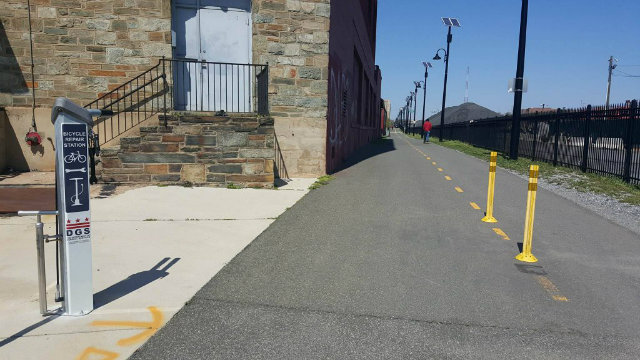 (Courtesy of the D.C. Department of General Services)
An air pump, a pair of tire levers, both Phillips and flathead screwdrivers, 6mm/11mm and 8mm/10mm wrenches, and a T-25 Torx key are all free for bikers to use at eight locations around the city, so long as they know where to look.
Over the past few weeks, the D.C. Department of General Services has been rolling out bike repair stations at the properties it manages. And in the next few months, they plan to add another six to eight.
“We are really committed to spreading these throughout D.C.,” says Mark Chambers, the sustainability and energy director at DGS. “Our goal is to be able to reach all of the city.”
Chambers’ job is to look at the 400-odd buildings the agency is responsible for (think schools, city offices, and recreation centers) and figure out ways to make them more sustainable. To be more supportive of multimodal transit, DGS has been adding more bike racks—and now “Bike Fixtations.”
The first set of repair stations, which each have a set of retractable tools and an air pump, are spread throughout the city at the Banneker Recreation Center, Takoma Aquatic Center, Rosedale Recreation Center, Francis Gregory Library, Reeves Center, Tenley-Friendship Neighborhood Library, Penn Center, and the Department of Employment Services. The sites were chosen based on their proximity to bike lanes and usage patters, as well as the ease of getting approval to install them.
But DGS says they are also focusing on getting the tools in neighborhoods that have less of a bike support infrastructure, with Barry Farms Recreation Center, Anacostia Library, and the SE Tennis And Learning Center among those slated for installations early this summer.
“One of the biggest problems with being a bicycle rider is that if you don’t have the tools yourself and you’re not adjacent to a bike shop, it can be difficult to get to the place where you can get things fixed,” Chambers says. “You might have a flat tire, or need to change out a tube or tighten up the spokes on your rims … these aren’t dramatic tools, but they are very necessary.”
There are a handful of other similar stations around the city—including two FIXIT stations by the NoMa BID, a Dero Fixit station installed by the Washington Area Bicycle Association outside the Anacostia Arts Center, and other one-off air pumps outside of private buildings and bike shops—but this represents a coordinated citywide effort for the first time.
“They have the capacity to maintain physical infrastructure that we don’t have,” says Colin Browne, a WABA spokesperson. The bike advocacy group installed the Anacostia Arts Center station through a grant, but they don’t actively maintain it (riders say it is often out of service). “It is great that DGS is stepping up.”
Over in NoMa, the BID says adding the two repair stations along with a handful of air pumps has been part of a series of efforts to encourage cycling, particularly on the Metropolitan Branch Trail.
“We just think the bicycle infrastructure in NoMa is really important,” says Robin-Eve Jasper, president of the NoMa BID. “We want to see the MBT be made more appealing and make sure people feel safe on it—that’s really a big focus for us.” Other recent efforts include adding mile markers last summer and a meeting point last week.
For now DGS is keeping an eye on the stations it has already installed, making plans for an additional six to eight stations, and actively soliciting feedback. “If people want more, we’ll deploy more,” Chambers says.