Rachel Kurzius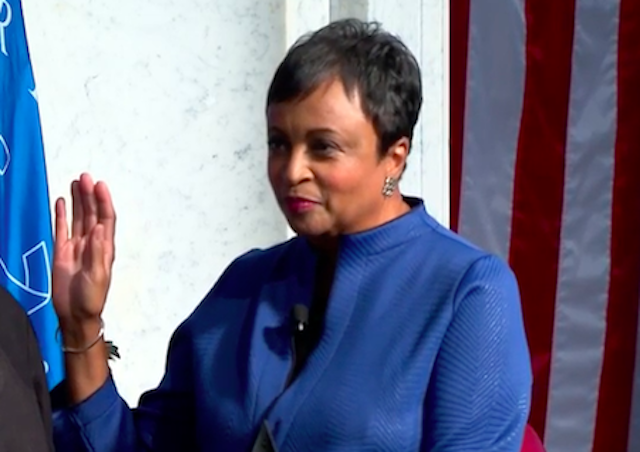
There’s a new leader at the helm of the Library of Congress. Meet Carla Hayden, who was sworn in today, becoming both the first female and first black person to hold the position.
She described herself as “overwhelmed with possibilities,” even as she faces an uphill climb to digitize many of the 162 million artifacts held by the 214-year-old Library of Congress.
Hayden took the microphone to a standing ovation. “Some people have noted that I am making history as the first woman and the first African American in this post, and that is true,” she said. “People of my race were once punished with lashes and worse for learning to read, and as a descendent of people who were denied the right to read, to now have an opportunity to serve and lead the institution that is the national symbol of knowledge is a historic moment.”
Hayden’s mother, Colleen, was there to hold the Bible for the actual swearing in portion of the proceedings, followed by an introduction from Maryland Senator Barbara Mikulski.
During the ceremony, Hayden sat on stage with Speaker of the House Paul Ryan and Supreme Court Chief Justice John Roberts. “As a librarian herself, she has the institutional memory necessary to run the largest library in the world—that’s a long way of saying she’s a pro,” Ryan said. “She understands the need to bring the library into the digital age.”
A Government Accountability Office report from 2015 called out the LOC for “serious technology management weaknesses.” When President Obama nominated Hayden in February for the position, he cited her experience “modernizing libraries so that everyone can participate in today’s digital culture.”
Hayden’s previous job was the leader of Baltimore’s Enoch Pratt Free Library, where fellow librarians described her as a “rock star” to The Washington Post. During the unrest in the city following the death of Freddie Gray in police custody, she kept the libraries open, including one across from the looted CVS, even as schools were shut down and the governor declared a state of emergency.
“In Baltimore, that particular library that was at the epicenter has been a community opportunity center. And we knew that people would look to the library that next day to be open. We wanted to also show that we weren’t closing our doors when people needed us the most,” she explained to USA Today. “We became actually a distribution center for food and supplies, because there was nothing else open in that community.”
More than a decade before that decision, she made waves by criticizing the Patriot Act while president of the American Library Association in 2003 and 2004, in particular Section 215, which gave the Justice Department and the FBI power to access library records.
“People wanted to know about jihad, they wanted to know what was going on,” Hayden told USA Today. “And we just wanted to make sure that people had a right to know, and that that right couldn’t be infringed upon … The books should battle it out on the shelves. So you should be able to read one thing and then read another thing, and there should be no infringement on your right to do that.”
Before her tenure in Baltimore, she worked in the Chicago and Pittsburgh public library systems.