By DCist contributor Julie Strupp
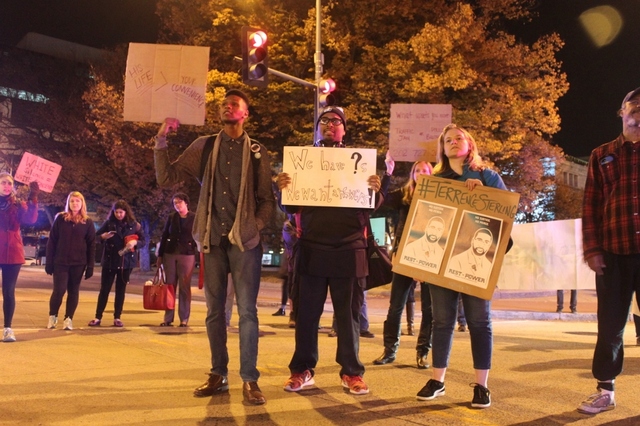
Every week since the fatal police shooting of an unarmed black motorcyclist nearly two months ago, protesters have taken to the streets. Last night was no exception, with around 60 people shutting down several downtown thoroughfares. But in the wake of reports of a grand jury investigation into the death of Terrence Sterling, protesters expressed both hope and impatience.
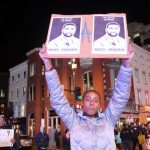
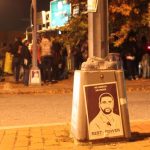
Wielding signs and bullhorns, they blocked traffic chanting, “No justice, no peace; no racist police,” and “Say his name: Terrence Sterling” as they marched from Third and M Streets NW (where Sterling was shot) to major intersections downtown.
According to a Fox5 report, the U.S. Attorney’s Office has opened a grand jury investigation into Sterling’s death, but protesters say they won’t stop marching any time soon. Although heartened by news of the grand jury, many are calling for more answers and for the firing of the police officer, Brian Trainer.
Reverend Steven Douglass, a minister at Cathedral Praise church in Capitol Heights, Maryland, started the protests on the Monday after Sterling’s funeral and has continued marching every week since. Sterling had been his friend for years.
“We got our hair cut every Saturday on the same day. We’d see each other weekly, laugh, joke, kick around, hang out, ” Douglass said. “[Sterling was] a very sweet human, a very well spoken young man, highly intelligent, just a beautiful soul. It was a very big tragedy to lose him to such a horrific crime.”
Trainer, a four-year veteran of the Metropolitan Police Department, shot and killed Sterling near Mount Vernon Square on September 11. There are conflicting accounts of the incident.
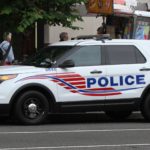
According to D.C. police, Sterling intentionally drove his motorcycle into the passenger side door of a police cruiser, prompting officer Trainer to fatally shoot him through the window. There had earlier been reports of a reckless driver in the area.
One eyewitness gives a different account. She says Sterling was trying to drive away but couldn’t because he was caught between the curb and the police car. The police officer tried to open the passenger side door but was blocked by the motorcycle; he then rolled down his window and fired two shots.
After an outcry from activists, city officials released the name of the officer responsible as well as body worn camera footage showing the aftermath of the shooting. The camera was not turned on during the incident and Interim Police Chief Peter Newsham has declined to say whether police have additional footage, such as from a dashboard-mounted camera.
“I literally see an epidemic. I see black men, black women, and black children being slaughtered, and every time they’re demonized, their deaths are justified,” said Arielle Montgomery, a student from Virginia and a regular protester. “This is most definitely a race issue, but it is also a police brutality issue, it is an abuse of authority issue.”
Protesters, sometimes as few as 20 or more than 100, march every week to send a message to officials handling the case that they care about the outcome.
“I didn’t know Terrence personally,” said Calvin Jones, a black Maryland motorcyclist who comes to protest regularly. “But we all ride, and it was just unjust. It shouldn’t have happened that way. When I heard about it I thought ‘that could have just as well have been me.”’
He held a neon sign reading, “Justice too long delayed is justice denied.”
“The grand jury is looking into the case, that’s wonderful news. It lets me and everyone else coming out here doing this the chance and opportunity to have hope,” Jones said. “So many times we see the system fail us. Even the way things have been happening and playing out, it’s just so slow.”
A grand jury does not determine whether a person is innocent or guilty of a crime, but instead whether there is enough evidence to bring charges. In D.C., grand jury service takes five consecutive weeks. The U.S. Attorney’s office does not comment on grand jury cases.
Meanwhile, Douglass told DCist that he is in the early stages of drafting and advocating for a federal “Terrence Sterling Law,” which would require any police officer found guilty of killing an unarmed individual to go to jail for first degree murder. He says he was inspired by a tough DUI law recently enacted in Maryland.
“We need to stop minimizing these things down to manslaughter because [police officers] know what they’re doing, and they need to be held to a higher standard when they have taken an oath to protect and serve,” Douglass said. “I thought if you could make a law about [the police officer killed in the drunk driving] tragedy, you could make a law about innocent victims killed by the police.”
Montgomery says she worries about the safety of her friends and family of color, and wants both police officers involved in the shooting to be charged and to serve jail time.
“I have a godson,” Montgomery said. “He’s half Spanish and half black, and I think about what will happen when he’s 14, 15, 16 and if his name will just be a hashtag…the people out here, black lives matter, we don’t hate other races. What we’re saying is that black lives are in jeopardy right now.”
This Friday marks the two-month anniversary of the shooting, and protesters are planning to gather for one hour at 7 p.m. at Third and M Streets in memory of Sterling.