 Rachel Sadon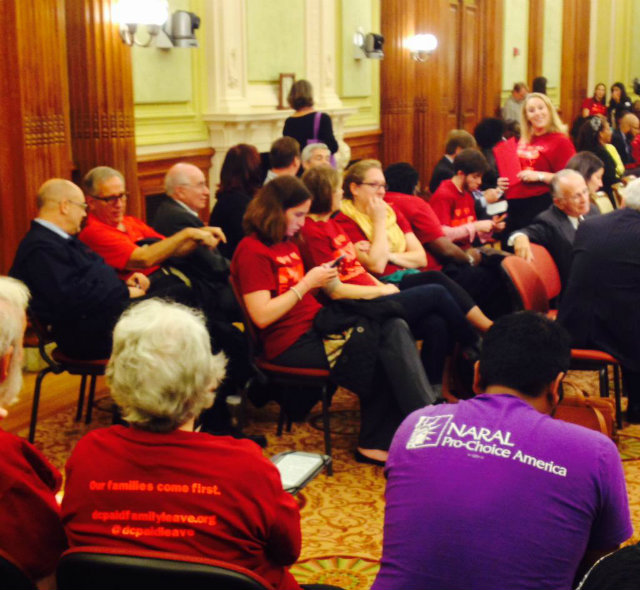
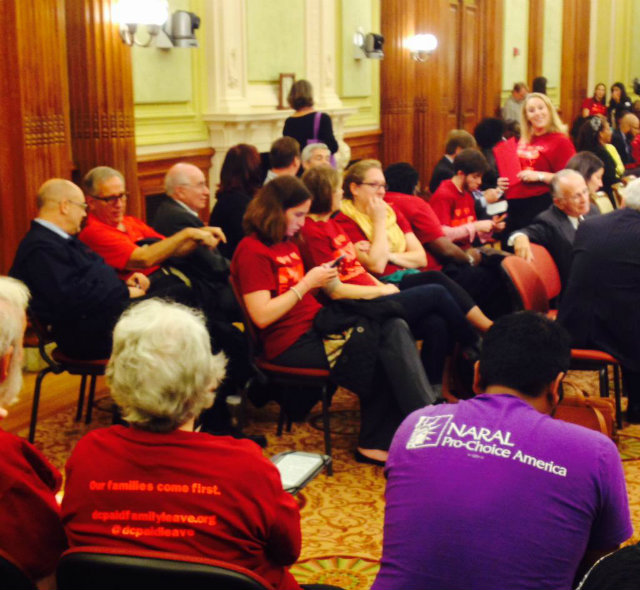 Paid family leave supporters have repeatedly gone down to the D.C. Council to show support for the bill. (Courtesy of the DC Paid Family Leave Coalition)
The D.C. Council is slated to take a first vote next Tuesday on a proposal that would create one of the most generous paid family leave laws in the country. After discussing and studying the issue for more than a year, Chairman Phil Mendelson has released the details: 11 weeks in the event of a birth or adoption and 8 weeks to care for an ailing family member, funded by a .62 percent increase in payroll taxes.
Those figures were simultaneously reported by WAMU and The Washington Post. Mendelson’s office confirmed they are correct but a draft of the bill won’t be available until tomorrow.
The District began offering eight weeks of paid leave to government employees two years ago. D.C. has codified and extended protections afforded to workers after pregnancy, and the D.C. Family and Medical Leave Act guarantees up to 16 weeks of leave—but it is unpaid, and only mandated for employees who have worked for more than a year and have completed 1,000 hours at a company with 20 or more employees.
Last October, At-large Councilmembers David Grosso and Elissa Silverman co-introduced a bill that would have offered 16 weeks of paid sick and family leave to all full and part-time employees in the District (except for those employed by the federal government). It quickly found support from many of their colleagues on the Council but analysts and the mayor’s office expressed skepticism about the funding model. Mendelson took over the issue and his office has been studying costs and logistics. The D.C. Council broke for its summer recess without taking a vote.
Mendelson now estimates that the revised plan will cost $246 million a year, funded entirely by the payroll tax increase. When employees take leave, their pay will come from a citywide pool. Anyone making 1.5 times the minimum wage, just over $66,000 a year, would get 90 percent of their wages back (the Post reported a different figure, but Mendelson’s office confirmed that the repayment structure reported by WAMU is correct). Those who earn more than that amount would get 50 percent of their wages back, capped at $1,000 per week.
For the measure to be passed this legislative session, it will need to pass a first vote on December 6 (supporters of the law are already planning to pack the legislative chamber) and a second vote on December 20. The mayor has expressed wariness over the original plan and her current position isn’t clear, but Mendelson told WAMU that he believes she will come around. “I think the mayor is cool to this …. This bill is perceived as having widespread support [in the Council].”
Silverman has already praised Mendelson’s efforts to advance the bill, though she plans to push for coverage of periods when workers need to take time off to deal with their own illnesses. “The Chairman’s proposal gives needed help to parents and family members, but it does not include self-care, leaving out, for example, the retail worker who told me in a hearing that she had to quit her job to make radiation and chemotherapy treatments,” Silverman said in a statement. “I look forward to working with the Chairman and my colleagues to make sure that self-care is covered by the program.”
Rhode Island, New Jersey, and California are the only states that currently provide paid leave, all at lower levels than D.C.’s proposal. New York passed a 12-week paid family leave law that will be phased in beginning in 2018.