Rachel Kurzius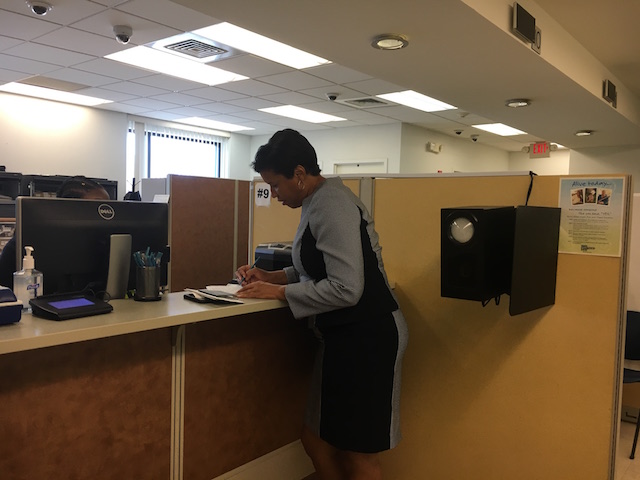
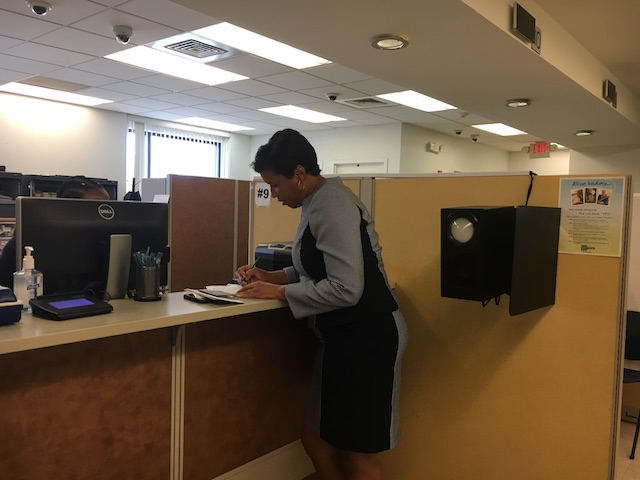 Mayor Muriel Bowser fills out her form at the DMV. (Photo by Rachel Kurzius)
Before heading to the Department of Motor Vehicles, the agency recommends that people look at the website to make sure they bring all their necessary documents.
Clearly, Mayor Muriel Bowser (or one of her aides) has done so. She’s got her passport, social security card, previous driver’s license, and utilities bills on hand on Friday afternoon as she heads into the DMV on 95 M Street SW.
Bowser is renewing her license and updating her address, but really, she’s here to draw attention to something new that begins at the DMV on Tuesday: a gender neutral option on D.C.’s licenses and IDs.
Starting tomorrow, the District will be the first jurisdiction in the country to offer “X,” in addition to “male” and “female” as options for gender on its identification cards.
“We’re always looking for how government agencies could be more inclusive,” Bowser says as she sits in the DMV waiting room among about 50 other residents. She says that government credentials are “the pathway to everything else,” from jobs to housing to medication.
“It’ll be incredibly validating to look down and see the truth on my ID next to my face,” says Brittany Willis, a non-binary collaborative artist who has lived in D.C. since 2014. They say learning about the new option “made me happy that this is my home and the people in charge, even if I don’t always agree with them or their decisions, are willing to see me for who I am.”
According to the 2015 U.S. Transgender Survey, only 3 percent of non-binary respondents always tell others they are non-binary—86 percent of non-binary respondents said their main reason was because most people don’t understand, so they don’t try to explain it.
“My ID currently says female—I am not. I am neither female nor male, I am non-binary,” Willis says. “It’s kind of painful to look at your legal identification and see something that’s not true over and over again.”
After a court case, the state of Oregon was slated to be the first place in the U.S. to offer a non-binary option when it implemented the change on July 1.
But D.C., in an administrative coup, will beat out the Beaver State—though Bowser insists that the date is not purposefully trying to compete with Oregon. “It’s just another great way to recognize our D.C. values,” she says, pointing to a phrase she’s been using to sum up the city’s progressive bent, especially in contrast with the Trump administration and Republican-led Congress. The DMV has had the plan in the works for several months.
Before the announcement from Bowser’s administration, Ward 1 Councilmember Brianne Nadeau introduced a bill earlier in the week to include a non-binary gender option on IDs.
“D.C. has had a good history of doing work on trans inclusion and really has set a model and example that other municipalities and governments have also been following,” says Nic Sakurai, a Washingtonian who identifies as agender. Gender identity has been a protected class since 2006, and the city’s Office of Human Rights works to enforce regulations regarding gender-neutral bathrooms and studies trans discrimination.
But this new push is going to be implemented by a different agency. Could it be that the DMV, long the butt of easy jokes about bureaucracy and hassles, is now an engine for progressive change in the city?
In addition to giving non-binary individuals the sense that their government sees them, the DMV will be at the forefront of executing the city’s new automatic voter registration law, which was funded in the 2018 fiscal year budget.
Lucinda Babers, the director of the D.C. DMV, says that, already, about 95 percent of voters in D.C. register at the agency, and they’re getting their operations ready to change the forms from opt-in to opt-out. (Starting this week, the agency will also issue IDs that say “Washington D.C.” rather than “District of Columbia,” mainly to ward off confusion when residents try to use them elsewhere.)
Babers says that the basic role of the agency is providing credential services and title and registration. But offering credentials is not nearly as neutral as it sounds. Securing IDs, especially when a person doesn’t have the necessary documents, can be a complex and frustrating process. In other parts of the country, crackdowns on IDs are part of larger efforts to make voting more difficult.
Updating an ID costs money, too—$47 for a driver’s license and $20 for a non-driver ID card, though those fees are waived for seniors, ex-offenders, and homeless residents. About 32 percent of respondents to the U.S. Transgender Survey said they could not afford to change their IDs or records to match their gender identity.
Bowser notes that, alone among U.S. cities, D.C. operates its own DMV—a function normally run by states.
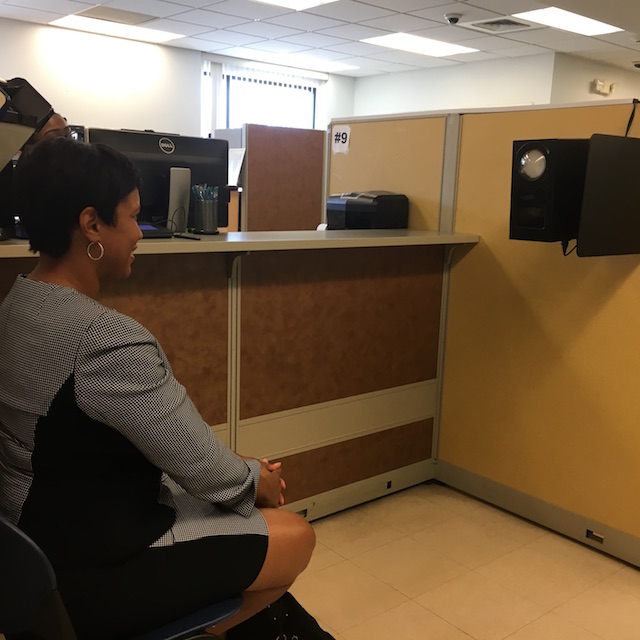 Mayor Muriel Bowser gets her photo taken at the DMV. (Photo by Rachel Kurzius)
“I haven’t been to the DMV in a long time,” Bowser says. While she owns a car, she says that, as the mayor of a major city, she’s not really supposed to drive it.
Indeed, when she arrived at the DMV, it was in the back seat of a large, black SUV. But she admits she gets behind the wheel every once in a while, mainly for errands. “Not that often, but I do drive,” she says. “I won’t talk about when I drive.”
While DMV workers offer her expedited service, Bowser chooses to wait on the line. (Full disclosure: I brought all my relevant documents to the DMV and got my license updated as I waited for the mayor to arrive. Never let a trip to the DMV go to waste, I always say. I wasn’t the only one with that attitude—a member of her community relations team got his license renewed there that afternoon as well.)
Less than 40 minutes after getting on the line, Bowser leaves the DMV with a print-out version of her new license and new registration for her car. “That was painless,” she says.
Willis is planning a trip to the DMV this week, too. They’re pleased that the administrative change does not require a doctor’s note or other kind of “proof” that they’re non-binary.
“Not having to bring in a third party signature means I could go tomorrow, which is amazing,” Willis says. Others are going as a group early Tuesday morning to be among the first with updated licenses. “This is just one of many changes that need to happen to take care of the most marginalized folks in our community. Personally, I can say this is going to change a lot of things for me.”
Reporting contributed by Rachel Sadon