 Photo by Reid Rosenberg.
By DCist contributors Jennifer Minich and Randy Smith
Nearly eight out of every ten gunfire events in D.C. go unreported to 911, according to estimates from ShotSpotter.
The ShotSpotter program uses remote acoustic-sensing technology, linked to closed-circuit cameras, to record and track gunshots in over 70 cities in the U.S., which it then reports in real time to law enforcement for evaluation and response.
In 2005, the FBI granted D.C. law enforcement $2 million dollars to test and implement ShotSpotter in Historic Anacostia in Southeast. Officials chose that neighborhood for a single reason: Anacostia led the city in gun-related homicides. By 2009, ShotSpotter was fully implemented throughout the District.
Almost 300 sensors are strategically placed throughout D.C., covering about 20 square miles (or about a third of the city), all in neighborhoods east of Rock Creek Park. As of 2016, over 69,000 gunfire incidents in D.C. have been recorded using ShotSpotter technology.
The sensors pick up noises and triangulate their location through an algorithm. Then, humans analyzed the sound in real time to verify it’s a gun shot before passing along the information to MPD for incident response. The process takes under a minute.
It didn’t always work that way. Per MPD spokesperson Dustin Sternbeck, the use of ShotSpotter has changed over the last seven years, as has the process for reviewing and interpreting alerts and confirming them as gunshots, which is now overseen entirely by ShotSpotter rather than by MPD personnel. D.C.’s Office of United Communications oversees the response times.
Through a Freedom of Information Act request to the Metropolitan Police Department, we were able to acquire a better picture of what information ShotSpotter is collecting, and what it says about when and where gun violence erupts in the city.
Where is gunfire being detected?
The interactive map below shows gunshots detected between 2006-2013 (when the last data release was requested) and 2014-2017. Scroll in and out and use the legend in the upper left hand corner to get a more complete picture of the number of gunshots detected.
Flipping between 2014-2017 and 2006-2013 gives insight into the frequency of reported gunfire in specific neighborhoods. Overall, there appears to be little change in where gunfire incidents are occurring and the frequency and quantity of gunshots.
The neighborhoods experiencing the most gunfire over both times periods include Washington Highlands, Barry Farms, Historic Anacostia, and Carver/Langston/Kingman Park.
In some neighborhoods, like Trinidad in Northeast D.C., gunfire activity appears to have decreased. In other neighborhoods like Brightwood Park, gunfire incidents have remained ostensibly low yet steady in number between 2006 and 2017.
When is gunfire being detected?
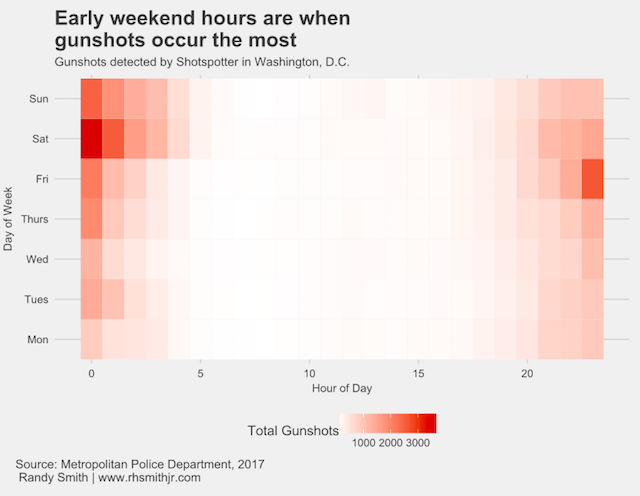
There is a very distinct pattern to when gunshots are occurring in D.C. According to data, gunshots occur with the greatest frequency in the late evening/early morning hours of Friday and Saturday and early morning Sunday. This data is unsurprising and concurs with data released by ShotSpotter in the 2016 National Gunfire Index.
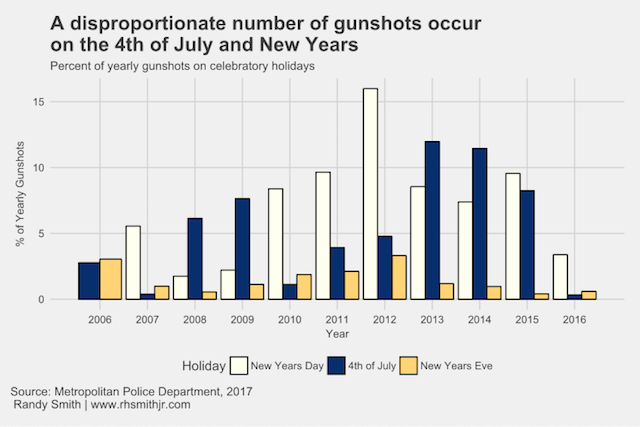
Since the program’s implementation in 2006, reported gunshots have peaked on holidays, specifically New Years Day, the 4th of July, and New Years Eve, in that order.
It’s tempting to conclude that holidays with fireworks skew ShotSpotter data—after all gunshots and fireworks cannot always be differentiated by the human ear. ShotSpotter does acknowledge that the system is not perfect, but there is an abundance of literature that confirms that celebratory gunfire spikes on these holidays.
How many gunshots are detected every year?
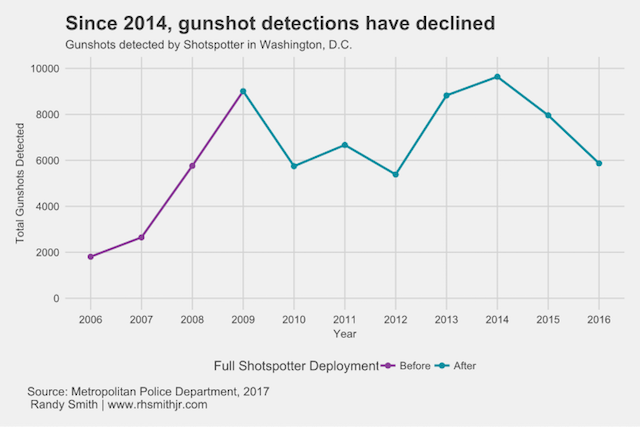
Beginning in 2006, at the outset of the program, gunshot detections steadily increased and reached a peak in 2009, the year ShotSpotter was fully implemented in D.C. The rise in gunshot detections between 2006-2009 is easily explained by the addition of sensors as the program was ramping up throughout the District.
However, after 2009, the number of gunshots detected by ShotSpotter fluctuates from year to year.
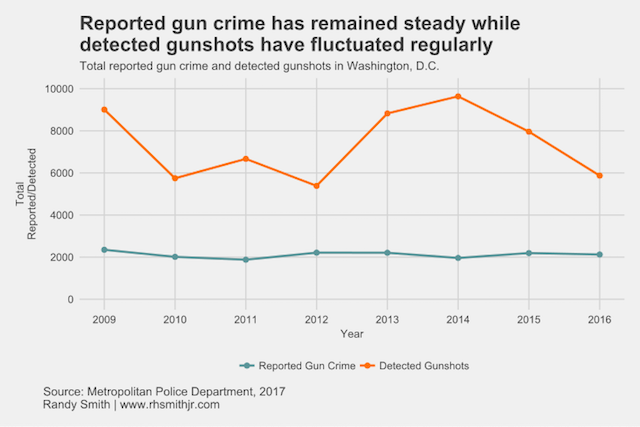
In the graph below, we’ve superimposed the number of detected gunshots between 2009-2016 with the statistics for reported gun crime. Despite the fluctuation in detected gunshots beginning in 2009, reported gun crime has principally remained steady.
Does ShotSpotter lead to a decline in gunshots?
In an undated, and unabashedly self-promotional, article released by ShotSpotter, the company details the percentage drop in gunfire incidents in D.C. immediately following its implementation during Police Chief Cathy L. Lanier’s tenure. Lanier herself is quoted praising ShotSpotter’s efficacy.
But is it really fair to say that ShotSpotter has been the main contributor to declining gun crime?
Criminologists say that a lack of transparency and inconsistent reporting metrics from city to city makes it difficult to determine whether it actually contributes to decreased gun violence. ShotSpotter is a significant financial investment for law enforcement and program investors, typically several hundreds of thousands of dollars per year, which increases the pressure on both parties to report successful metrics.
Plus, knowing about gunfire once it occurs doesn’t necessarily solve the case or prevent a shooting from happening. Despite the number of gunshots reported by ShotSpotter, for whatever reason, the police might be unable to respond effectively.
“ShotSpotter is just one of the many tools we use to address crime,” says Sternbeck, MPD’s communications director. “MPD responds to ShotSpotter detections on a routine basis and we have found this system to be effective in alerting us to shots fired in a specific location. Our officers have responded positively to having ShotSpotter, and feel that it is a useful tool responding and investigating incidents.”
Sternbeck suggests that more confusion may arise from the misclassification of “gun” crime, like armed robbery, which may contain the threat of a gun but not necessarily a gunshot.
In a Washington Post interview this May, Ralph A. Clark, the president and chief executive of ShotSpotter, says the company’s effectiveness should not be measured by the percentage of criminals captured with guns—it should be measured by a decrease in dropout rates, teen pregnancy, alcohol and drug abuse, and violent crime.
Sternbeck says that ShotSpotter, “while very helpful to our officers on the scene (dramatically reducing time needed to find evidence, assisting with crime classification, etc,) does not necessarily lend itself to a simple analysis.“
The Data
The data was acquired through a Freedom of Information Act request from the Metropolitan Police Department. Geographic coordinates for detected gunfire incidents are to the 3rd decimal, resulting in an accuracy of ±360 feet. Crime data acquired from the crime incidents datasets available through D.C. Open Data. You can find complete code for the analysis and visuals on github.