 The Boring Company’s new sign in Anne Arundel County. Photo via Gov. Larry Hogan/Twitter.
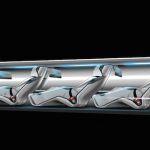
In a single hokey video posted to Twitter two weeks ago, Maryland Gov. Larry Hogan gave his blessing for the ironically named Boring Company to begin digging a tunnel beneath a 10-mile stretch of the Baltimore-Washington Parkway. The passageway would be designed to send commuters between the two cities within minutes, made possible by pressurized pods zooming through on electric skates.
“Hey Gov., what do you think about The Boring Company’s Hyperloop?” asked a bodiless female voice behind the camera.
“I think it’s coming to Maryland and it’s going to go from Baltimore to Washington,” Hogan responded, adjusting his shades. “So, uh, get ready.”
As exciting as it was, for many people, that the Hogan administration granted a conditional utility permit to Musk’s firm to start digging, it was equally puzzling. While The Boring Company has big plans—founder Elon Musk once tweeted that the Hyperloop will be able to reach New York from D.C. in 29 minutes—the firm has still never tested its technology on humans. So far, it only has a test track running beneath the parking lot of SpaceX, another Musk-owned firm based in Los Angeles that’s dedicated to space travel.
When asked for more details about The Boring Company’s Maryland plans, company spokesman Sam Teller pointed out that the firm plans to seek zero dollars in public funding, but otherwise declined to comment.
In the wake of Hogan’s announcement, Musk said on Twitter that he wasn’t ready to “do a proper announcement,” but that one would be forthcoming. The firm issued also issued a brief statement: “The Boring Company would like to thank Maryland, Washington D.C., and the White House Office of American Innovation for their support.”
Meanwhile, plenty of skeptics have emerged.
“As I understand it, there’s still a number of technical feasibility issues that have not been proven to work,” said Uwe Brandes, executive director of Georgetown University’s Urban and Regional Planning Program, in September, before Hogan’s announcement. “So it’s really an idea at this point and less of a real proposal.”
Unsurprisingly, some of the doubters are The Boring Company’s established competition. The Northeast Maglev, with affiliated developer Baltimore-Washington Rapid Rail, is already in the midst of planning a high-speed, electromagnetically propelled train from D.C. to New York. Amtrak, the institutional rail operator in the Northeast Corridor and beyond, plans to upgrade its existing system to be faster and accommodate more passengers.
“I don’t think [The Boring Company] even has a track that’s gone more than 500 meters; they’ve never put a person inside it,” says Wayne Rogers, CEO of The Northeast Maglev. (It’s actually only 500 feet at present, Musk says.)
“I would like to meet him in person,” adds Janet Campbell-Lorenc, director of business development for Amtrak. “I think he’d be really fun to talk to. Elon, he’s got a lot of ideas.”
Brandes maintains Amtrak is the best contender to actualize the dreamy prospect of high-speed rail from D.C. to the Northeast. The company holds a significant advantage with its right of way in the form of hundreds of miles of existing track, though it needs some work.
“It’s just three big issues. One is the electrical systems need to be updated. The track needs to be upgraded, including, in some places, straightened. And then they would have to buy new trains,” he says.
Campbell-Lorenc notes that the rail operator already plans to straighten out curves that require trains moving along the Northeast Corridor to slow down. Amtrak is also adding 28 faster trains that will move up at to 186 mph by 2021.
That’ll be a welcome boost for passengers from the current system.
“Today we operate at a top speed of 150 mph,” she says. “And about half of our trains also operate at speeds of 100 mph,” though the ones moving along the Northeast Corridor generally travel at speeds between 125 and 150 mph.
Following Hogan’s Hyperloop announcement, Amtrak said in a statement to DCist, “We appreciate big thinking about future technologies but conventional high-speed rail technology remains the proven solution of choice around the globe for connecting city centers safely and efficiently.”
Maglev stood its ground as well, saying in a statement, “While we applaud innovative transportation concepts like Hyperloop, we believe that the region and nation cannot afford to wait any longer to deploy the next generation of proven high-speed rail and that’s the Superconducting Maglev.”
Rogers argues that even if Amtrak does straighten tracks and add faster trains, it still won’t be able to accommodate an influx of passengers over the next two decades. He also notes the trains would be significantly slower than the Maglev, which has successfully shuttled passengers in Japan and China at speeds upwards of 375 mph and 260 mph, respectively.
Amtrak spokeswoman Chelsea Kopta says “NEC rail ridership will continue to grow, which is why Amtrak is seeking funding to advance a series of projects that will benefit both Amtrak and the commuter railroads.” One comprehensive plan, NEC Future, is designed “to meet the capacity needs of the future on the Northeast Corridor,” she says.
Of the three projects in the high-speed train sweepstakes, Musk’s is the fastest—at least in theory. Musk’s 2013 white paper on the technology said its vacuum-like propulsion system would be able to transport passengers as fast as 760 mph. So far, however, The Boring Company has reached a much lower speed record of 220 mph.
Brandes says implementing such a project typically requires “many, many steps,” including an environmental impact study, feasibility studies, and a challenging process of assembling a right of way.
For these reasons, Maglev and the Hyperloop “are very speculative ideas, still,” he argues.
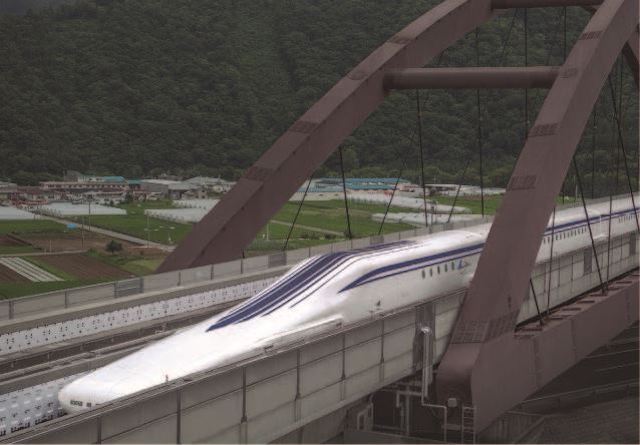
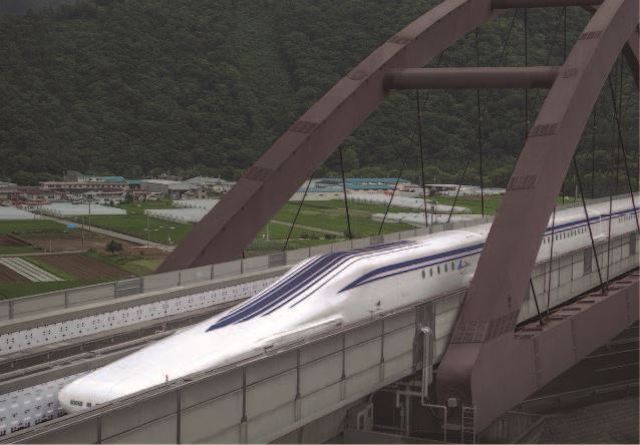 A rendering of the proposed Maglev train. (Image courtesy of the City of Bowie)
But for purposes of comparison, the Maglev proposal appears to be considerably further along in that process than The Boring Company. Baltimore-Washington Rapid Rail has completed about a third of a federally funded, three-year environmental impact study, according to Rogers, and successfully acquired an abandoned railroad franchise with approval from the Maryland Public Service Commission in 2015. The Maryland Transit Administration and the Federal Railroad Administration are leading the study in concert with the company.
“It’s a necessary part in order to have all the permitting and things approved, and so we’re working our way through that process,” says Rogers. “We hope we will be finished with that in two years so that we could start construction in 2019, 2020.”
As multiple outlets have noted, The Boring Company would likely need to complete similar steps to measure the effects of its project on surrounding communities. At present, Musk’s company has permission to dig beneath 10 miles of Maryland-owned land, starting in Anne Arundel County, but the federal government owns the other 23 or so miles between the two cities, and hundreds more miles across multiple states lay ahead on the path to New York.
A Maglev line running from D.C. to Baltimore would also incorporate some tunneling, similarly to the Hyperloop. Sixty percent of it would move underground, including in downtown D.C., according to Rogers.
“The route would take you outside [from D.C.] in a tunnel all the way to where you got past Greenbelt,” he explains. “And then at that point where it opens up a little more, you could go above ground for a period of time until you get up near Fort Meade, and then it would go back underground again the rest of the way to Baltimore.”
A crucial question lingers, however: where?
Baltimore-Washington Rapid Rail recently finished yet another round in a series of public meetings to help try to find an answer. Suhair Al Khatib, deputy administrator of the Maryland Transit Administration, said through a spokesman in October that his agency and the FRA have now recommended three proposed routes “be carried forward for further engineering development and environmental evaluation.”
Each would begin at either the Mount Vernon Square or NoMa-Gallaudet Metro stations, he said. Two options would then travel along the BW Parkway through Laurel and Fort Meade, according to a map provided by the company. A third path would veer east though Bowie and Severn en route to Baltimore Washington International Airport and downtown Baltimore, running parallel to the existing Amtrak line.
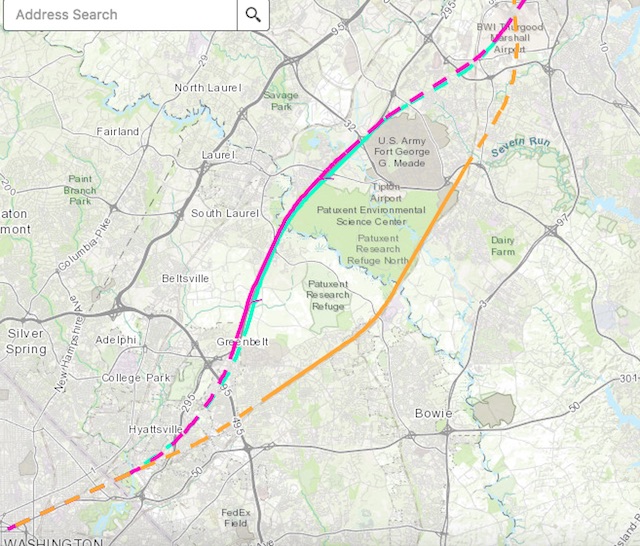 Three proposed Maglev routes. (Image via Superconducting Maglev Project)
Under the terms of the railroad franchise awarded to Northeast Maglev in 2015, the company could use eminent domain to acquire at least some of the land needed to build its line, though project director David Henley has said “that doesn’t mean we will use it,” according to WTOP.
In D.C., it remains unclear where digging would take place. Rogers says his firm would use a tunnel-boring machine to dig 150 feet beneath the earth.
Asked to comment on obstacles for bringing a high-speed rail stop to the city, Edward Giefer, associate director of the D.C. Office of Planning, wrote in an email on Sept. 21, “We are active in the conversation about improvements to Union Station to accommodate more trains, but otherwise would defer to the District Department of Transportation for any comment.”
Terry Owens, a spokesperson for DDOT, wrote in an email days later, “We’ve had no discussions with Elon Musk or his team on their project.” He noted Amtrak is conducting its own environmental impact study to expand the station’s capacity.
Asked about Maglev’s plans, he said DDOT isn’t a primary party on the environmental impact study: “It’s not our project, so it really doesn’t behoove us to comment on it at this point.”
Hogan’s support for The Boring Company may signal a change of heart. Only two years ago, the Republican Maryland governor returned from a visit to Japan singing the Maglev’s praises.
“It was an incredible experience, even more impressive than I expected,” he said at the time.
But his decision in October to greenlight The Boring Company’s subterranean expedition came days after reports of discontent at Baltimore-Washington Rapid Rail’s community meetings. According to WTOP, some Prince George’s County Council members and residents have balked at the Maglev plan, arguing the train would generate huge amounts of noise and disrupt nearby communities.
Hogan’s office hasn’t responded to multiple requests for comment about whether he still supports the Maglev proposal.
While the Boring Company hasn’t provided a timetable for its Hyperloop project, the other players have offered some details. Kopta says Amtrak will have its faster trains operating within four years, and at that point will have also upgraded 30 miles of track between West Baltimore and Landover using money from a $2.45 billion investment package.
For Maglev, Rogers says construction would take between five and seven years, with shovels going in the ground once the environmental impact study is finished.
Asked to comment on Hogan’s approval of The Boring Company’s digging plan, Brandes, of Georgetown, acknowledged the benefits of “exploring the useful application of new technologies” in a follow-up email.
Still, he maintains utilizing the region’s existing infrastructure is the most ideal option.
“The fact of the matter is that we have about 200 years of sunken costs in the Northeast Corridor,” the urban planning professor says. “We need to make that system work for the communities along the rail line, and for future generations.”