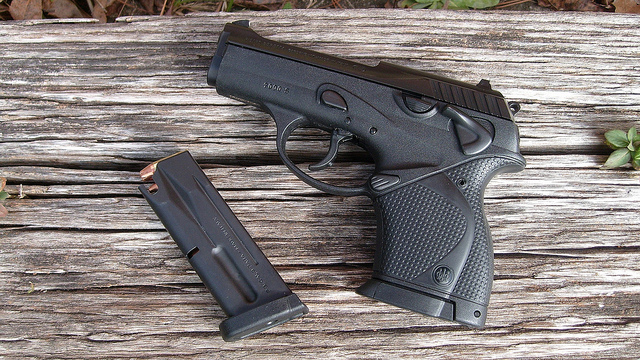
 Photo by James Case.
By Kojo Nnamdi Show producer Julie Depenbrock
It’s been 10 years to the day since the Supreme Court ruled that the right to bear arms is an “individual” right. In District of Columbia v. Heller, the court said that the District’s restrictive gun laws, which included a handgun ban and a trigger-lock mandate, were unconstitutional.
Over the past decade, the Supreme Court has heard only one additional gun case—McDonald v. Chicago, in which that “individual” right was extended to the states.
A study found that of the thousand or so Second Amendment challenges brought since District of Columbia v. Heller, most have failed in the lower courts–including quite a few in D.C.
“D.C. has been one of those jurisdictions that has continued to push the envelope to see if they can establish constitutionally permissible control on guns,” said Jonathan Turley, a law professor at George Washington University. “I think the D.C. Council has been a bit too eager to pull that trigger, so to speak. You can create much, much worse law if you take the wrong case forward.”
After the Heller decision, D.C. crafted legislation in 2014 that required people to have a “good reason” to obtain a permit for a concealed handgun. That law was soon challenged in the courts, and the U.S. Court of Appeals for the D.C. Circuit deemed it unconstitutional in a 2-1 decision in July 2017.
D.C. Attorney General Karl Racine opted not to appeal the decision to the Supreme Court, fearing that an adverse decision by the Supreme Court could have wide-ranging negative effects not just on District residents, but on the country as a whole.” Officials had Heller in mind when making that call.
Many states, Maryland included, have successfully passed gun regulations since Heller, like bans on bump stocks and assault weapons, and “good reason” laws similar to the District’s.
In his dissent in the Heller case, Justice John Paul Stevens wrote that the decision would cause a “major upheaval,” but, other than the expansion of lawful gun rights, what has the case meant for Washington?
“The Heller decision didn’t really have an impact on gun violence in our city,” D.C. Police Chief Peter Newsham said Tuesday on the Kojo Nnamdi Show.
Indeed, Newsham said, there aren’t too many gun carriers in the District. Of the population of 700,000, about 8,000 hold permits. “In Washington D.C., there’s not a strong inclination to carry a firearm,” Newsham added.
About half of the concealed carry permits the Metropolitan Police Department issues are to folks living out of state.
“It’s a lot more difficult to possess a firearm in the District of Columbia than it is in many other jurisdictions,” Newsham said.
These numbers only reflect firearms obtained legally. As far as illegal firearms go, the D.C. Police last year recovered more than 2,000 guns.
The gun recovery program came under scrutiny recently after a stop-and-frisk incident outside a barbershop in Northeast Washington.
Lorenzo Green, a local advisory neighborhood commissioner, said there’s widespread belief that the BB gun officers found was planted by law enforcement. Newsham contests that claim.
“I have reviewed the video. With 100 percent certainty, I can say that weapon was not planted,” Newsham said. “I think we all need to take the emotion out of these situations and get the facts.”