Rachel Kurzius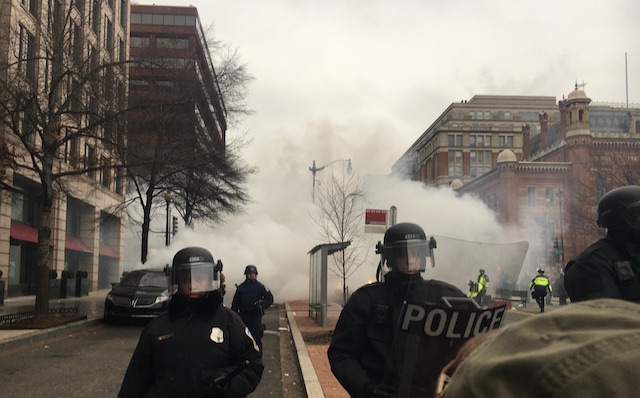
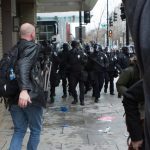
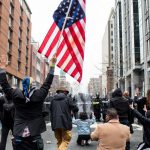
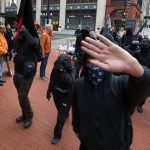
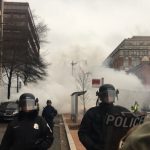
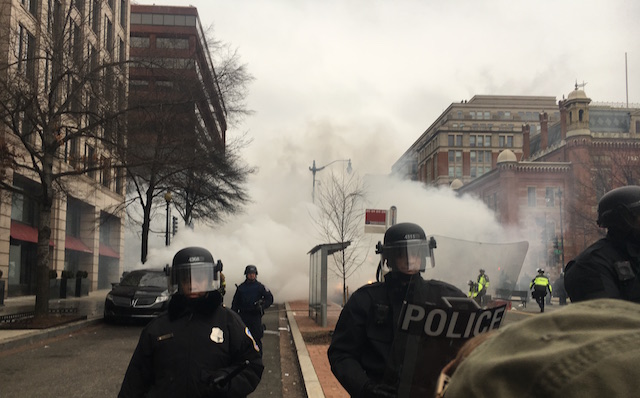 The scene near Franklin Square on the afternoon of Inauguration Day. (Photo by Rachel Kurzius)
Federal prosecutors say they’ve filed a notice to dismiss felony charges against the remaining defendants accused of rioting in downtown D.C. on Inauguration Day.
However, the motion to dismiss included 38 names, and there were 39 remaining defendants. Isaac Dalto, who was charged with felony rioting, was not included in the motion in an apparent oversight.
Bill Miller, the spokesperson for the U.S. Attorney’s Office of D.C., says the office intended to dismiss charges against all the remaining defendants and plans to dismiss the case against Dalto as well. (Update: The USAO of D.C. has now moved to dismiss Dalto’s case, too.)
The USAO of D.C. said in a statement that the dismissals come “in light of the results in the cases brought to trial,” in which prosecutors were unable to secure any guilty verdicts in the two jury trials held so far.
The office still “believes that the evidence shows that a riot occurred on January 20, 2017, during which more than $100,000 in damage was caused to numerous public and private properties,” per the statement.
On January 20, 2017, police mass-arrested more than 200 people, including journalists, medics, and legal observers, after an unpermitted march from Logan Circle to Franklin Square. (The American Civil Liberties Union of D.C. is suing D.C. police and the city over what it alleges are excessive force and unconstitituional arrests that day.) Those marching were doing so under the banner of “J20,” named for the day of the demonstration.
The following day, 230 of them were charged with felony rioting. In April, a superseding indictment added even more felony charges.
Civil rights advocates have long maintained that the felony charges represented an attack on the First Amendment.
“This indictment does not allege that the moving defendants personally destroyed property or engaged in violence, nor does it allege that the moving defendants said anything to urge others to do so,” one motion to dismiss from lawyers for 21 of the defendants read.
“Rather, the indictment seeks to hold the moving defendants criminally responsible for participating in a large group protest and simply failing to walk away when a small number of other individuals in the group allegedly broke the law.”
Before the jury trials began, one person pleaded guilty to felony charges and 20 more to misdemeanors.
During the first trial, Assistant U.S. Attorney Jennifer Kerkhoff did not present any evidence that the six defendants, facing decades in prison, had themselves destroyed any property. Instead, the prosecution argued that the group, by dressing in black and marching together, acted as a “getaway car” that provided cover for the people who did destroy property.
A jury found all six of them not guilty. Shortly thereafter, the USAO dropped charges against 129 of the remaining defendants, claiming it was focusing on the “core group” of 59 who it could prove had engaged in violence, acts of destruction, or the planning of it.
During the second trial, prosecutors were unable to secure any guilty verdicts. One of the four defendants was acquitted outright, with the other three having some charges acquitted and others deadlocked by the jury. Prosecutors continued to drop charges against more defendants.
A judge also sanctioned prosecutors for hiding evidence from the defense. The U.S. Attorney’s Office played videos at trial from right-wing activist James O’Keefe’s Project Veritas, a group that conducts undercover operations against groups it deems liberal. However, Superior Court Judge Robert Morin agreed with defense attorneys’ contention that prosecutors hid 69 other O’Keefe recordings.
Elizabeth Lagesse, a former defendant whose charges were dropped in June and a plaintiff in the ACLU’s case against the city, says that she’s “glad people are getting out from the thumb of these prosecutions. It’s been 18 months of uncertainty and putting people’s’ lives on hold.”
Lagesse has first-hand experience with that. In addition to her charges, her fiance, Michael Webermann, was a defendant until his charges were dropped on July 6. What comes next? “Now we’ve got to pick up where our lives left off,” she says.