Rachel Kurzius
Update, 3/26/19: D.C. Delegate Eleanor Holmes Norton officially introduced legislation to sell the RFK stadium site to D.C. today in the House of Representatives.
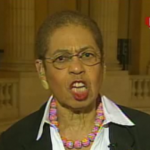
Original: Under a bill that D.C. Delegate Eleanor Holmes Norton plans to introduce in Congress next week, D.C. would be able to purchase the RFK property at fair market value from the federal government, which currently leases the property to the District.
The bill “endeavors to put to use the largest most valuable unused tract of land in the District of Columbia today,” Norton tells DCist. “It’s a wasteland. This is federal land that consists chiefly of parking lots. The federal government isn’t using it. All I’m trying to do is allow the District of Columbia, fair and square, to purchase the land, with the proceeds going to the U.S. Treasury.” The Washington Post was the first to report on the bill.
D.C. Mayor Muriel Bowser issued her support for the legislation during her State of the District speech earlier this week, calling the RFK campus a “national park dedicated to asphalt,” and emphasizing that the bill would not necessarily lead to a deal to bring a football stadium for D.C.’s local NFL team. “Whether a stadium or sports arena is included in the reimagined RFK Campus is a debate for a future date, which we as a city should decide by, and for, ourselves,” she said.
The National Park Service leases RFK to the District’s sports and entertainment authority, Events DC, under terms that require the property be used for a stadium, “recreational facilities, open spaces, or public outdoor recreation opportunities,” or similar public uses. There is currently work underway to provide playing fields and park space on the campus, but RFK Stadium has sat empty since D.C. United decamped for a new home last summer.
While there’s broad agreement among city officials that D.C. ought to have control over the 190-acre property, the question remains whether Dan Snyder’s team, whose name is a dictionary-defined slur, should make it their new home. The team’s lease at FedEx Field in Landover, Md. expires in 2027.
Last summer, right after participating in the groundbreaking for the first phase of RFK redevelopment, Bowser made the case for the football franchise to return to the District at a luncheon for team VIPs. “The mayor has made it quite clear in the past that she wants the Washington football team home, period,” her spokesperson, LaToya Foster, said at the time. Her office worked with Republicans on Capitol Hill and the White House, along with Snyder, on a measure that would have extended the city’s lease and opened the land for commercial development, including a new 60,000-seat stadium. The effort was unsuccessful.
Bowser’s chief of staff, John Falcicchio, told DCist that “we can’t dictate who we work with or how we work with them. What we want to plan for is how to make the RFK site vibrant for the next 50-100 years.” That vision is a mixed-use community of residential, retail, and office space alongside the stadium. While D.C. originally faced competition from Maryland and Virginia over landing the team (Snyder has indicated the District is his first choice), Maryland Governor Larry Hogan announced he dropped out of negotiations with the team in February.
But not all of the councilmembers are on board. Ward 6 Councilmember Charles Allen, who represents the neighborhoods surrounding RFK, launched a petition opposing the idea of a football stadium on the campus. “Housing with affordable housing, retail and commercial spaces, parks and public spaces—there’s so much more opportunity for what I think is a better vision for that land,” he told DCist in December. “When you look at NFL stadium deals around the country, you see largely very large tax breaks going to very wealthy people to build stadiums and luxury suites. I don’t think that’s a great way for us to use our money.” Still, Allen backs the notion of D.C. getting the land back: “Whether you support or don’t support a stadium—we should have that land.”
Norton declined to comment on whether she wanted a stadium there. “That’s exactly what a member of Congress, even one who represents the District, shouldn’t opine on,” she says, adding that if she shared her preferences for the land, “every Tom, Dick, and Harry who has the word ‘congressman’ or ‘congresswoman’ next to their name would opine.”
She says she’s already in discussion with committee chairs in the House of Representatives about the measure, and is working to try to get it a hearing. “The bill won’t be controversial,” says Norton. “What’ll be controversial is some members will wonder about the team.”