 Jordan Pascale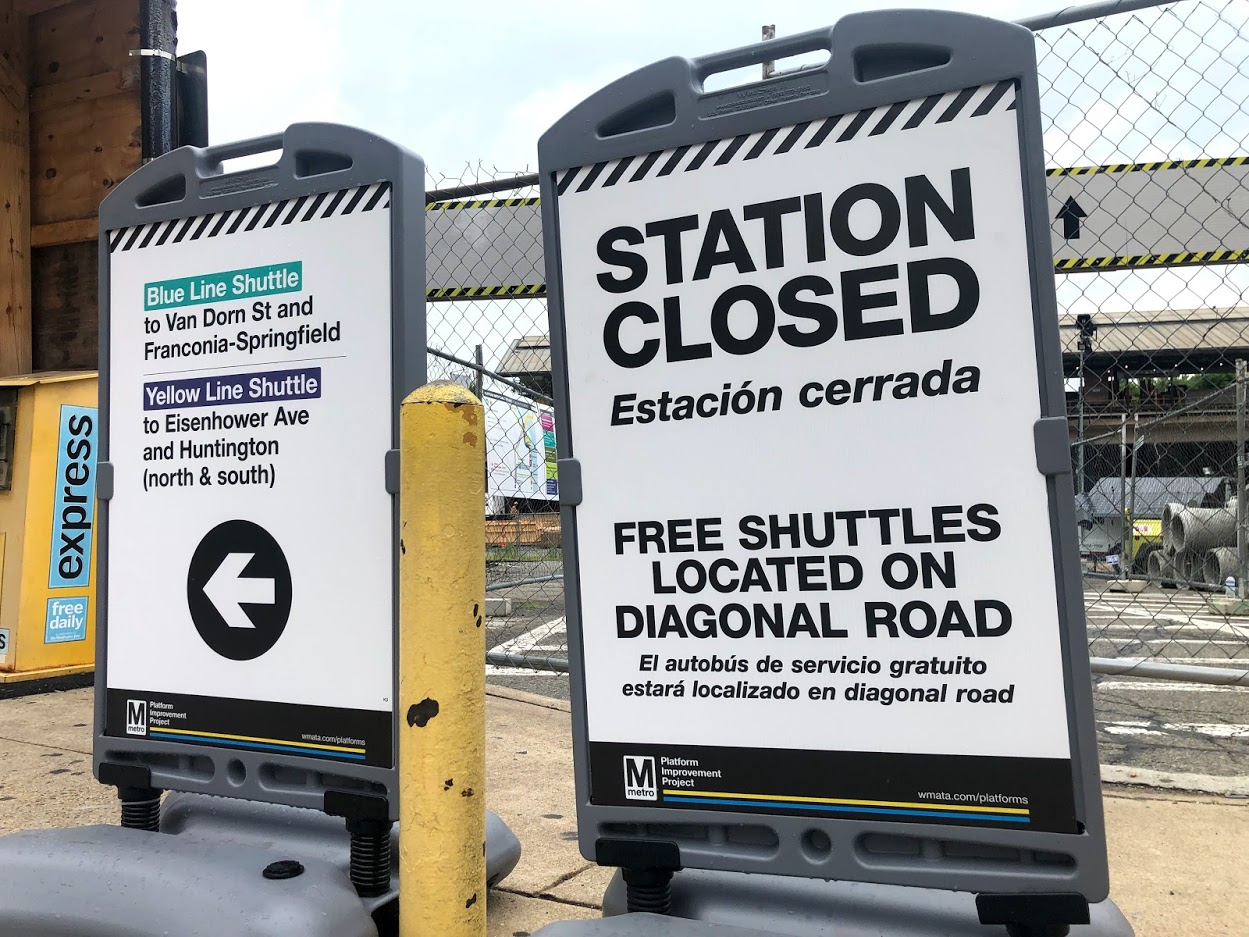
Alexandria and Arlington residents are nearly a third of the way through the Blue and Yellow Line Metro shutdown with stations set to reopen Sept. 9.
Stops south of Reagan National Airport are closed for platform reconstruction. While riders report shuttle operations have improved from the first week, problems persist.
Shuttle operations
No one, not even Metro, has hard data on how the shuttles are performing. The charter buses aren’t equipped with real-time GPS, so anecdotal evidence is as far as it goes.
“Metro’s shuttle buses, along with DASH on the Blue Line and key Metrobus routes, are doing a tremendous job providing service to customers at the six closed stations,” Metro spokesperson Sherri Ly wrote in a statement. “Shuttle bus operations and rail service from National Airport are running fairly smoothly, following some operational adjustments over the first few weeks.”
You may remember out of state bus drivers unfamiliar with Northern Virginia roads missing the I-395 Express Lanes or getting lost. While mostly cleared up, it is still happening as recently as this week.
https://twitter.com/landomansmash/status/1143496714244034561
And others are building an extra hour into their commute.
https://twitter.com/eric_espino/status/1141320961880481793
Riders also are talking about long lines at the Huntington station. Metro has added more buses to the Express and weekday Yellow Line route, but won’t say how many.
About 26,000 to 34,000 trips a day, which accounts for about 45 to 60% of the Metrorail ridership at the stations, take place on the shuttles.
One day last week, lines were short at the Huntington station around 7:15 a.m. There were more Metro workers directing traffic than shuttle riders from 7:30 to 8 a.m.
Rider Nawal Atallah says her commute from Huntington to DuPont Circle, while 30 minutes longer, has mostly been smooth. She said Metro has made some good adjustments and overall, she can deal with the shutdown.
But one day last week, she had to wait more than an hour on the shoulder of I-395 when the windshield wiper on her shuttle bus stopped working during a storm. Metro told riders they were going to bring another bus, but it never came. Instead, a Metro employee drove a pilot vehicle in front of the bus.
“My biggest issue is transparency,” Atallah said. “Nobody ever told us why another bus never came… And they still drove the bus that they said wasn’t safe because the windshield wiper wasn’t working.”
Another rider, Kristina Ament, who has visual impairments, says the closure is a big ordeal for her.
“It seems that the Metro buses and shuttles never stop in the same place, so I am forced to beg for help from fellow riders,” Ament said in an email. “(Earlier this month), none were available to help, so I ended up lost in Crystal City.”
“As I understand it, Metro is reporting that everything is smooth and going well, but I don’t think two-hour commutes qualify as either one,” Ament added.
Traffic and alternatives
The Metropolitan Washington Council of Governments will be studying how traffic congestion changed during the shutdown, but that data won’t be available for a while.
The city of Alexandria is tracking travel times on its roads, but found in the first week that weather, crashes and a power outage made it “difficult to determine the impact.”
“Generally, in the morning, travel times on the city’s main north-south corridors (Route 1, Washington Street and North Van Dorn Street) were between 15% and 30% higher than usual. Evening travel times varied between 30% lower than normal to 30% higher than normal peak hour traffic,” city officials wrote in a report.
Noise and construction progress
Jackhammering and other construction noise has disrupted residents living near Braddock Road, King Street and Huntington stations under reconstruction.
Kiewit construction workers must stop loud work between 10 p.m. and 6 a.m.
Fairfax County, home to the Huntington station, granted Metro a waiver to extend its noisiest work an hour later than normally would be permitted.
Alexandria’s noise code has an exemption for “work necessary to restore and maintain services provided by public service companies, the rail rapid transit system and the city.”
Metro is also fixing track that links the six stations. That work is exempt from noise ordinances. Metro decided to have 24/7 construction work for three straight months instead of doing the work over many years.
Nighttime work may involve concrete cutting and jackhammering activities for periods of time, both of which will generate noise.
“We’re doing our best to use the time we have to work around the clock to get stations done and reopened,” Sherri Ly said. “We’re doing the noisiest work in daytime hours, but in some cases can’t help it.”
Metro regrets any inconvenience caused by the work, she said.
The transit agency is posting construction updates on its website. Jackhammering work to tear out old tile and concrete is done at many stations, and crews have started to pour the concrete lip of the platforms.
This story first appeared on WAMU.