To the untrained eye, they may look like Egyptian hieroglyphic symbols or some obscure variety of neume.
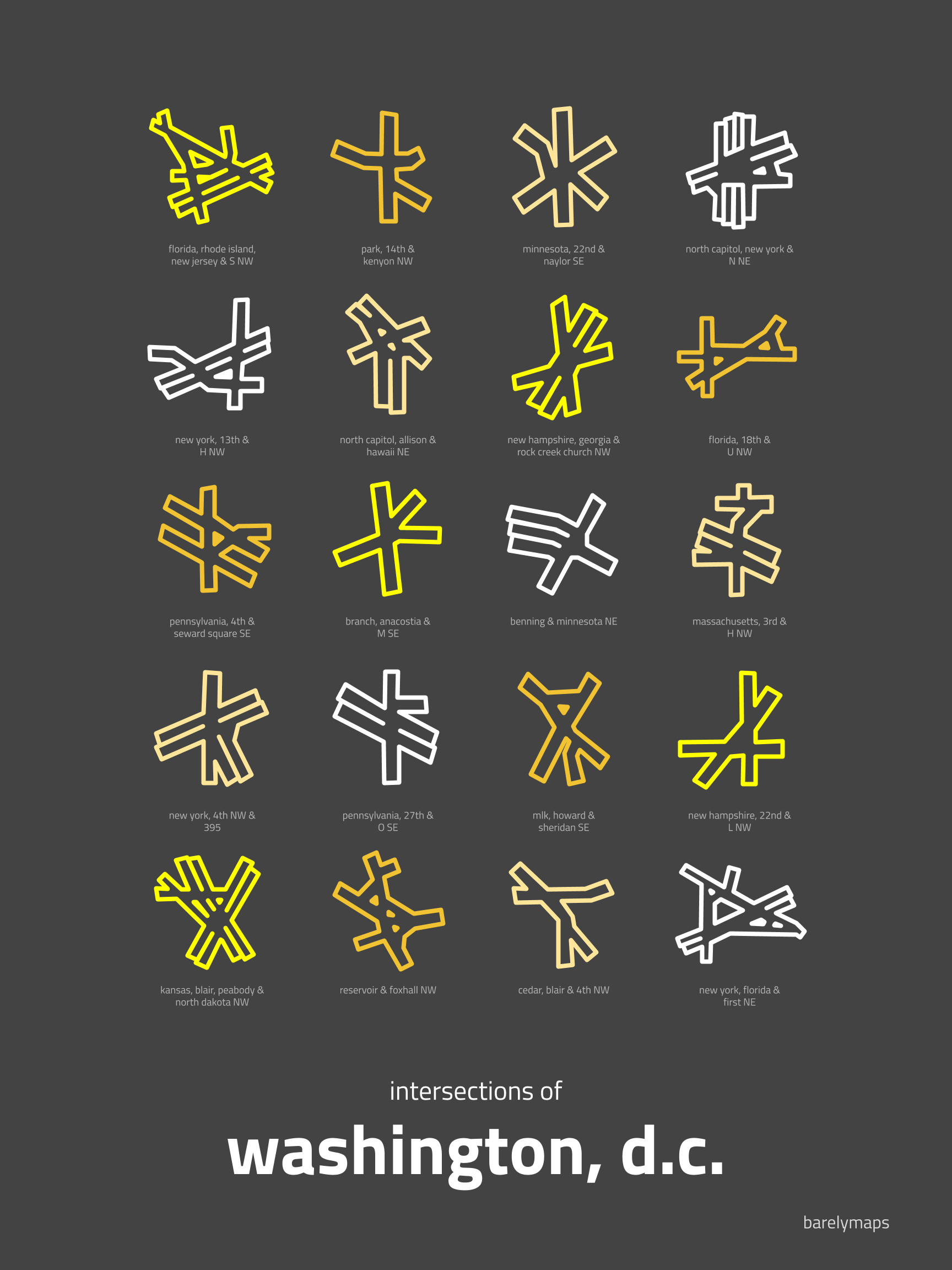
But the strange shapes on Peter Gorman’s graphic are actually more familiar than they appear—they’re just D.C. street intersections.
Gorman was inspired to make a series of “minimalist maps” of intersections in dozens of cities after a year-long, 11,000-mile bicycle trip around the country. “When you’re biking in a city you have to be paying a lot more attention to the street layout, just for your own personal safety,” he tells DCist.
It was a hobby at first, but after posting a graphic of Seattle’s intersections online, the designs started blowing up. “It ended up being on the front page of the Seattle Times a couple days later, which was just a crazy thing,” says Gorman, who now sells his designs for a living. Within a couple days, he was overwhelmed with more than 600 orders for the print. “I kept enough supplies to fulfill about 10 orders.” Since then, Gorman has created dozens of graphics depicting street intersections across America, from Los Angeles, to Seattle, to Boston, and New Orleans.
To pick the intersections for the D.C. graphic, he got help from his sister, who lives in the District. “D.C. doesn’t look like any other city in the country,” Gorman says. “It’s obviously very planned with the traffic circles and the diagonal avenues.”
At first glance, the shapes themselves seem rather random. Some of D.C.’s intersections, like Minnesota, 22nd, and Naylor, vaguely look like a star symbol. Others are more anthropomorphic, like Park, 14th, and Kenyon, which looks like some sort of stick figure. And some are downright cryptic, like Massachusetts, 3rd, and H streets NW, which is like a number seven bisected by an equal sign.
But what do the shapes say about the District’s street layout?
Gabe Klein, the former director of the District Department of Transportation, says that many of the more convoluted intersections on the graphic weren’t designed with humans in mind.
“Typically, the more complex an intersection design, the less friendly it will be to pedestrians and cyclists as you have more crossings,” Klein told DCist in an e-mail. “There are some exceptions to this rule when complex intersections are designed with active mobility as a primary focus, like in the Netherlands.”
In American cities, many of the issues that arise at intersections are caused by streets that are diagonal, like Massachusetts or New York avenues in D.C., Klein said. Last year, New York Avenue and Bladensburg Road NE was ranked by DDOT as one of the most dangerous intersections in Washington, with 165 car crashes in 2018.
But the longstanding nature of these intersections can make them difficult to fix. “In some cities these were old Indian trails, and naturally occurring as the fastest points between A and B,” Klein said. “Once people built structures around them, they became part of the landscape and were hard to get rid of.”
Circles are a more “natural” way to address the potential traffic headaches that come with convoluted intersections, Klein said. Funny enough, Gorman also made a minimalist graphic of D.C.’s traffic circles.
For Rudi Riet, a longtime cycling advocate in the District, Gorman’s graphic is “absurdity made pretty.” Given how poorly designed D.C.’s streets are, memorializing them is both funny and sad, Riet told DCist. “None of these designs strike me as either surprising, given D.C.’s history of trying to move car commuters around efficiently, or particularly great,” he said. “But the upside is that some of them are being redesigned to better suit all road users.”
As someone who bikes through D.C. every day, Riet says he takes extra cautions at large intersections. “When I ride a bike through them, I know that I’m taking chances and that I need to be both extra vigilant and extra assertive in my approach.”
Online, Twitter users had their own takes on Gorman’s graphic.
Slingshot for mail pic.twitter.com/0kYBtsfpR6
— Eric Fidler (@EricFidler) August 20, 2019
Has Cedar, Blair, and 4th been dabbing on us this whole time? pic.twitter.com/jwksjjaXwE
— see schrader (@Deers1) August 21, 2019