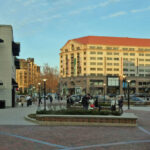
While you may think of Friendship Heights as the area around a long stretch of Wisconsin Avenue, there are actually two separate geographic entities—a special tax district called the Village of Friendship Heights (located in Montgomery County, Maryland and governed by a village council) and the portion of Ward 3 (just north of Tenleytown and west of Chevy Chase) that simply goes by “Friendship Heights.”
Best known as a shopping mecca, the neighborhood has more of a storied history than one might expect. There’s quite a history of contentious development that led up to the creation of what the area is today. And while you may already be aware that the only Cheesecake Factory in D.C. is located in the neighborhood (although not for long), here are ten facts you may not know about Friendship Heights.
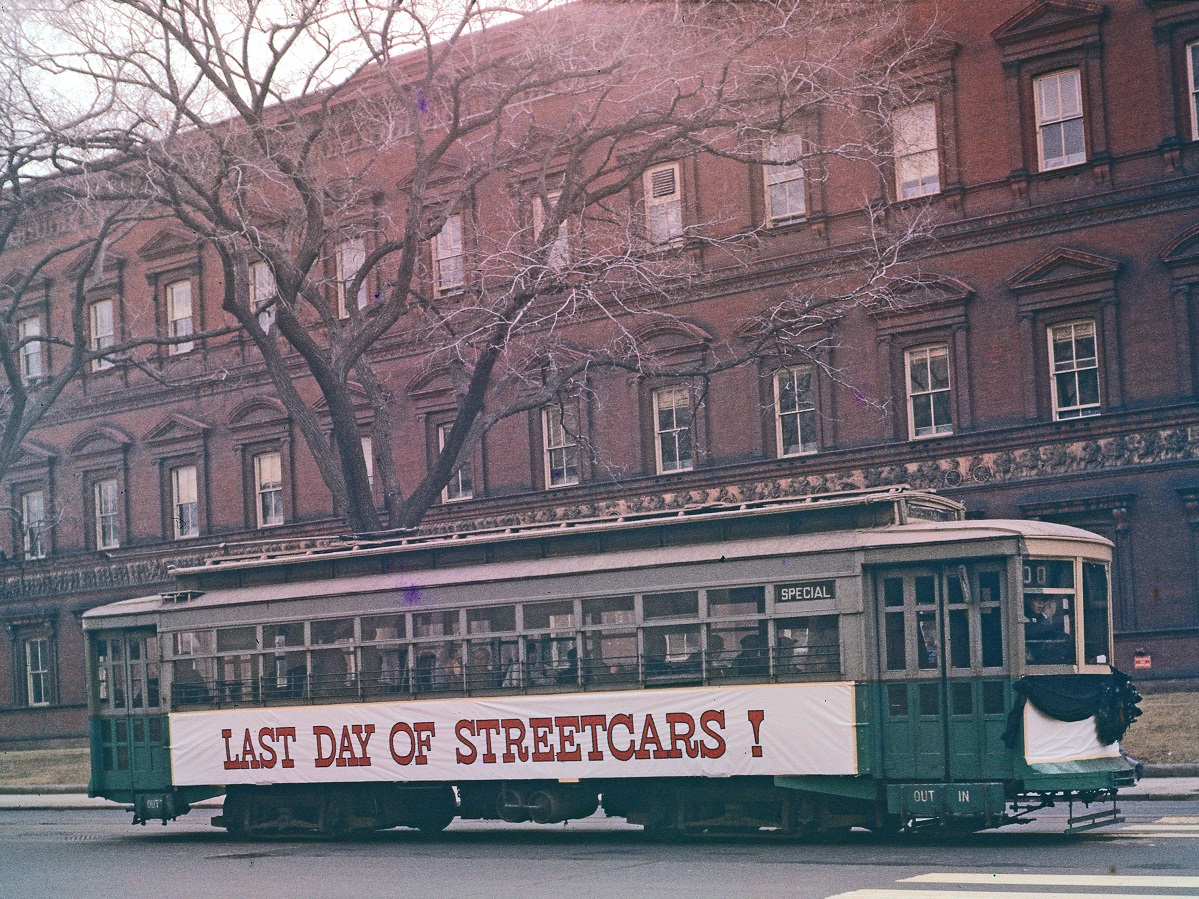
1. The streetcar line’s impact lingers in Friendship Heights
In 1890, the Georgetown streetcar line was extended into Maryland through Friendship Heights, making the suburb much more accessible to the city and raising the value of the land.
Anne Sheiry, a resident in Friendship Heights at the turn of the century, described the transportation system in the town’s centennial history book: “Our streets were just mud roads and the sidewalks were boardwalks. The streetcars had double tracks to Somerset … A single track, with sidings, went to Rockville.” That same booklet notes that some residents used to phone in their grocery lists to Georgetown and would pick up their groceries directly from the streetcar, like a a 19th century version of Peapod.
While the final streetcar (before the modern incarnation on H Street) last trundled along in 1962, there are still some signs of it in the neighborhood, if you know where to look. The end of the line is now the Friendship Heights bus depot (and the source of a fight over historic preservation). Meanwhile, utility workers still occasionally run into the tracks when doing work—rather than remove the rails, they were largely paved over.
2. People once took to the streets to protest development in Friendship Heights
Friendship Heights is now known for its plethora of high-end shopping options, but that wasn’t always the case. Lest anyone think that massive fights over development and marathon zoning hearings are a recent phenomenon, look no further:
Neighbors fought developers over the vision for the corridor for most of the 1970s, with corresponding visions of “little stores and small offices, with parks and benches” versus “a booming commercial center, a cluster of Washington’s finest stores” in the run-up to the 1984 opening of the Friendship Heights Metro station.
In 1972, nearly 500 people participated in a protest along Wisconsin Avenue, according to a report in the Sunday Star and Daily News. The Citizens Coordinating Committee on Friendship Heights argued that “impending development will create an undesirable traffic-clogged CBD (central Business District) which will pose a serious threat to the quality of life in our communities, if not a threat to the very existence of those communities.” The protesters—some of whom were taking to the streets for the first time in their lives— made their sentiments clear with signs saying, “Stop Radical Development” and “County Council Doesn’t Care … We Care.”
“It was the perfect storm,” recounted civic activist Julie Davis in a 2014 interview with Bethesda Beat. “Nobody knew anything about planning and zoning, but we learned on the job. We got into the citizens advisory committee. Adversarial doesn’t begin to describe it. Nothing went on other than shouting matches.”
The battle lasted for years in both the District and Montgomery County (the case even landed in court in 1977, setting precedent for zoning rules in the county).
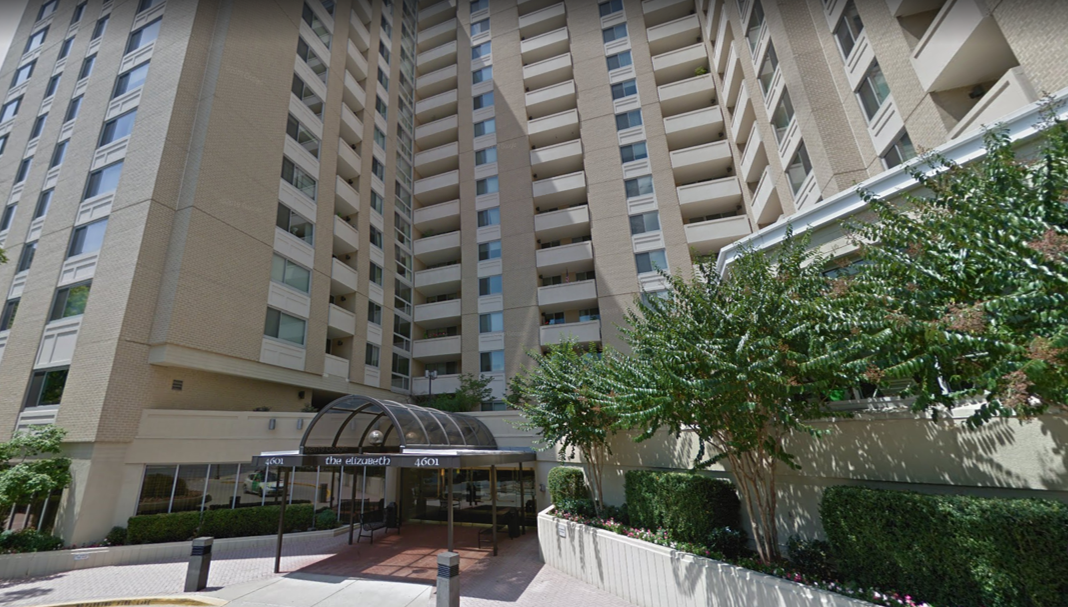
3. A 17-story apartment building, the Elizabeth, was nearly torn down in the middle of construction
In the contentious decade of intense development, anti-high-rise construction activists in Friendship Heights had a temporary win in 1973. According to a story in the Washington Star, the Montgomery County Board of Appeals ruled that a previously-issued building permit to the Elizabeth should not have been issued, citing problems with air pollution and excessive sewage.
If the decision was upheld, the 17-story, $21 million high-rise (and its 676-car parking garage) would have been ordered taken down.
But luckily for the developers, a Montgomery County Circuit Court Judge said that the Board of Appeals “acted arbitrarily and capriciously” in their decision to halt construction on the high-rise, and the Elizabeth was not torn down. The condo building is still standing.
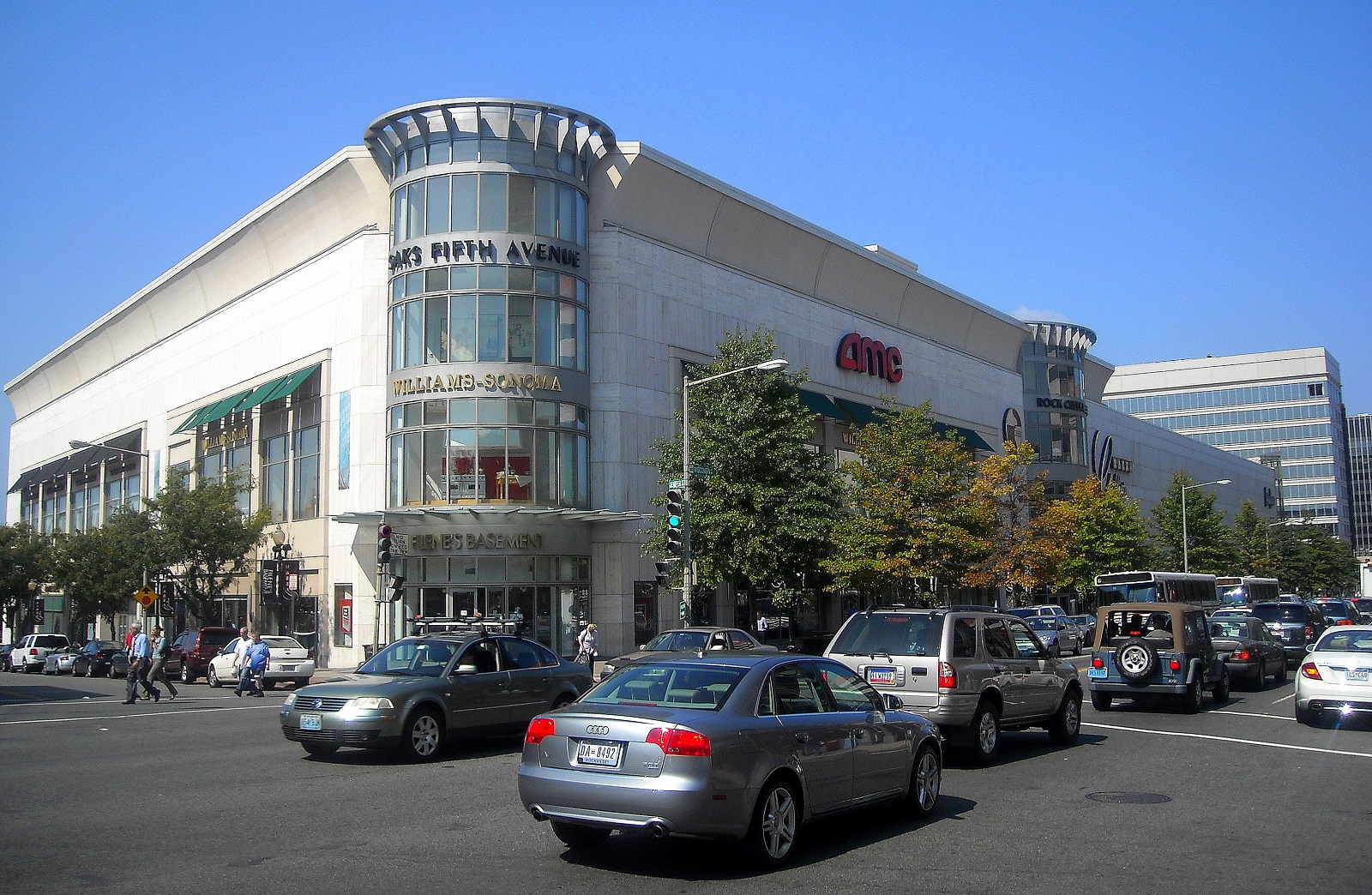
4. But controversy over development predated the 1970s. In the decade before, let’s just say that people weren’t pleased about the arrival of Saks
As reported in a Bethesda Magazine feature, a longtime Northwest resident Edith Claude Jarvis revealed some interesting history about the community’s fight over Saks Fifth Avenue in a 1971 interview that is on file at the Montgomery Historical Society library.
Jarvis is quoted as saying they had “quite the squabble” over the store when she was a member of the Chevy Chase Village Board of Governors, recalling charges of the store’s arrival as “commercial rape.”
While a number of development groups supported the New York-based Saks Fifth Avenue’s plan for a $2.5 million store at Wisconsin Avenue and Oliver Street, which required rezoning the land, there was an outcry from neighboring residents on all sides in the early 1960s.
“It is our belief that this project would adversely affect not only the adjoining residential properties but also the entire village,” the Committee for the Preservation of Chevy Chase Village wrote in a letter, according to a story published in the Sunday Star in March 1961 ahead of the rezoning decision.
Regardless, the Montgomery County Council approved the rezoning, albeit with a close margin—4 to 2 in favor of rezoning. Naturally, there was a lawsuit challenging the decision, but Saks Fifth Avenue prevailed and it still stands to this day on 5555 Wisconsin Avenue (they also expanded in the early 2000s, opening a men’s store on the D.C. side of Friendship Heights due to a lack of space at the original location).
5. The neighborhood takes its name from a former colonial estate
Imagine a gigantic, undeveloped tract of land extending from Cleveland Park all the way to Rockville. That parcel of land was called “Friendship,” and it’s where Friendship Heights gets its name (two colonists were granted the 3,000-acre plot in 1713, according to Bethesda Magazine.)
A 1914 article from the Evening Star explains that until the turn of the 20th century, only two homes were located in the area. “One was located several hundred yards back from Wisconsin avenue in a grove of silver maple trees and the other on an embankment close to the road,” according the report.
The latter residence, owned by the Ball family, functioned as both a blacksmith shop and a changing station for stage coaches. “Ball did the blacksmithing for the residents of a wide area surrounding his home. He also shod the horses which were used on the old stage coach route between Rockville and Georgetown before the building of the Metropolitan branch of the Baltimore and Ohio railroad,” the Daily Star reported. (What’s located there today, you ask? According to the centennial history book for Friendship Heights, it’s now the site of the Courtyard by Marriott.)
But the land was quickly subdivided (largely by two men, Albert Shoemaker and Henry Offutt), and by 1914, the Evening Star described it as a “thriving little community” with “attractive homes and well kept grounds” (it also notes that most houses were supplied with water from a “privately owned water works system”). Still, it was definitely a different time and place. An autumnal hog killing ritual is mentioned in more than one historical account.

6. There are a ton of local radio stations located in the area
Between WFED (1500 AM), WTOP (103.5 FM), WMAL (105.9 FM), ESPN D.C. (630 AM), and WRQX (now defunct; formerly known as Mix 107.3), there are lots of radio stations headquartered in Friendship Heights.
As a matter of fact, they’re pretty much located in just two buildings—4400 Jenifer St. NW houses WMAL and ESPN D.C. as well as the former studio for Mix 107.3. And just an eight minute walk away is WTOP and WFED, housed at 5425 Wisconsin Ave.
Meanwhile, the local Fox 5 affiliate is located just a few blocks south of the District line, at 5151 Wisconsin Ave. NW.
7. Geico is also headquartered in the neighborhood
When the Government Employees Insurance Co. set up shop in Friendship Heights in the late 1950s, it did so on the Maryland side of the neighborhood. Perhaps unsurprisingly, the site became one of contention for local activists against further commercial development in the area.
According to the Evening Star, tensions rose in 1971 when Geico proposed that the 28-acre tract of land, which was partially zoned for commercial use to host Geico’s building, be rezoned to transform the park-like space to a more commercial area. Local activists argued that the “28-acre tract was to be left as a buffer between the commercial areas and nearby residential neighborhoods,” while an attorney for Geico stated that he “never heard that the whole tract was to be a buffer.”
Local fears increased the following year, when Geico proposed constructing additional parking spaces for employees. A local leader was quoted in the Evening Star as saying, “we feel that what they’re aiming at is rezoning.”
While the company did end up building an employee parking lot, the Montgomery County Council stepped in to ensure the continuation of a park-like area in the neighborhood, acting as a buffer between commercial and residential interests. A 1976 story from the Evening Star reports that the council bought four-and-a-half acres from the tract of land for nearly $1 million, with a tight vote of 4 to 3 in favor of purchasing.
The park was developed alongside Dalton Road, where Brookdale Neighborhood Park still stands today.
8. The first Miss America tried to help thwart local “flim-flam teams” in the neighborhood
There was apparently a string of banking scams targeting elderly women, in Friendship Heights in 1973, according to a short but dramatic report in the Washington Star that uses the terms flim-flammers, bunco artists, and bamboozle.
The first Miss America, Margaret Cahill, who was in her late 60s by then, was one of at least three women targeted by the scammers and recruited by police to help catch them.
Cahill received a phone call by men pretending to be “bank examiners” who tried to get her to withdraw a large sum of money. The former Miss America cooperated with police “to the point of carrying dummy packages to the bunco artists’ pre-arranged meeting places,” waiting for about 20 minutes on Wisconsin Avenue. But they never showed up. “I was scared to death. I was absolutely terrified,” Cahill told the reporter.
The lifelong Washingtonian died at 90 in 1995.
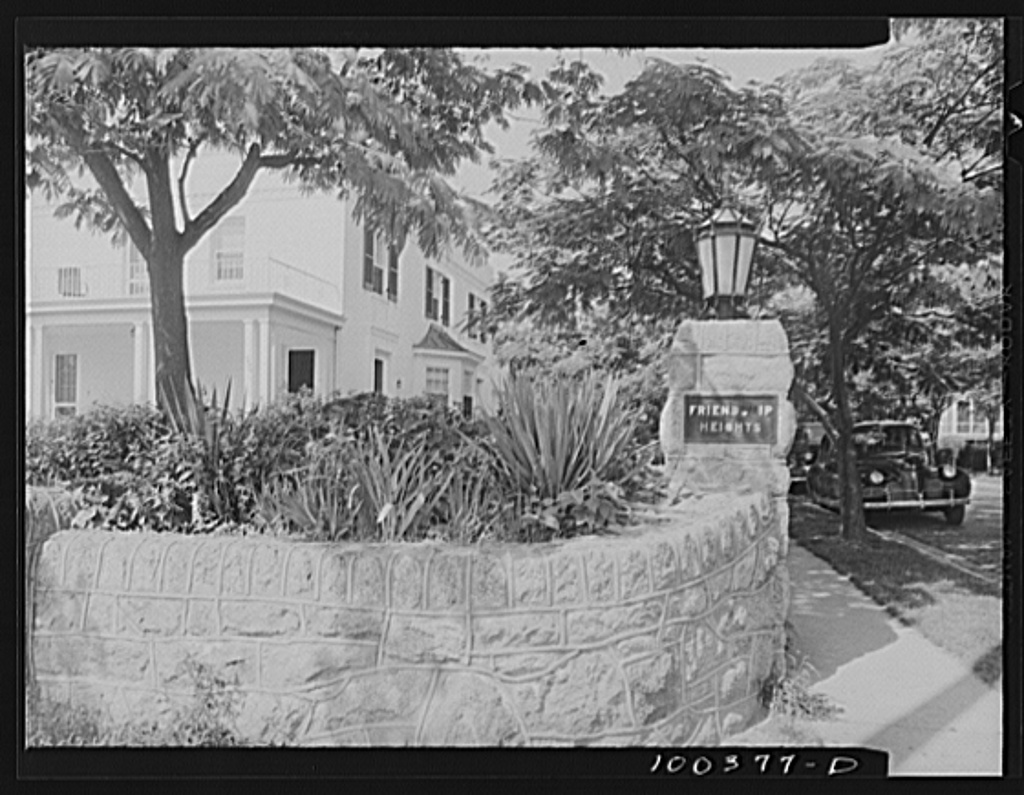
9. Friendship Heights was one of the first two neighborhoods in D.C. to get residential parking permits
In November of 1975, more than 100 Friendship Heights neighbors showed up to the first public hearing for the District’s new residential parking program.
And they were seriously upset. “Ron Reed, chairman of the transportation committee of the Friendship Heights Neighborhood Coalition, testified that residents of the area have a ‘helpless feeling’ about the invading army of suburban commuters ‘who may not care about the inconvenience or expense’ they cause in Friendship Heights,” reads a report in the Washington Star.
To resolve the issue, the new residential parking program would prohibit commuters from all-day parking in the neighborhood and provide permit to residents at a cost of $5 permits. There was overwhelming support for the plan.
A few months later, the Washington Star confirmed that the D.C. City Council approved the program in both Friendship Heights and in Northeast’s Gateway neighborhood (north of the Arboretum).
10. People in the area live an extremely long time, on average
Friendship Village not only has the highest life expectancy in Maryland, it has the second-highest life expectancy in the United States, with a whopping age of 96.1 years, according to data from the U.S. Small-area Life Expectancy Estimates Project. (Chatham, NC beat them out of the top spot, with a life expectancy of 97.5 years.)
But the D.C. area also comes second in another category—it has the second-largest life expectancy gap in all of the country’s metro regions. Just 10 miles away, in D.C.’s Barry Farms neighborhood, life expectancy is more than thirty years lower—just 63.2 years. As the Washington Post points out:
Several demographic forces move in tandem with this concentration. Both the longest-lived Maryland neighborhoods are in the top 10 percent for college-educated residents and for fewest residents living below the poverty line, while almost the opposite is true of the neighborhoods with the lowest life expectancy. That encapsulates the trend nationwide, as higher levels of college education and lower poverty rates tend to correlate with a longer life expectancy.
In the D.C. area and much of the southern U.S., there’s also an inverse relationship between life expectancy and the size of the local African American population. Nationally, black Americans face lower life expectancy than their white, Hispanic or Asian peers.
In Barry Farm, more than 90 percent of the population is black. In Friendship Village, the population is more than 80 percent white.
Previously:
Ten Facts You May Not Know About Takoma
10 Facts You May Not Know About Columbia Heights
Ten Facts You May Not Know About Petworth
Ten Facts You May Not Know About Chinatown
Ten Facts You May Not Know About Spring Valley
Ten Facts You May Not Know About Navy Yard
10 Facts You May Not Know About Brookland
Ten Facts You May Not Know About Anacostia
Ten Facts You May Not Know About Dupont Circle
Nine Facts You May Not Know About The Southwest Waterfront