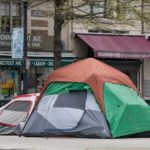
The District says it will set up 17 handwashing stations near homeless encampments and service sites amid the growing COVID-19 pandemic. The move comes as the novel coronavirus continues to spread across the region, putting those who lack stable housing at a heightened risk of getting sick, especially if they live in close quarters with others or have pre-existing medical conditions.
Most of the stations were installed earlier this week, according to an email a top official at D.C.’s Department of Human Services sent to a legal-services advocate. In the email, which was obtained by DCist, the agency’s chief of staff, Larry Handerhan, said nine stations had been installed as of Tuesday afternoon. A document attached to the correspondence shows the 17 sites are located across the city, including in downtown, Dupont Circle, Foggy Bottom, Columbia Heights, Brookland, Capitol Hill, Congress Heights, and NoMa.
DHS didn’t immediately respond to a request for comment Friday regarding the status of the installations. But a photo posted on Twitter depicts a gray handwashing station in Dupont Circle Park, across the traffic circle from a handful of tents on Connecticut Avenue NW.
On this morning’s sunrise walk I noticed that DC has set up hand washing stations in the parks for our homeless population and it basically wrecked me. #COVIDー19 #WeAreInThisTogether pic.twitter.com/e93S40KPxQ
— pithypants – @pithypants@dmv.community (mastodon) (@pithy_pants) April 3, 2020
Global health officials strongly urge frequent handwashing and maintaining social distance as ways of keeping COVID-19 in check. Such practices, however, may prove difficult to follow for unhoused residents who do not have consistent access to running water and restrooms, whether public or private.
While D.C. homeless shelters are now open 24/7 during the District’s public health emergency, some have still had vacant beds, recent shelter-counts reviewed by DCist show. The city also temporarily closed two of its day centers for homeless residents in mid-March. Many of the other spots where people typically gather—such as public libraries and coffee shops—have shut down as well.
The Washington Legal Clinic for the Homeless said in a blog post Thursday that it would independently review the locations of the 17 stations to ensure there are enough “for all the food stations and all the encampments of more than 10 persons.” “We may need more at larger encampments, like the ones in NoMa,” the group said.
Earlier on Thursday, Laura Zeilinger, the director of DHS, said on The Kojo Nnamdi Show that eight people at three different shelter sites had been diagnosed with COVID-19 up to that point. Zeilinger added that D.C. was deploying port-o-potties on the streets, but did not provide details. Along with nonprofit partners, her agency is screening shelter residents for signs of the disease and redirecting those suspected of exposure for testing and quarantine or, if necessary, hospitalization.
It’s unclear whether the city will have more handwashing stations and port-o-potties installed as the coronavirus crisis develops. Eric Sheptock, a D.C. homeless advocate who is homeless himself and works for a company that provides portable toilets, says this week he saw five encampment and shelter locations where port-o-potties have been set up.
But one of the new handwashing stations he saw, a foot-pump-operated device outside Union Station, appeared to have run out of water as of Thursday evening. “One of the homeless guys [there] told me he tried to use it and it was empty,” says Sheptock.