Margaret Barthel
Megan Newman is sticking to a strict morning routine these days: she wakes up, gets a few chores done, and logs on to work for a few hours. Then, at around 11:00 a.m., she switches gears: she gets her mother up, makes her brunch, maybe takes her on a walk or tries to get her to focus on an activity. In the afternoon, Newman gets in a few more hours of work before she makes dinner and puts her mother to bed.
Newman’s mother, Marilyn Lavery, has Alzheimer’s disease — and now, in the midst of the coronavirus pandemic, Newman has become her primary caregiver.
“It’s been an adjustment for both of us,” Newman says. “We’re trucking along.”
She’s gone from working two jobs to just one, part-time, at the Alzheimer’s Association’s National Capital Area chapter. She and her mother leave their house in Burke, Virginia, for walks around the neighborhood, to pick up her mother’s favorite Chick-fil-A order for dinner, and little else.
It’s the first time in seven years that Newman has been solely responsible for her mother’s well-being, every day of the week. But like many families with loved ones with Alzheimer’s disease and other dementias, Newman is no stranger to juggling her mother’s care with the rest of her life: Lavery started showing signs of the disease during Newman’s senior year in high school. Newman relied on home care workers through much of college and graduate school, though she had to bring her mother to live with her for her junior year in college when care options fell through.
In normal times, Newman used to spend a few hours a day with her mother—now, they’re together from the moment Lavery gets up in the morning to when she goes to bed at night. Lavery’s two in-home caregivers have had to stop coming to the house. Given her mother’s age—72—Newman decided it would be safest for the two of them to isolate together.
Nearly 250,000 people in the Washington region have Alzheimer’s disease or another form of dementia, and they rely on help from close to 800,000 caregivers, often family or friends. But the pandemic has brought big changes to caregiving. Home care help is increasingly scarce, as families and aides alike worry about exposure and agencies struggle to find the protective gear and supplies necessary to perform the work safely. Long term care facilities are locked down and no longer receiving visitors. In-person Alzheimer’s-friendly activities and meet-ups that can offer respite to caregivers are no longer operating. And like Newman, many families are choosing to take on caregiving responsibilities exclusively, keeping their loved ones occupied and active while trying to fulfill other job and family obligations.
Seeking Support
Alzheimer’s disease can be very isolating for families who struggle to communicate the daily reality of watching a loved one deteriorate—and in the context of the pandemic, that sense of isolation can be heightened, according to Ana Nelson, Vice President of Programs and Services for the National Capital Area chapter of the Alzheimer’s Association.
The association runs a 24/7 hotline for people with questions or concerns about caring for someone with the disease, or who just want to talk to someone who understands. Calls, Nelson says, are significantly up. So is participation in caregiver support groups, which are now virtual.
“They’re already realizing that they’re going to need a lot more support,” she says.
The calls range from questions about how to help people with dementia adjust to new routines and realities to concerns about how to prepare in case the caregiver or patient get sick.
One of the best things families can do to ease the transition for people with dementia, Nelson says, is maintain familiar routines.
“If they like to sleep late, let them sleep late and get up at the same time, go to bed at the same time, keep their daily routines the same,” she recommends.
Nelson worries that caregivers aren’t taking care of themselves.
“We remind them how important it is to take care of their own health, because if they don’t take care of their health, they are putting themselves at risk,” she says. “If they get sick, then who’s going to take care of their loved one?”
But Nelson also wants families to be prepared for that possibility. Caregivers should make lists of the medications both they and their patient are taking, and contact friends or relatives who might be able to drop off groceries or medications, Nelson says.
Newman agrees that it’s difficult to ask for help, and it can be complicated talking with family and friends about the disease if they have no experience of it. But over the years she’s developed a support system of family and friends, who are now ready to drop anything to FaceTime with her mother so that she can have a break.
“It did take me a long time to get there,” she says. “I still struggle sometimes asking for help when I should.”
Dealing With Distance
Families with loved ones with dementia in long-term care facilities can no longer visit face-to-face. Many are making do with calls, video chats, or visits through windows. But staying at a distance is still hard. Some worry that the long slide of the disease won’t wait for a pandemic.
Loretta Veney hasn’t seen her mother, Doris Woodward, who lives in a nearby group home, in two months. The staff have been “phenomenal,” texting updates and pictures of her mother doing activities, and she says she feels that her mother is safe.
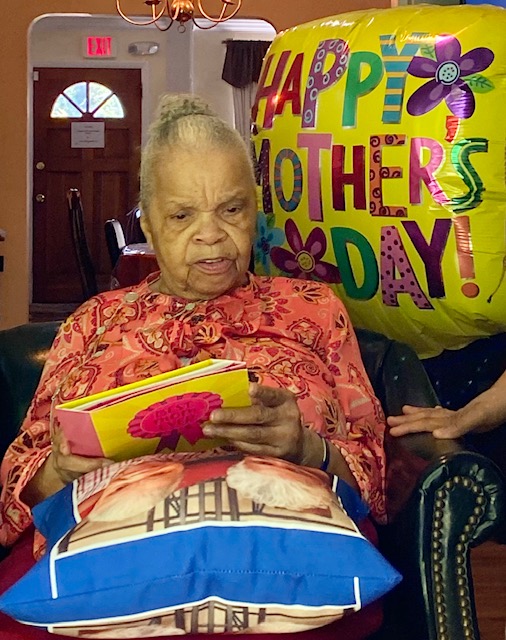
But Woodward no longer recognizes Veney as her daughter — and Veney worries the extended absence will make her mother unable to recognize her altogether. Her mother didn’t wave when they talked recently by FaceTime. And while she lives close by, Veney has decided not to visit Woodward in person through a window, as other families are doing. The one time she tried it, her mother didn’t understand why she couldn’t come outside to say hello, and became distraught.
“She was getting ready to cry,” Veney says. “I went to my car and cried.”
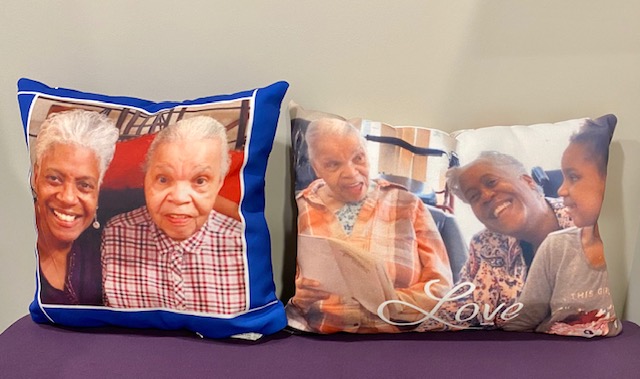
One bright spot: a friend made Veney and her mother pillows, with photos of mother and daughter together printed on them. When she was given hers, Woodward recognized Veney’s face.
Inside memory care units, staff are doing their best to keep residents active and engaged, despite new public health measures.
Rita Altman is the Senior Vice President of Memory Care and Program Services at Sunrise Senior Living, which operates dozens of locations with memory care living across the Washington region. Staff have had to modify major parts of life at Sunrise to promote social distancing, keeping residents in their rooms instead of out in common spaces and shutting down the dining room. But they’re trying to keep some familiar things, bringing in plants in from the garden and finding ways to transform group art and music activities so that residents don’t have to leave their rooms. In one case, a resident was having trouble remembering how to eat dinner out of the context of the shared dining hall. So staff set up one of the dining tables in the resident’s room.
In particular, Altman says that familiar music can be very calming to people with Alzheimer’s. Sunrise staff make a point to play the genre of music individual residents like on a regular basis.
“For individuals with memory loss, it’s almost as if music outsmarts Alzheimer’s,” she says.
Explaining Coronavirus
Newman has told her mother the basics about what’s happening in the world with the coronavirus.
But her mother doesn’t fully grasp the seriousness of the pandemic, and once in a while she forgets about it entirely. Sometimes, she gets frustrated with Newman for preventing her from going over to a neighbor’s house or going out to eat at a restaurant. Then Newman has to explain the situation all over again, patiently reminding her mother about the danger.
“She knows that there is a virus — we call it ‘the virus’ because names don’t really matter in her world,” Newman says. “She knows it exists. She knows it’s scary and big and that’s why things are closed.”
Talking with people with Alzheimer’s about a topic as stressful and vast as a global pandemic is often a difficult balancing act. Caregivers have to simultaneously explain the facts in an understandable way, and also keep loved ones from spiraling into anxiety and stress.
For that reason, Nelson doesn’t recommend watching, listening to, or reading the news with a loved one with Alzheimer’s. But she says there are practical things caregivers can do to remind loved ones with dementia to wash their hands regularly or wear a mask, like putting up signs near the bathroom or modeling the behavior themselves.
If people with Alzheimer’s do become anxious about the pandemic, Altman says one way to help is to put the situation in context with another time in their life where they faced fear and uncertainty. She related the story of a World War II veteran with Alzheimer’s who told her he was frustrated about not being able to go outside. She responded by asking him to recall a difficult time in his life, and what helped him through it.
“He said, ‘Yes. Oh, boy. World War II, the Battle of the Bulge. Bullets flying. Oh, yeah. There was a time that was hard,’” she says. “I said, ‘And what got you through that?’ And he said, ‘My comrades, my fellow soldiers, they got me through.’”
She and another staff member reassured him that they were his comrades, and they’d get through the pandemic together.
“Our seniors are the most resilient population in the world,” Altman says. “They have been through so much. And regardless of memory loss, that’s something in their core.”