Rachel Kurzius
 Martin Austermuhle
“They stared down crisis and led,” declared the ads for a CNN town hall last weekend. D.C. Mayor Muriel Bowser was one of the headliners for the Sunday evening special, “Mayors Who Matter.” It capped off a huge week of national interviews for the mayor of the District, including NPR, TMZ, and NBC.
But even as Bowser entered the national discourse, an entirely different debate was playing out on her doorstep. A protest led by trans organizers of color arrived in front of the mayor’s house on Saturday evening, calling on her to defund the police as demonstrators danced and chanted.
“We’re here basically to come to Mayor Bowser and ask her, ‘Why?’ ” said protester Pontianna Ivan, a trans woman. “Why do we have to keep going through this trauma? Why do we have to keep experiencing this injustice? … With just the flick of a finger, she’s able to change and help a whole lot of people. … We want [people] to know that it’s not being done.”
The mayor didn’t emerge from her house until after the crowd largely dissipated.
Since demonstrations over police brutality and anti-Black racism kicked off in D.C. in late May, Bowser has become an increasingly prominent figure — interviewed on late-night shows, her press conferences carried live by cable news, the subject of “vice presidential chatter,” and featured in international newspapers — even as some of the District’s protesters say her actions are part of what they’re fighting against.
Bowser told DCist/WAMU that she sees her elevated media profile as a opportunity to advance two causes. She says she aims to “call attention to how we all need to band together, people of all backgrounds and beliefs, about what we saw in Minneapolis and how we can work together, so something like that — like a killing in an American city by a police officer — never happens again,” and to educate the rest of the country “about Washington, D.C., and how it is that a president could act in this way to show force, to intimidate Washingtonians, just to keep other Americans in line.”
While Bowser is unquestionably doing the latter, her current budget proposal and repeated defenses of the legacy of recent D.C. policing make the former a harder sell to many activists.
“Mayor Muriel Bowser, she’s doing a lot of publicity stunts,” said protester Justin Dawes last week, among those calling to defund the police. “But when it’s behind the curtains, she’s acting with the police and giving them more money.”
Yet other residents view the mayor’s new national platform as a powerful way to draw attention to D.C.’s lack of autonomy, just as the House of Representatives schedules a historic vote on legislation to make the District the 51st state.
“I want to have the conversation around the local issues, around defunding the police, why has the police budget gone up — that’s something she should be held accountable for,” says D.C. author and activist Natalie Hopkinson. “But it’s important to look at the larger picture around the bigger goal, which is statehood.”
While District residents are almost uniformly united on the need for statehood, views on both police reform and the mayor’s performance vary widely in D.C., even within neighborhoods.

Bowser has seen her support grow in Wards 7 and 8 — areas that were a stronghold of support for her predecessor, Vincent Gray — but she isn’t always warmly embraced by the communities most affected by police brutality and racism.
In a 2019 survey conducted by the Washington Post, nearly half of residents in Wards 7 and 8 said things in the District are on the wrong track — the highest percentage across the city. Meanwhile, 64 percent of Ward 7 and 8 residents said they believe the mayor is doing a poor or not-so-good job of reducing crime, which was the leading answer in those wards when asked about what is the city’s biggest problem.
Aliyah Clark, this year’s salutatorian at Anacostia High School, says that “You don’t feel like [Bowser] has your back 100%. She doesnt pay attention and try to help in Ward 7, Ward 8.” That’s why she’s among those who are skeptical of Bowser’s national profile and the now-world famous Black Lives Matter Plaza.
“How is you painting ‘Black Lives Matter’ in the street really helping with what’s going on in Washington, D.C.?” says Clark, who is Black. “It’s a nice gesture, but people are still being harassed by police, and they’re still wondering whether their neighborhood is going to get torn down.”
Clark says her experience, and that of her peers, with police is that “they pick on you for no reason … you could be walking down the street and it’s a common thing.” She thinks that MPD needs to “start the whole academy over — have people who are actually there to protect and serve.”
Jacalyn Ward, a Black real estate agent in Anacostia who is active in community groups, voted for Bowser and largely dismisses the criticism against the mayor and the police department.
“The police here, probably because I’m a senior citizen, most try to help. I give them no problem and they give me no problem,” she says. “I have never had a bad interaction with the police.”
But even she says that she’d like to see a reconsideration of some instances in which police are first-responders. “Police are called out on calls that are really mental illness issues,” Ward says. “I would say that we look at some portion of that which goes to mental illness and makes sure our mental illness agencies are funded so they can perform more community intervention.”
Others see both signs of the coin.
“I think [Bowser’s] in an impossible position,” says Troy Donté Prestwood, president of the Ward 8 Democrats and chairman of the Advisory Neighborhood Commission that spans Anacostia, Fairlawn, Fort Stanton, and Hillsdale. “On one hand, she wants to say, ‘Hey, Black lives matter and they are meaningful and they ought to be respected and they should not be murdered by the state.’ … She also has to balance the calls for police and for public safety and for communities that are in distress from violent crime — ordinary people who say, ‘Where are the police?’ ”
He points out that the areas that he represents have high violent crime rates — particularly homicides.
“What we often hear from residents, especially moms and grandmothers and people who are crying out — they want police to solve those problems, to solve those murders, to help them bring justice to their families,” says Prestwood, who is Black. “The calls to defund police are not loud in my community. That doesn’t mean that there aren’t systemic changes that must be done to police in order to improve public safety in communities. … My neighbors want police, but they want police who care about them. They don’t want police who are going to abuse them, who are going to take them for granted, who are going to put them in harm’s way.”
The mayor is balancing all of that, he says, while in a subservient position to the federal government and with the backdrop of the pandemic.

Much of Bowser’s newfound national attention traces back to President Donald Trump’s immediate reaction to the protests in D.C. After the first night of demonstrations in response to the police killing of George Floyd, he called out Bowser by name on Twitter, wrongly asserting that she did not allow D.C. police to help defend the White House.
When some of the early nights of demonstrations included some looting and property destruction, the president told governors on June 1 that he planned to “clamp down very, very strong” in D.C. The president called in other states’ National Guard and federal law enforcement, all without Bowser’s go-ahead. The violent clearing of peaceful protesters at Lafayette Square and the use of helicopters to disperse demonstrators that evening have led to investigations, lawsuits, and widespread criticism of the Trump administration, as well as a handful of new Congressional co-sponsors for the D.C. statehood bill.
It also prompted Bowser’s most high-profile response to Trump. “The moment I decided to create Black Lives Matter Plaza was when I came face to face with a line of federal police blocking a street in my legal jurisdiction,” she said in a Washington Post op-ed.
After a week of protests, she directed artists and public employees to paint “Black Lives Matter” in 35-foot-tall yellow letters on the blocks of 16th Street NW leading to the White House as a way to show “whose street this is,” she said, and renamed the intersection at 16th and H streets NW “Black Lives Matter Plaza.”
Since then, “Black Lives Matter” street murals have been painted in cities across the country.
To many in national media, the contrast between Bowser, a Black D.C. native and single mom, and Trump proved irresistible. Eerie images of armed forces in D.C. became the prevailing images from June 1 — followed by Bowser’s calls for them to leave the city.
This largely took attention from the way that Metropolitan Police Department officers acted during demonstrations. On June 1, D.C. police officers trapped protesters on a sleepy Dupont street and arrested nearly 200 of them. MPD Chief Peter Newsham, while standing next to Bowser at a press conference, defended his officers’ actions. (The basis for those arrests was a curfew that Bowser imposed for four consecutive nights — prosecutors have dropped all but a few of the charges related to curfew violations.)
And while federal police have largely become the face of tear-gassing District protesters, firsthand accounts indicate that MPD was involved as well in the early days of protests.
“At one point, the D.C. police sprayed the crowd with so much mace it looked to me like they were using a water hose,” wrote freelance journalist Abdallah Fayyad. “One local police officer, after detonating a stun grenade, threw his fist in the air and cheered.”
Meanwhile, activists added “Defund the police” in large yellow letters to the Black Lives Matter mural a day later, and used the moment to bring a focus back to local issues — particularly the mayor’s current budget proposal. (City employees restored the stars to the D.C. flag, which had been removed to make an equals sign, but otherwise left the addition intact — forestalling the possibility of a public fight over the mural.)
Across the country, protesters’ demands in the wake of Floyd’s killing have been clear: Defund the police. In Minneapolis, there’s a growing consensus around sweeping changes to how the police department operates. In Los Angeles, Mayor Eric Garcetti proposed and the City Council approved cutting $150 million from the police budget. And in New York, most members of the city council say $1 billion should be cut out of the police department’s $6 billion budget.
On the Late Late Show with James Corden, Bowser made the case that MPD has already “been on the trajectory of reform for 18 years,” pointing to D.C.’s use of body-worn cameras and the independent Office of Police Complaints.
“We think we’ve instituted a number of important reforms,” the mayor said. “I don’t believe every department in our country is in the same place. There may be some out there who need to be completely dismantled and rebuilt, some cultures that have to change.”
Bowser has proposed a 3.3% budget bump for the Metropolitan Police Department next year. While she has defended the increase as what the department needs to serve a growing city, activists say it’s further proof of her doubling down on traditional policing. And they say it’s being done at the expense of alternatives like violence interruption, which would see a small cut.
Political pressure has built on the D.C. Council to shift some of MPD’s budget to homeless services, housing programs, and mental health professionals in schools. In a recent public hearing, almost all of the 90 people who were able to speak argued in favor of some type of defunding or dismantling of the police department.
While serving as the previous MPD chief, Cathy Lanier made public statements in 2015 that wouldn’t have been out-of-step at the recent budget hearing. “Policing has become a drive-thru 24 hour McDonalds of services,” she said. “The goal should be to put us out of business … The goal should be having investments before someone gets in the system. More investments in social services, and less in policing and incarceration.”
But the response from Newsham — who was nominated by Bowser for the position — to possible reforms has been hostile.
After the D.C. Council passed an emergency police reform bill on June 9, Newsham, told officers that lawakers had insulted and “completely abandoned” them. That prompted angry rebukes from several councilmembers, who called his comments “dangerous,” “inflammatory” and poorly timed.
During a hearing this week, Deputy Mayor for Public Safety and Justice Kevin Donahue tried to contextualize Newsham’s statement, saying he was just trying to rally his troops during a difficult moment. But Donahue also gingerly distanced Bowser from Newsham’s comments. “I don’t believe nor does the mayor believe that the council has abandoned MPD,” he said.
Still, Bowser had called on the council to delay the passage of the emergency bill to allow for a public hearing.
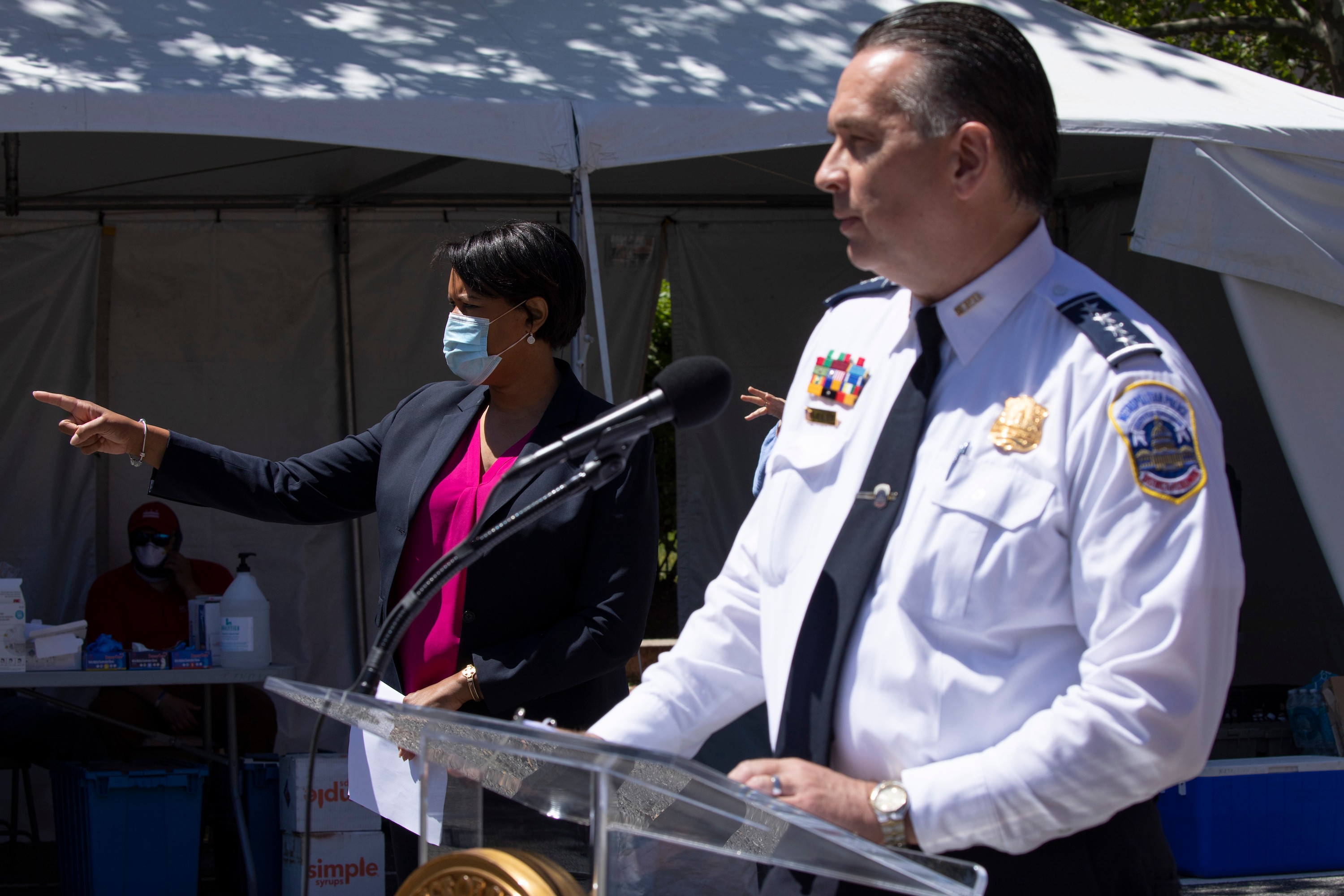
The mayor’s rocky relationship with the local chapter of the Black Lives Matter movement far predates the current moment. In 2015, dozens of activists disrupted a press conference in which Bowser outlined steps to address a spike in crime. “We don’t need more police!” members of the group shouted. More recently, activists criticized Bowser for defending then-New York City Mayor Mike Bloomberg’s stop-and-frisk record as a prominent surrogate during his presidential run.
D.C. has a wide racial disparity when it comes to stop-and-frisk stops, too. Data released by MPD shows that nearly three-quarters of police stops were of Black people, though they comprise less than half of the city’s population. (Just getting that information was a struggle. Civil rights groups — including Black Lives Matter D.C., the Stop Police Terror Project D.C., and D.C.’s chapter of the American Civil Liberties Union — had to sue the department to get them to comply with a District law that required the release of the stop-and-frisk data.)
When asked if she is glossing over local issues amid her national media appearances, Bowser responds that “the larger message can’t be lost — the impact that we can have on a national and global discussion. There are going to be differences of opinion and ways to get to what we all want.”
The mayor has long used her moments on the national stage to remind people of D.C.’s lack of autonomy — it was a prominent part of her speech at the Women’s March, for instance. (While statehood is exceedingly popular in D.C., a nationwide poll from last summer indicates that the measure lacks support outside of city borders.)
To Hopkinson, Bowser’s stroke of genius was bringing the fight to Trump. “There’s never been a D.C. mayor who has taken it to a president in that way, and to do it in a way that’s so showy, it really raised our status nationally,” Hopkinson says.
Now, Bowser has more opportunities than ever before to make the case for D.C. getting the 51st star on the flag. That 20-minute Late Late Show clip, for one, is titled “Mayor Muriel Bowser: Make D.C. a State!”
The statehood bill is expected to pass in the House of Representatives — a historic first — though, without any Republican support, the measure has little chance of being taken up in the Senate. The only way to fix that, Bowser says, is to elect a Democratic president and Senate majority, in addition to keeping the House blue.
Without statehood, the federal government can continue to meddle in local affairs, including police reform. Per Hopkinson, Bowser “could say tomorrow, ‘We’re going to abolish the police,’ and the president could say, ‘No, you’re not.’”