Margaret Barthel
The state of Maryland has released its long-awaited draft environmental impact assessment for the Hogan administration’s controversial Beltway expansion project.
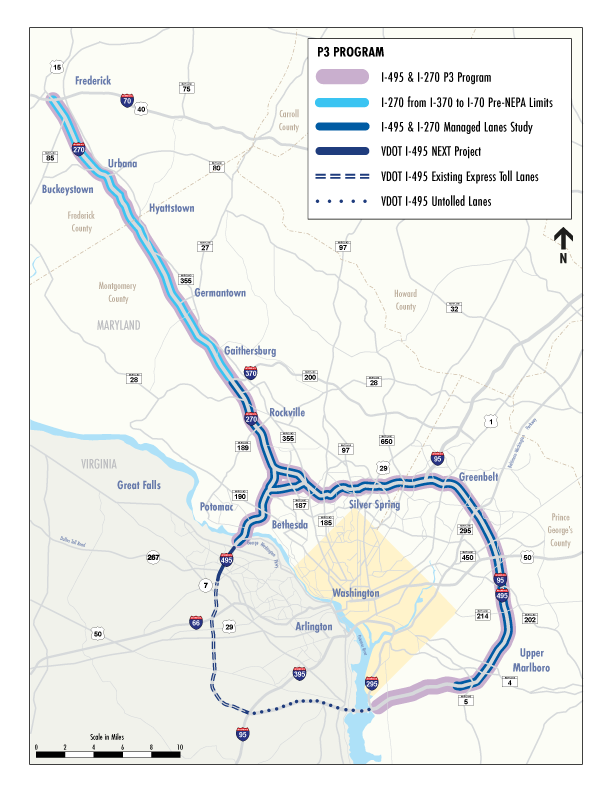
The report examines the effects a range of possible design options for widening parts of I-495 and I-270 in Montgomery and Prince George’s counties would have on air quality, water quality, wetlands, wildlife, environmental justice, parks and historical sites, and more. The state has been working on the review since 2018. It is 18,000 pages long, including associated technical reports.
The additional highway lanes would be express toll lanes or high-occupancy toll lanes, meaning that drivers using them would pay extra to drive in the less-congested lanes. The project has an estimated $11 billion price tag and would be built as part of a public-private partnership.
The project already passed an important milestone in January, when a revised plan for it was approved by the state’s Board of Public Works, over the objections of some environmental advocates, who wanted the environmental impact study to be completed before the Board approved the plans.
What’s In The Study
Maryland is legally required to conduct a draft environmental impact study and release the results for public comment before proceeding with signing contracts or construction.
The study presents the state’s case for why the highway expansion is necessary, and what steps the state could take to mitigate any adverse environmental and community consequences that might arise from the project and its construction.
Widening the highways to add paid express lanes, much like the ones in Northern Virginia, will reduce worsening traffic congestion and help the state keep up with significant population growth in the next few decades, the study argues.
“Long-term traffic management options are needed to address the existing and future recurring congestion along study corridors,” it says. “The addition of general-purpose roadway capacity alone cannot keep up with the growing demand for mobility due to the expanding populations and growth in and around the cities.”
The study examines a range of highway expansion configurations, including general purpose lanes, price-managed lanes, and high-occupancy vehicle lanes. It narrows an original list of 15 options down to seven by comparing them against a list of qualitative criteria. Then it evaluates those seven quantitatively, in terms of their effects on traffic and on the environment.
Two of the best alternatives in terms of reducing traffic congestion, according to the study, would add two price-managed lanes to both interstates. The options could reduce delays due to congestion as much as 35 percent in some cases.
But all seven options would have significant environmental impact, the study determined. In all seven, more than 140 acres of public parks and historic sites could be affected, as could more than seventy acres of wetland. Close to 1,400 acres of forest canopy would be cleared, damaged, or disturbed.
Under all seven options, about 34 residential homes and four businesses would have to be relocated. More than 4,000 noise-sensitive land areas–like homes, schools, churches, and parks–could be impacted by the sound of the expanded highway.
The Hogan administration contends that highway expansion will reduce air pollution alongside congestion, though that claim has been contested in the past. The study also concludes that the expansion will result in a decrease in greenhouse gas emissions because it will decrease the amount of time car travel takes.
Critics Respond To The Study
Opponents to the plan say there are far better options for fighting congestion while reducing emissions and mitigating environmental impacts. They worry about the environmental consequences of the project, and question the efficacy of creating more space for cars as the Earth confronts the reality of climate change.
“This is going to be such an insensitive thing to do during the middle of a climate catastrophe,” says Jane Lyons, of the Coalition for Smarter Growth, a transit and development advocacy group.
The state’s own estimates suggest that public transit emits roughly 40-50 percent less greenhouse gases per passenger mile than single-occupancy vehicles.
But while the study lists three public transit-oriented options initially–light rail, heavy rail, and bus rapid transit–it does not include them in the second, data-driven analysis.
Critics say the state isn’t thinking creatively enough about public transit, especially in conjunction with land use policies that could further incentivize development near Metro and MARC stations and near underutilized roadways.
“Building an absolutely unprecedented and extremely expensive highway plan is one possible way to put your fingers on the scales and try to directly address this issue [of congestion],” says Tracy Hadden Loh, a fellow at the Brookings Institution. “But another way to do it would be to say, ‘This isn’t okay. We need to concentrate growth around our existing infrastructure, be maximally efficient in how we use that infrastructure. And then when we do invest in new infrastructure, we need to invest in infrastructure that is efficient and is equitable and that is climate resilient.’”
Lindsey Mendelson, of the Maryland chapter of the Sierra Club, agrees.
“We have to look at everything in terms of a whole system, including public transit, including land use, how people are walking around and getting from their homes to grocery stores to essential jobs,” she says.
Environmental advocates also point out that long-term shifts in commuting patterns due to the coronavirus and heightened telecommuting may mean that the state’s predictions about traffic growth are off-base.
“We’ve seen that traffic has dropped extraordinarily from pre-COVID levels while so many people are telecommuting,” says Lyons, of the Coalition for Smarter Growth. “I’m going to venture to guess that it’s not going to be good for private toll lanes.”
The Maryland Department of Transportation acknowledged the uncertainties resulting from the pandemic.
“There is no definitive traffic model to predict how this unprecedented global pandemic will affect long-term future traffic projections and transit use. MDOT SHA [State Highway Administration] is committed to tracking trends in travel behavior and monitoring traffic volumes over time as businesses and schools slowly begin to reopen,” said spokesman Terry Owens.
With the digital ink on the study only just dry, opponents to the highway expansion say they’re only just beginning to scrutinize the state’s analysis. Mendelson says the Sierra Club will be working with community members and experts to do that work.
Debates Over The Public Comment Period
With the publication of the report, the Maryland Department of Transportation will begin a 90-day public comment period on the study.
But Congressional representatives and local environmental and civic associations want a longer public comment period–at least 120 days–for the massive document.
A coalition of more than 40 environmental and community advocacy organizations submitted a letter asking for the extension, citing the sheer amount of information as well as the complications of gathering public feedback during the coronavirus pandemic.
“I actually calculated that it takes about two minutes per page of reading, and there’s 18,000 pages. So that’s 600 hours of reading,” says Mendelson, of the Maryland Sierra Club. “So you actually couldn’t get through all the pages of this document in 90 days if you were to read the document 40 hours a week.”
Members of Maryland’s U.S. Congressional delegation, including Rep. Jamie Raskin, Rep. Anthony Brown, Sen. Ben Cardin, and Sen. Chris Van Hollen also sent a letter in support of a longer public engagement process, citing the volume of information and the complications of the coronavirus pandemic.
“COVID-19 creates special problems for full participation at this moment,” the letter says. “In-person hearings raise health risks for all participants, especially seniors and the immuno-compromised, while virtual hearings create differential access for communities with lesser access to the Internet.”
Owens, of the Maryland Department of Transportation, said the agency had received the congressional letter and is “currently reviewing the request and will be following up with them very soon.”
“Our number one priority during COVID-19 is the health and safety of the public and our team,” said Transportation Secretary Greg Slater in a press release. “We are taking every precaution and following the guidance of public health officials to ensure the public has ample opportunity to review the DEIS and safely provide their valuable feedback.”
The state says it will hold four virtual public hearings and two in-person hearings. People can also comment on the study online or by mail. Further details on how Marylanders can testify is available here.
People attending the in-person hearings will be required to register in advance and observe strict social distancing while testifying.
Following public comment, the state will respond to comments in a final environmental impact study, which it must complete before the state can finalize contracts for the project. The final study is not expected until at least the spring of 2021.