 Cydney Grannan
Updated Aug. 31 at 10:05 a.m.
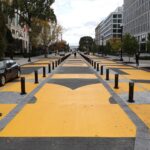
When Keyonna Jones joined seven other artists to paint the words Black Lives Matter in 35-foot-tall letters that spanned two blocks of downtown D.C., she didn’t think she was creating a plaza.
“At that point, there was a lot of tension between the mayor and the president,” Jones says. “It’s like, we don’t know how the president’s going to react. And some of the artists was afraid the mayor may not really back it.”
Jones, the founder of the Congress Heights Arts and Culture Center, says she would have been content if the mural had stayed up just for one day. But she’s ecstatic the mayor has kept the mural and renamed the space Black Lives Matter Plaza. She thinks the mural and the new name changed the space itself.
“The energy there is completely different,” Jones says. “It has created, I think, a place of hope. And like I said, a place of healing.”
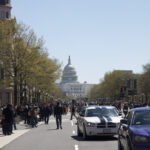
Before it was renamed, Black Lives Matter Plaza was already a gathering place for activists, largely because of its proximity to the White House. Protests against police brutality have taken place at Lafayette Square and surrounding streets following the killing of George Floyd by Minneapolis police in late May. Federal law enforcement and military from at least 15 agencies were deployed in D.C. to quell the protests, inflaming tensions between the presidential administration and the District. Four days before the mural was created, law enforcement teargassed peaceful protesters outside of St. John’s Church so the president could have a photo op there. Days later, D.C. saw its biggest day of protests on June 6.
This, plus the new mural and an official designation from the city, has given the space new meaning for D.C. But what that meaning is depends on who you ask. While some see it as a place of unity and hope, others think that giving the plaza too much attention distracts from larger issues.
Who Is The Mural For?
When Washingtonians talk about the plaza, they talk about the mural. And when they talk about the mural, they often bring up the person behind it: D.C. Mayor Muriel Bowser.
In an opinion piece in June for The Washington Post, Bowser said she decided to create Black Lives Matter Plaza when federal police blocked D.C. streets during protests. The mural was largely seen as a direct response to President Donald Trump and an appeal for D.C. statehood.
The creation of the plaza garnered national attention. But in the District, the mayor got mixed reviews. The D.C. chapter of the Black Lives Matter movement called it “performative.”
Some activists worry that the focus on the plaza might distract from the bigger issues at stake. Justice Shorter, who identifies as a Black blind lesbian, co-organized a D.C. Black Disabled Lives Matter event with fellow activist Keri Gray. She hopes less attention will be given to the plaza and more to the people and the policies that will help them.
“A lot of times there is this emphasis on these symbolic spaces, but I also think we cannot ignore or set aside the very real concerns as to why that space is even relevant,” Shorter says.
Brandi Thompson Summers is an assistant professor of Geography and Global Metropolitan Studies at the University of California, Berkeley, who lived in D.C. for eight years. She studied the demographic and political shifts of H Street, which she writes about in her book, “Black in Place: The Spatial Aesthetics of Race in a Post-Chocolate City.” Summers took issue with the mayor’s mural because she says it uses Blackness to align D.C. with a set of values that, Summers says, city officials haven’t necessarily supported. Summers points to D.C. increasing its police budget as an example of a policy that harms Black residents.
“You can invite someone to paint a mural on the ground, paint a mural on the side of a building, that’s supposed to reflect the value of Black lives, that’s supposed to show that the city is interested in protecting Black lives,” Summers says. “But you don’t actually have to make the city habitable for Black people. … It just means you have to put up a picture to show that you acknowledge them, not that you welcome them and create conditions that allow them to stay.”
Summers wouldn’t say Black Lives Matter Plaza does more harm than good for Black residents, but it does add a level of complexity to life in the District.
“We have to question who the mural is for,” Summers said on The Kojo Nnamdi Show on Tuesday. “We’re wondering, what does it actually mean for the people on the ground?”
Reclaiming The Space
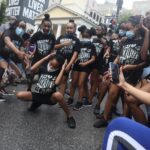
To many activists, Black Lives Matter Plaza gets its meaning not from its mural or its name, but from how people use the space. Bethelehem Yirga, one of the co-founders of The Palm Collective, an organization working to build a coalition among the dozens of grassroots organizations in D.C, says she and other groups are putting together “reclaim” events on and near the plaza, like movie nights, dance classes, midnight yoga and paint-in protests.
“A lot of our organizations within the collective have kind of transformed that Black Lives Matter Plaza as a place for community, self-healing and being there for one another,” Yirga says.
Yirga thinks it’s necessary to balance activism with self-care — and that self-care at Black Lives Matter Plaza is, in itself, a form of activism. Personally, she’s attended every midnight yoga at Black Lives Matter Plaza.
“It is so transformative to look up at the stars and be in front of the White House and be like, ‘This is why I’m here. This is what I’m fighting for,'” says Yirga.
Gary Williams Jr., the cofounder of D.C.-based marketing agency Creative Theory Agency, was commissioned to photograph the late civil rights giant, Congressman John Lewis, at Black Lives Matter Plaza. It was originally intended to be a private photoshoot, and ultimately was Lewis’ last public appearance. For the photos, Lewis stood on a rooftop on 16th Street overlooking the mural, wearing a mask and his 1619 hat.
“You could definitely see in his eyes that it was a reflective moment for him,” Williams says.
Williams understands the criticism of Black Lives Matter Plaza and how some have interpreted it as a public relations stunt for the mayor. But he thinks it’s important to consider how the space affects people who visit it.
“When I walk that plaza, I saw kids, I saw older folks, I saw every ethnicity, gender, age — I saw everything out there, either putting their fist up, taking pictures with their kids, people crying, people putting posters up,” says Williams. “Whether it’s performative or not, it has had an impact on people.”
Artist Keyonna Jones says she is one of those people.
“All my clothes that I painted in that day still have the paint on it,” Jones says. “And then it’s like, when I go down there and I’m wearing the same shoes and the paint’s matching, it’s like, ‘Damn, I was really a part of this.'”
The Future Of Black Lives Matter Plaza
While D.C. paved over activists’ addition to the mural that read “Defund The Police,” the Black Lives Matter mural is staying put for now.
Black Disabled Lives Matter organizer Justice Shorter isn’t concerned with how long Black Lives Matter Plaza lives on. She wants to see the message endure through policy changes.
“What does it matter if the plaza is there in 10 years if 100 more Black people are dead at the hands of police in that time?” she says.
Geographer Brandi Thompson Summers thinks the plaza will become a designated tourist spot — and one more way people can consume Blackness in D.C. as its Black population dwindles.
“I wouldn’t be surprised if there wasn’t a plaque installed somewhere,” she says.
Some activists would be happy if Black Lives Matter Plaza continued to be a pilgrimage site or a monument of sorts. That’s what Palm Collective co-founder Bethelehem Yirga hopes, if only to honor Congressman Lewis.
“It was that important for him to be on that plaza. That means it was in alignment with his life’s work,” she says.
But more needs to be done, Yirga says. And she thinks the size of the mural reflects the size of the fight ahead.
“It’s such a huge undertaking that we’re going to be just ants on the road on these huge words,” Yirga says. “Are we ever going to be able to obtain that actual statement?”
This article has been updated to correct the time frame in which artists were asked to paint Black Lives Matter Plaza.