 Aja Beckham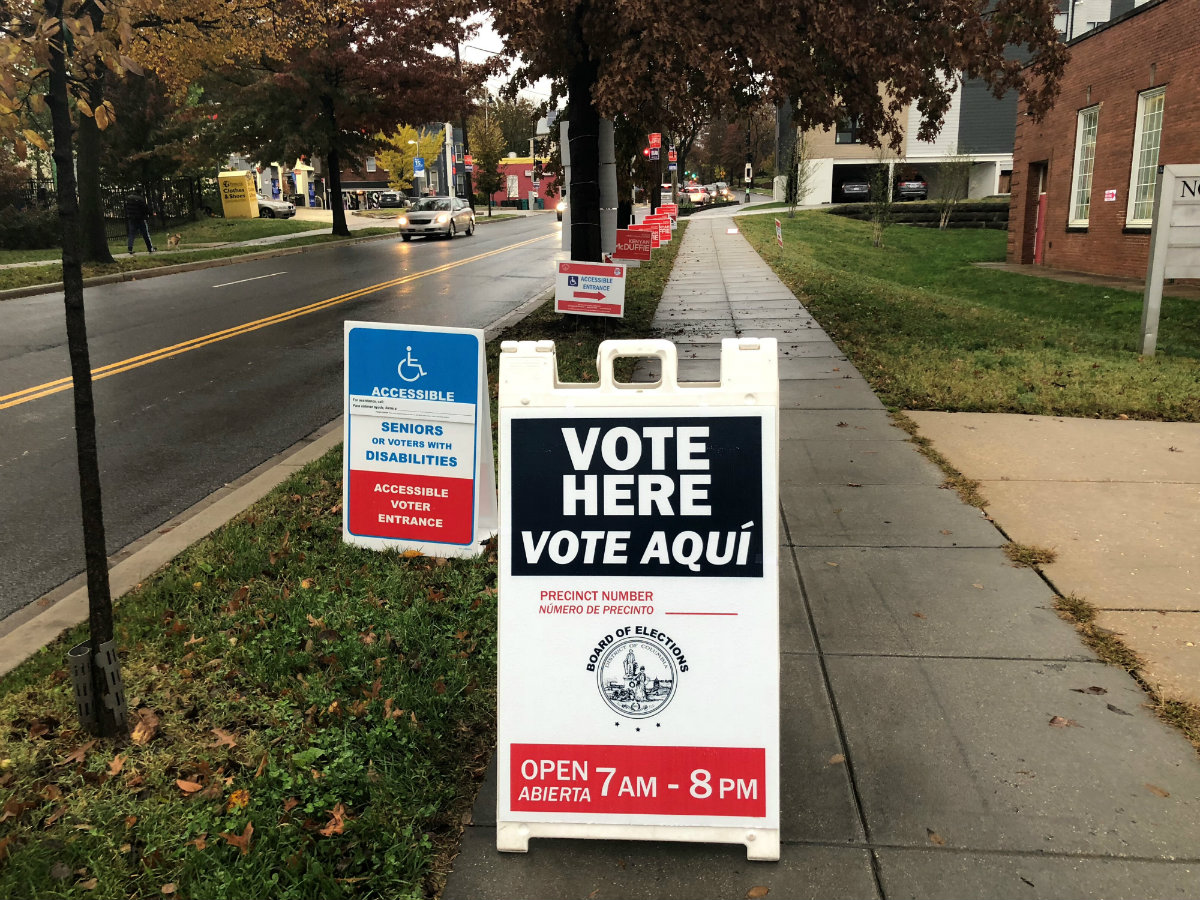
Ward 8 resident Juanita White, 84, says she won’t be sending an absentee ballot through the U.S. Postal Service this November. She’s worried her vote won’t be counted, especially because she’s had issues receiving mail in the past—like a doctor’s referral that she was supposed to receive several days ago.
Although White is in a high-risk age group for contracting coronavirus, she plans to show up to the polls to vote and volunteer with a local candidate. (She asked DCist not to name the candidate so that her perspective doesn’t seem reflective of that candidate and impact their election.)
If history is any indication, White may not be alone in her plans. During this year’s June primaries, Ward 8 was the only ward in the District to lean more towards traditional in-person voting than absentee ballots during the June primaries. The influx of people at voting sites led to a slew of problems, including long lines at the polls that led to inflated wait times. (Long lines were an issue across the city, as well).
Political strategists and campaign managers in the ward say they’re expecting high in-person turnout again, and they believe the Board of Elections needs to be better prepared this time around.
“The board [of Elections] will say, ‘We hope [issues during the June primary] encourages people to vote early.’ No, that’s not how it works,” says Chuck Thies, a Ward 7 political strategist and the campaign manager for Ward 7 Councilmember Vincent Gray. (Thies says his comments are not intended to represent Gray’s stance.)
Thies and others say the elections board should create a concerted public relations campaign to inform and update voters about voting and continue to strengthen voters’ trust, especially in Ward 8.
In June there were three polling sites in Ward 8. “As polls closed on Election Day, the line leading out of the Malcolm X opportunity center was more than 500 voters long. Most voters stayed and some were still voting well after midnight,” says Tom Lindenfeld, a staffer for Ward 8 Councilmember Trayon White’s campaign. Ward 8 Councilmember White told a Fox 5 reporter in June that the elections board “completely dropped the ball in so many areas.”
Juanita White says she agrees with that assessment. She volunteered with a candidate during the primaries and says she had to step in to help BOE staff who were disorganized. Elderly and disabled voters pulled up for curbside voting, but no one from the elections board was there to assist them, she says. Also, she says the board’s staff didn’t enforce social distancing.
Alice Miller, the Board of Elections’ executive director, says BOE staff verbally enforced social distancing and put up signs reminding people to social distance. Long lines in Ward 8 and across the city happened because residents didn’t take advantage of early voting, she says. In November, the BOE is increasing the number of curbside registration clerks at polls who can assist voters with issues that White described.
Still, Lindenfeld says he’s concerned about the potential for long wait times. He says lines in Ward 8 were long because voters didn’t receive their ballots in the mail due to inconsistent mail service, not because voters waited until Election Day. The elections board not only miscalculated logistics but ignored evidence that voters were not receiving their voter guides and absentee ballots, says Lindenfield.
Ahead of the primaries, in May, some Ward 8 residents decided to take legal action against the Board of Elections over an alleged lack of access to voting centers and issues with mail service.
Aristotle Theresa, an Anacostia-based civil rights attorney, represented two Ward 8 residents who sued the Board of Elections because they didn’t receive their voter guide in the mail, and one who said she never received her absentee ballot.
Theresa says he has 20 affidavits from Ward 8 residents who had spotty mail service and had not received a voter guide or absentee ballot. (As a Ward 8 resident himself, Theresa says his own influx of mail is inconsistent.)
The two residents Carnecia Robinson and Florence R. Barber, sued the elections board for violating the Voting Rights Act, as they alleged Black voters were disenfranchised by polling locations placed in gentrified or less populous neighborhoods.
The lawsuit against the board ended up being voluntarily withdrawn, says Theresa. “We could prove disparate impact and that Black Ward 8 residents would be impacted by limited voting sites and placement of voting sites. What wasn’t there was a history of government discrimination… It was just something that we were unable to prove because libraries [and] collections were closed due to COVID. [Those offices’ records] were very hard to access,” says Theresa.
But Theresa continues to believe that issues with USPS will make it difficult for people in communities east of the river to get their votes counted. Earlier this month, the U.S. Postal Service sent letters to D.C. and 46 states warning voters that absentee ballots may not arrive to the BOE in time to be counted this fall, according to the Washington Post.
“I wouldn’t rely on the Postal Service. I would definitely try to vote in person, and I would try to vote early,” says Theresa.
The BOE, for its part, acknowledges that there could be problems with mail service.
“We do realize that there are issues with the mail, and voters may not get their mail-in ballot… We encourage individuals to vote early,” says Miller. She also recommends that voters use BOE drop-boxes to cast their ballot, instead of USPS.
The BOE says it has also tried to be responsive to criticisms of its handling of the June election.
This November, there will be two early voting sites in Ward 8, as well as every other ward. There will also be drop boxes where people can drop their ballots off, a new development that wasn’t in place during the June primary.
In late July, the Board of Elections Chairman Michael Bennett sent a letter to D.C. Mayor Muriel Bowser committing to opening at least 80 polling locations throughout the District, and putting more in neighborhoods east of the Anacostia River. Since then, the number of polling places has increased from 80 to 90 voting sites throughout the District. (Voters can cast a ballot at any of the 90 polling locations, a change from previous elections where most voters use designated polling places associated with their home address.)
In Ward 8, 12 voting centers will be open, on par with the number of polling sites in other wards.
Theresa says the elections board seems responsive to residents’ concerns since the June primaries.
Miller says some polling sites for November elections were chosen based on recommendations from Advisory Neighborhood Commissions and community groups to build confidence in voters about the voting process.
Ward 8 Commissioner and Councilmember Trayon White’s campaign manager, Absalom Jordan, says he has to give the BOE credit for adding the polling site Councilmember White suggested. He says Councilmember White suggested Ferebee Hope Recreation Center, so that residents wouldn’t have to go to Barry Farm Recreation Center, and now Ferebee Hope will be open in November, as well as Barry Farm.
In anticipation of large turnouts at the polls, the elections board also plans to open super voting centers, including Omni Shoreham Hotel, Capital One Arena, and Washington Nationals Park, a historic first. (The Southeast Washington Nationals Park is located across the Anacostia River and nearby Ward 8 residents.)
Miller says the super voting centers will have significantly more poll workers, so that lines don’t become too long, and voters are processed more quickly. To ensure safety precautions during the pandemic, Miller says there will be signs at all polls to remind voters to social distance six feet apart, and masks will be provided if voters don’t have them. Masks are required at all polling locations. There will be hand sanitizer, the equipment will be wiped behind each voter who uses it, and even the “I Voted” stickers will be in sanitized bags, says Miller.
But Miller still emphasizes early voting.
“I would just suggest that anyone who plans to come to vote in person, that they plan to vote early,” says Miller. “I know voters want to show up at the polling sites, and certainly that’s understandable … Voters who wait until Election Day exercise that option, knowing that it may be a longer wait. The longer you wait, the longer you may wait.”
Still, the possibility of a long wait isn’t deterring Juanita White.
“We are showing up for change in the nation’s leadership, and we will have to be out there wearing masks and gloves at the polls,” she said. “We want our community to be represented in those political seats. That’s why we’re showing up.”
This story was updated with the correct spelling of Tom Lindenfeld’s name and his correct position with Councilmember Trayon White’s campaign.