Margaret Barthel
A police officer has filed a complaint against the Metropolitan Police Department, alleging professional retaliation for speaking up about discriminatory policing practices.
The complaint alleges that Sgt. Charlotte Djossou, who’s been on the force since 2004, faced professional retaliation — mainly a lost job opportunity, poor performance evaluations, exclusion from meetings, poorly scheduled hours, and a transfer to a different division — because she reported abuses within MPD.
Those abuses included supervisors in the narcotics division instructing officers to target young Black men in low-income neighborhoods for “jump outs,” searches without probable cause; directing officers to make felony arrests; and a habit of reclassifying felonies as misdemeanors in order to make crime statistics look good.
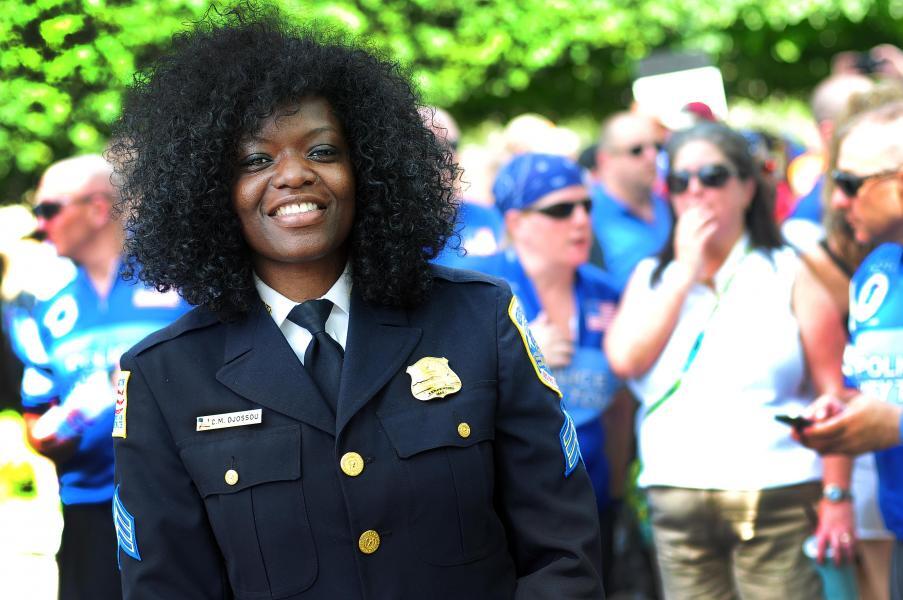
The lawsuit suggests that Djossou is still feeling the professional repercussions of speaking out, most recently in the form of a citation for a miscommunication during a roll call in August, which Djossou says she wasn’t present for in the first place.
A D.C. police spokesman said the department could not comment on pending litigation.
The local branch of the ACLU applauded Djossou’s lawsuit.
“Both the race-based tactics she opposed within D.C. Police Department and MPD’s subsequent retaliation against Sgt. Djossou demonstrate the urgent need for top-to-bottom reform of MPD’s discriminatory tactics and toxic culture,” wrote ACLU-DC Legal Director Scott Michelman in a series of tweets. “We salute Sgt. Djossou’s courageous stand in repeatedly calling out unlawful and discriminatory policing in MPD.”
Djossou said she’d reported problems to her superiors in MPD in 2015, 2018, and 2019. She also testified in front of the D.C. Council’s Committee on the Judiciary and Public Safety in January.
Djossou’s complaint details several notable alleged incidents.
In 2018, she reported that her superior officer in the narcotics division “openly stated ‘we want felonies,’” which the complaint suggests is “due to the fact that [narcotics] officers are financially incentivized to increase these felony numbers through receiving additional overtime pay due to having to testify in court for felony cases, and through MPD’s promotional system which rewarded officers who handled more important crimes.”
Also in 2018, Djossou reported to Investigative Services Bureau Assistant Chief Robert Contee that a supervisor had told officers “to target large groups of men in poverty stricken areas and to search them without probable cause. He also instructed them to violate established Body Worn Camera (BWC) directives by purposely delaying turning on the BWC until after the initiation of the search,” according to the lawsuit.
After her report to Contee, Djossou’s complaint says she was transferred away from the narcotics division to a job patrolling the Fourth District, instead of a job in the Investigative Services Bureau, which she says she was promised by then-Assistant Chief Peter Newsham in 2014. Newsham now leads MPD.
Still, in 2019, Djossou continued reporting practices that concerned her. This time, she spoke up about a practice pushed by superior officers to downgrade thefts to misdemeanors, “solely because the theft could not be solved, regardless of the dollar value of what was stolen,” her lawsuit reads.
As a result of her reporting, 100 theft incidents were upgraded back to felonies. But she said she faced a poor performance evaluation following her report.
MPD has long faced criticism over-aggressive policing of Black Washingtonians and use of force, most recently during racial justice protests and in the police killing of teenager Deon Kay earlier this summer. Djossou’s lawsuit points to recent reporting about racial discrimination of gun crime enforcement to back up her allegations.
“This targeting of Blacks is part of the same pattern and practice of targeting Blacks that Sergeant Djossou protested when she challenged the use of ‘jump out’ arrests,” her complaint reads.
Djossou is seeking compensatory damages and an injunction that will promote her to a position as a Detective-Sergeant, the job she says she lost due to retaliation.