 Jordan Pascale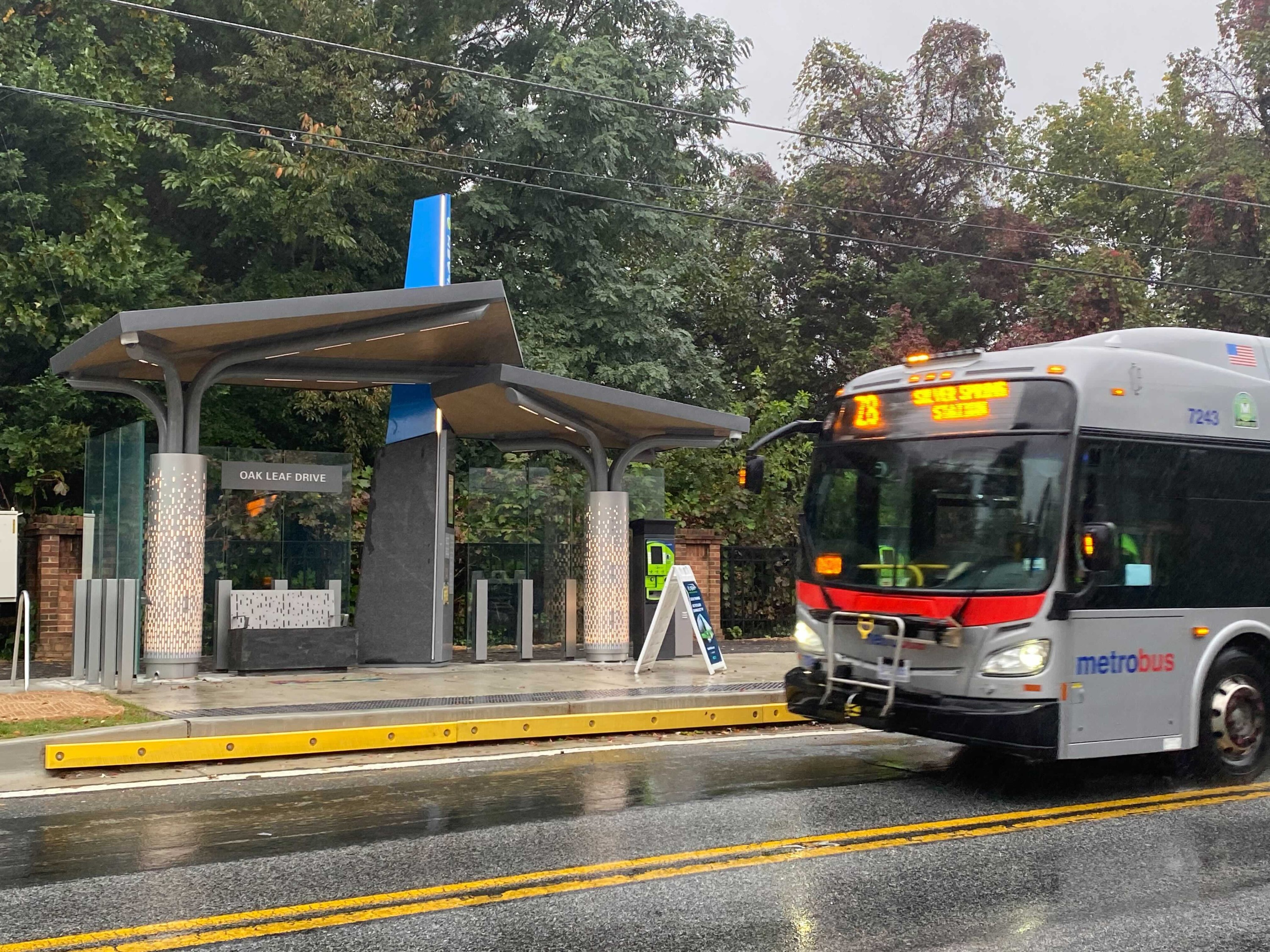
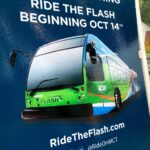
On Wednesday Montgomery County is launching its first Bus Rapid Transit line, a type of bus service that transit experts describe as “rail service but on wheels.”
The Flash BRT runs on one of the region’s busiest transit corridors, a 14-mile stretch down Route 29/Colesville Road/Columbia Pike between Burtonsville and Silver Spring.
County Executive Marc Elrich said the project will help address congestion and enable people get to work more quickly and easily.
“I’m most excited about bringing high-quality transit service to the east side of the County,” said Elrich. “We have a huge population that has a very difficult time getting to work if they don’t drive.
Here’s all you need to know for Wednesday’s launch.
What Is A Bus Rapid Transit Line?
Bus Rapid Transit is a higher-quality bus service that has features that speed up the trip, compared to regular buses.
High-frequency service (every 15 minutes or less) and dedicated right of way are the two most important features of BRT systems, says Robert Puentes, CEO of the non-profit think tank Eno Center for Transportation. BRT has seen success mostly in Latin American countries, but also in Cleveland’s HealthLine and Hartford’s CTfastrak.
The idea is to create a reliable trip that takes the same time or is faster than driving in a car.
“Congestion is one of the key criteria that riders might consider,” Puentes says. “If the bus is stuck in traffic along with regular traffic, it’s not really much of an advantage.
“So the best systems are those that have built and constructed lanes specifically for buses so that they can be as efficient as possible.”
The Flash will mostly be in mixed traffic in the southern portion of the route. It can use existing bus-on-shoulder lanes on Route 29 in the northern section of the corridor for a few miles.
The county says the BRT could shave about 16 minutes off a trip, which is 30% faster than current bus routes. That’s because of features that include:
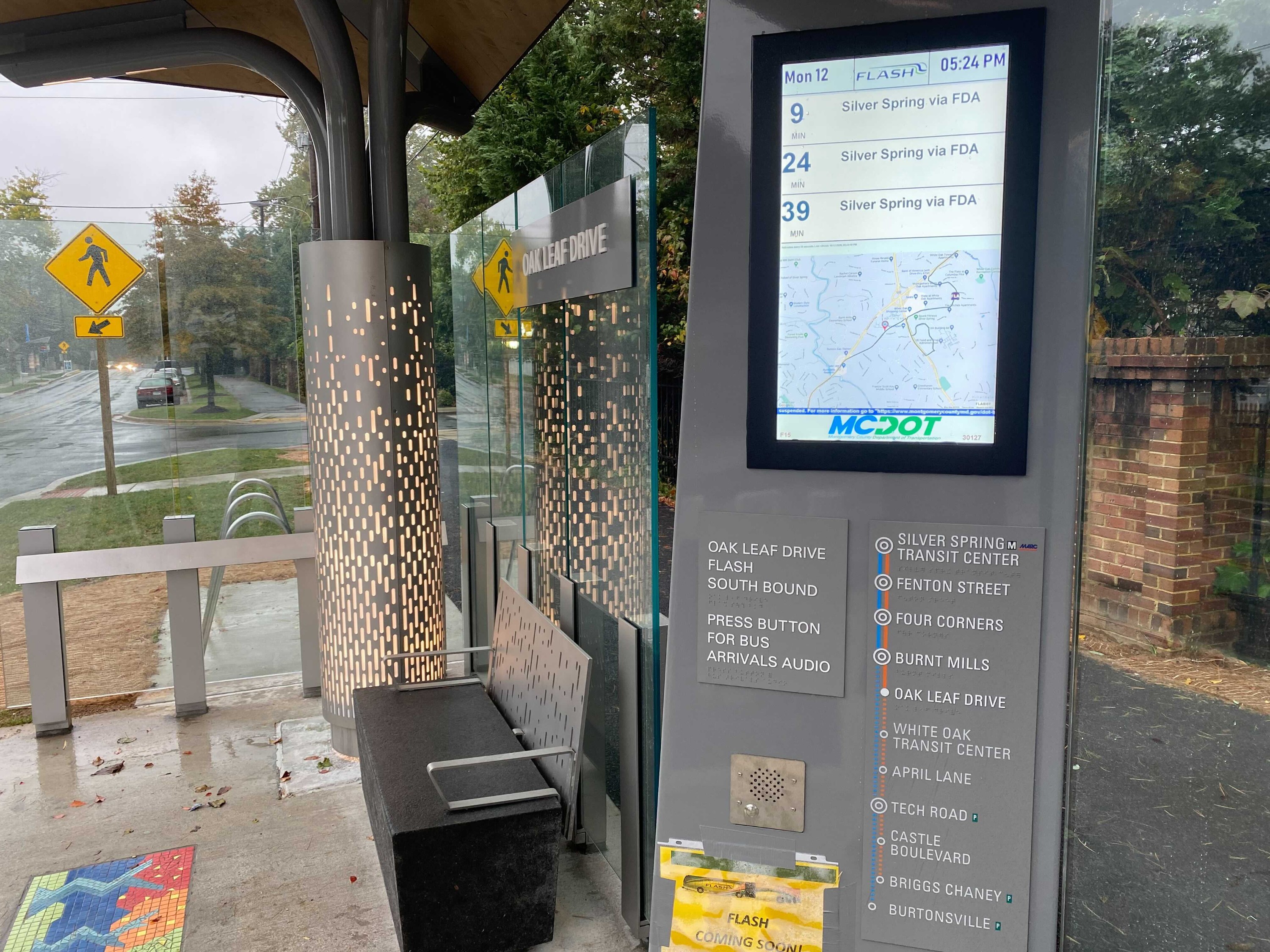
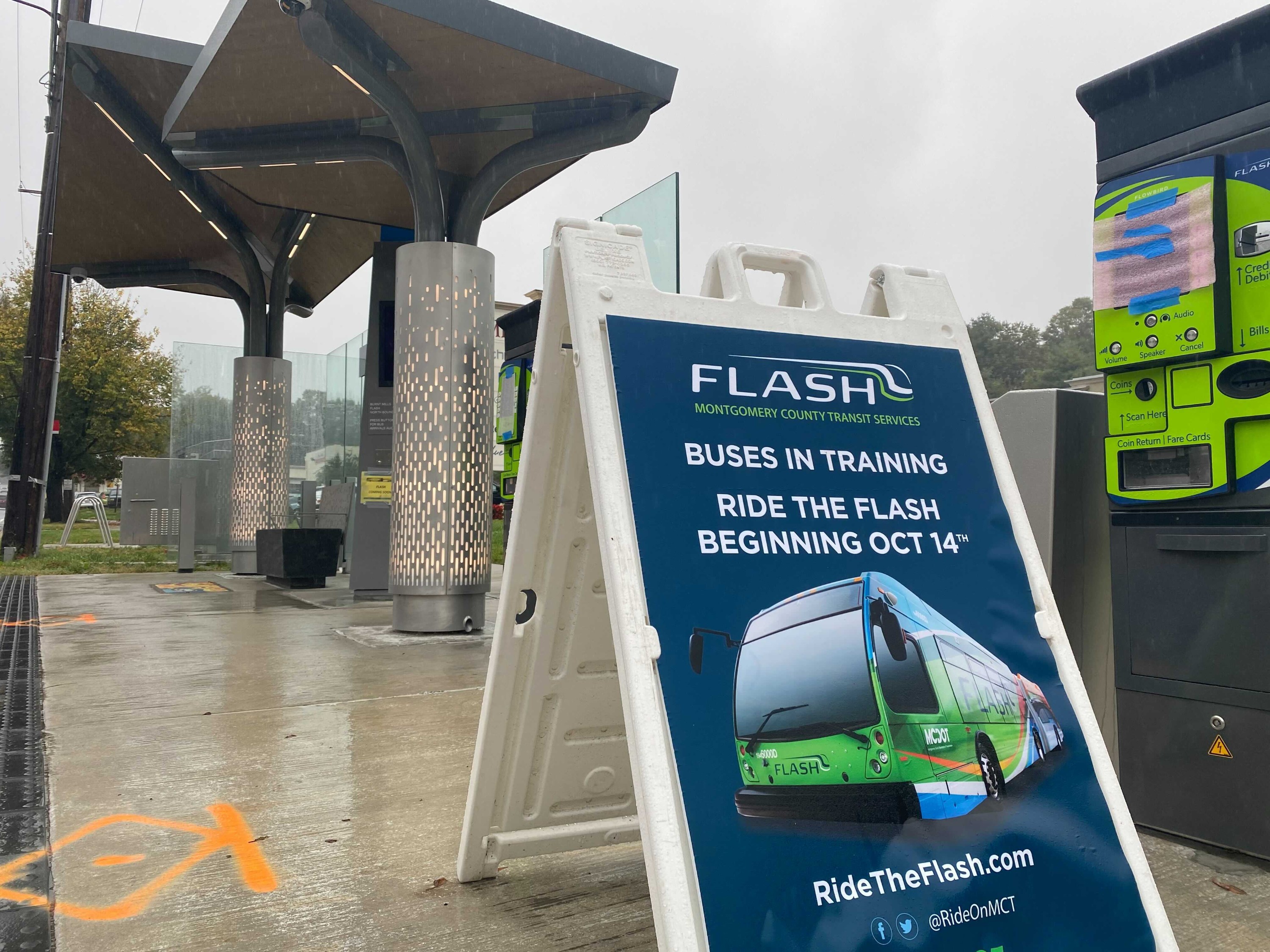
- Off-board fare collection: Riders pay at kiosks at the stations. That prevents slowdowns from fumbling with change or SmarTrip cards on board.
- Priority at intersections: The Flash will have dedicated lights to bypass other vehicles at more than a dozen locations.
- Platform-level boarding: This makes the system more accessible for people who have trouble with steps and makes it easier and faster to board with carts, bikes and wheelchairs.
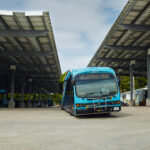
Upgraded vehicles: Flash will have longer, articulated buses that can hold 80-90 passengers. You can board at any of the three doors (except during the pandemic when you can enter only in the back two doors), which will make boarding faster. The buses will be the first in the region to have an automated system to secure wheelchairs. The bus is also equipped with a new pedestrian detection system called Mobileye that will alert drivers.
- Upgraded bus stops: The stops have artsy metal trees that provide some shelter from the weather. It also has real-time arrival information and kiosks to buy your ticket. Wi-Fi and USB charging is available at the stops and on the buses.
- Prominent brand or identity: The Flash is differently-branded from the rest of the county’s Ride On system, and has far less stopping than buses on regular routes.
There aren’t many Bus Rapid Transit lines in the region, but think of Metroway in Alexandria and Arlington, which uses a dedicated right of way. Richmond, Virginia launched the Pulse BRT in 2018.
Where Does The Flash Go And When Does It Operate?
The Flash has two routes, Blue and Orange, that mostly follow the same path. The service will run from 5 a.m. to 12 a.m. every day.
The Orange Route operates every 15 minutes. Stations don’t go as far north as the Blue Route, and it instead ventures a bit off the path to hit shopping centers, neighborhoods and the FDA at certain times.
Orange stations include:
- Briggs Chaney
- Castle Boulevard
- Tech Road
- April Lane
- White Oak Transit Center
- FDA
- Oak Leaf Drive
- Burnt Mills
- Four Corners
- Fenton Street
- Silver Spring Transit Center
The Blue Route operates every 15 minutes and only during weekday rush hours, 5:30 – 8:30 a.m. and 3:30 – 7:30 p.m. It sticks to Colesville Road/Columbia Pike.
Blue stations include:
- Burtonsville
- Tech Road
- Burnt Mills
- Four Corners
- Fenton Street
- Silver Spring Transit Center
Where routes overlap, service is every 7 to 8 minutes on weekdays during rush hour.
Who Will It Benefit?
Transportation Committee chair Tom Hucker says the transit upgrade will benefit many who need it the most.
“This is gonna address a long-standing transportation equity inequity,” Hucker says, recalling long lost plans to create rail transit up to Burtonsville. “Those communities have gotten denser and denser for years, and yet they are not served by transit and they really need it more than most areas of Montgomery County.
“Forty percent of the residents [up the corridor] don’t have access to a car. It’s lower-income individuals. There’s a heavy immigrant population. And many of them have been dependent on our ride on buses up and down the 29 Corridor for years. They really do deserve a much higher quality product. And now they’re gonna be able to get from the affordable housing that exists around Burtonsville all the way down to the transit center to connect to jobs in Silver Spring and jobs in D.C.”
It will also provide a faster connection to other bus routes, Metro’s Red Line and, eventually, the Purple Line light rail.
MCDOT head Chris Conklin also says the new bus line could spur new development along the route. There’s room for redevelopment around the FDA’s facility and a new medical center, which recently opened about a mile away from the Tech Road stop.
When Can I Ride?
Wednesday starting at noon. County officials are holding a ribbon-cutting event at 10:30 a.m.
What Does A Flash Ride Cost?
Right now bus rides are free because of the pandemic. Riders have been boarding in the back of the bus to protect bus operators. But when fares do return, Flash will cost $2 per ride, the same as any Montgomery County Ride On bus fare. All discounted fares (student, senior, SmarTrip, etc.) apply.
What Did The Project Cost?
The capital work of construction and new buses cost about $40 million, the county says. About $10 million came from federal grants.
Why Is MoCo Starting More Transit Service When Ridership Is At Historic Lows?
Unfortunately, it’s just bad timing. The project began years ago with design starting in 2017, construction beginning in 2018 and training in 2020.
Flash will still operate at its full service when it opens at noon on Wednesday, though other Ride On service remains at about 80% of pre-pandemic levels.
Conklin said the system was set to open this summer, but the pandemic led to delays.
As for ridership, he says the communities along the route have continued to use transit throughout the pandemic.
“[The Flash] benefits these communities in the pandemic as much as they do in normal times,” Conklin said. “So we decided it’s the right time to launch.”
MoCo Seeks To Launch Two More BRT Lines
The county is planning on two more BRT lines on the west side of the county along MD 355/Rockville Pike and MD 586/Veirs Mill Road. The projects are in the design phase and have no funding identified, but officials hope they could open in three to five years. The Rockville Pike route would be 22 miles from Bethesda to Clarksville. The Veirs Mill Road route would serve Wheaton to Montgomery College’s campus in Rockville.
Montgomery County is also discussing the idea of extending the Route 29 Flash into Howard County with the neighboring officials.
“Each [segment] would work on their own, but they are stronger as a network,” Conklin said.
Puentes says the county’s endeavors are great experiments for BRT in the region.
“While it would be great to have gold-rated BRT everywhere, it’s good to see what works and what doesn’t work,” Puentes said. “This will have an impact not just for the county, but for the whole region as D.C. is planning a busway through K Street.
“You hope they learn from Montgomery County and the Metroway in Alexandria.”
Puentes says BRT is catching steam in America because you can build it faster and cheaper than rail transit. But he says BRT must be built the right way. Many places are building what he calls BRT “lite” without a dedicated right of way or signal priority that really creates the benefit for riders.
“You want to build on the best example, not the cheapest,” he said.