Ally Schweitzer
D.C. Mayor Muriel Bowser is calling on the U.S. Department of Homeland Security and other federal agencies to drastically scale up security in the District ahead of the presidential inauguration on Jan. 20. But the mayor has not asked to close the inauguration to the public entirely.
In a Jan. 9 letter to Homeland Security Acting Secretary Chad Wolf, Bowser urged federal authorities to enact additional security measures ahead of the ceremony in less than two weeks, saying the event “will require a very different approach than previous inaugurations, given the chaos, injury and death experienced at the United States Capitol during the insurrection.”
Asked by a reporter during a Monday press conference whether she supports closing the inauguration to the public, Bowser responded that she did not. “The transition of power happens when Joe Biden and Kamala Harris are sworn in, and that event, in my view, should be public,” Bowser said.
Instead, the mayor called for Homeland Security to work with other federal agencies to establish a “security and federal force deployment plan for all federal property” so Metropolitan Police Department officers can focus on policing the city before and during the inaugural ceremony. Bowser has also asked the president to enact a pre-emergency declaration for D.C. — similar to one that was granted ahead of President Barack Obama’s first inauguration in 2009 — among other measures.
The goal is to prevent “a repeat of the violent insurrection experienced at the Capitol” on Jan. 6, the mayor said Monday.
In her letter, the mayor asked Homeland Security to extend the National Special Security Event (NSSE) period overseen by the Secret Service — which manages inaugural security — from three days to 14 days. Lengthening the special period from Jan. 11 to Jan. 24 “will allow for better Federal and District government interagency preparation for the inauguration, given the new threats from insurgent acts of domestic terrorists,” the mayor wrote.
The agency partially fulfilled that request Monday. In a statement, Wolf said he instructed the Secret Service to begin the NSSE on Jan. 13 instead of Jan. 19 at the recommendation of Secret Service Director James Murray.
In a request that may prompt controversy, the mayor also asked the Department of Interior to cancel any and all public gathering permits that have been submitted for federal property between Jan. 11 and Jan. 24.
As of Saturday, the National Park Service had received seven applications for public demonstrations in downtown Washington. A list of permit applications reviewed by DCist/WAMU shows that only one application is clearly an event catering to supporters of President Donald Trump, with 300 attendees expected. The permit applicant, “Let America Hear Us, Roar For Trump”, describes the event as a “1st Amendment Rights Gathering.”
Canceling permits for First Amendment demonstrations could spark lawsuits alleging infringements on free speech.
Permits for public demonstrations don’t capture unofficial pro-Trump events in the works in D.C. and elsewhere. Researchers at Elon University, the Anti-Defamation League (ADL) and other organizations have uncovered chats and flyers on right-wing channels detailing an “armed march” in D.C. and on state capitols on Jan. 17, the Sunday before the inauguration.
State leaders across the country are starting to brace for possible violence in the coming days. Pro-Trump demonstrators gathered Saturday outside of the Kentucky Capitol building for a “patriot rally.” Some attendees were heavily armed and at least one demonstrator brought zip ties, which can be used as handcuffs.
The state’s governor tweeted, “Three days after domestic terrorists attacked our U.S. Capitol, there was a militia rally in Frankfort. They brought zip ties. We will not be intimidated.” No violence was reported at the rally in the Kentucky capital.
Lawmakers in Virginia are scheduled to convene in Richmond this week for a 46-day legislative session. Virginia state senators are meeting in person at the Science Museum of Virginia near the state’s capitol; the House of Delegates plans to meet remotely. In Maryland, lawmakers in both the state Senate and House of Delegates plan to meet in person for a 90-day session, with some proceedings online, unless a spike in COVID-19 cases forces more meetings to be conducted remotely. Maryland and Virginia lawmakers have not made public-facing changes to security protocols for their legislative bodies in the days since last week’s insurrection.
Talk of a “Million Militia March” on Inauguration Day has also been circulating online.
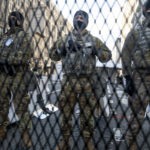
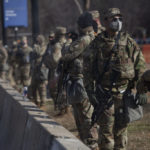
In the District, roughly 6,200 National Guard troops from Maryland, Pennsylvania, New York and Virginia have been dispatched to the city ahead of the inauguration. Bowser has urged Congress to transfer authority over the D.C. National Guard from President Donald Trump’s office to her office in case additional reinforcement is needed quickly.
In an interview with the Washington Post, ex-Capitol Police chief Steven Sund — who announced his resignation last week— said his requests to put the D.C. National Guard on standby ahead of the Jan. 6 demonstration were repeatedly rebuffed by House and Senate security officials.
The mayor stressed during Monday’s press conference that both the city and federal agencies need to take seriously the potential for more violence.
“People coming to demonstrate peacefully are very different than the people we saw storm the Capitol the other day. I think that it will be shown that those people were organized, trained people who went into that building,” Bower said. “This inaugural planning period has to be very different from all the others.”
This story was updated to include an announcement from the U.S. Department of Homeland Security that the agency will extend the National Special Security Event (NSSE) for the 2021 inauguration.