Colleen Grablick
After COVID-19 metrics soared to record-setting levels in a post-holiday spike earlier this month, average daily case rates have declined in recent days. Still, most metrics remain well above those seen during the spring peak, and experts have warned against growing complacent.
The average daily case counts per 100,000 residents in D.C. and Maryland have dropped by 26% in the past week, according to the Washington Post’s regional coronavirus tracker, and in Virginia, the rolling average of daily new cases has declined by about 12%, after climbing to an all-time high last Sunday.
The local numbers mirror trends seen across the country. Anthony Fauci, now President Joe Biden’s chief medical adviser for Covid-19, said Thursday that cases nationally may be “plateauing.” But it’s not clear if the country has reached a new peak or if this is a temporary reprieve, and Fauci warned Americans to stay cautious as new variants of the virus crop up. Other experts have suggested that while the country may have made it through January’s surge, the spread of variants could outpace vaccine distribution, causing yet another peak in the coming months.
The slight declines in COVID-19 metrics this week comes as officials across the D.C. region forge ahead with vaccine distribution — albeit with hiccups and logistical snafus.
Maryland Gov. Larry Hogan announced that the state would begin vaccinating residents ages 65 to 74 on this coming Monday. But both Prince George’s and Montgomery counties have hit snags in their distribution plans: Montgomery County has not received the adequate allotment doses it needs from the state and officials decided against moving to phase 1B with the rest of the state. In Prince George’s County, distribution was originally slowed by a staff shortage, and internet accessibility has created challenges for seniors seeking to book appointments online, according to County Executive Angela Alsobrooks.
Virginia has faced criticism for its sluggish rollout, administering only approximately 400,000 doses of the more than one million doses it received from the federal government. Governor Ralph Northam defended the state’s efforts on the Kojo Nnamdi Show on Friday. “As far as the vaccination rate, we’re doing very well, especially compared to other states per population, how many vaccinations we’re giving,” he said. “It’s going to be supply dependent, but we’re going to get there.”
And D.C. is grappling with equitable distribution as it attempts to move through its vaccination phases with demand far out pacing the city’s federal supply. On Monday, the city will move into its next phase of distribution, administering doses to police officers and public and private school staff that are working in person.
While last week week’s case counts point in a more positive direction for the region, death and hospitalization numbers continue to underscore the urgency of vaccine rollouts and the severity of the pandemic in the region.
The District
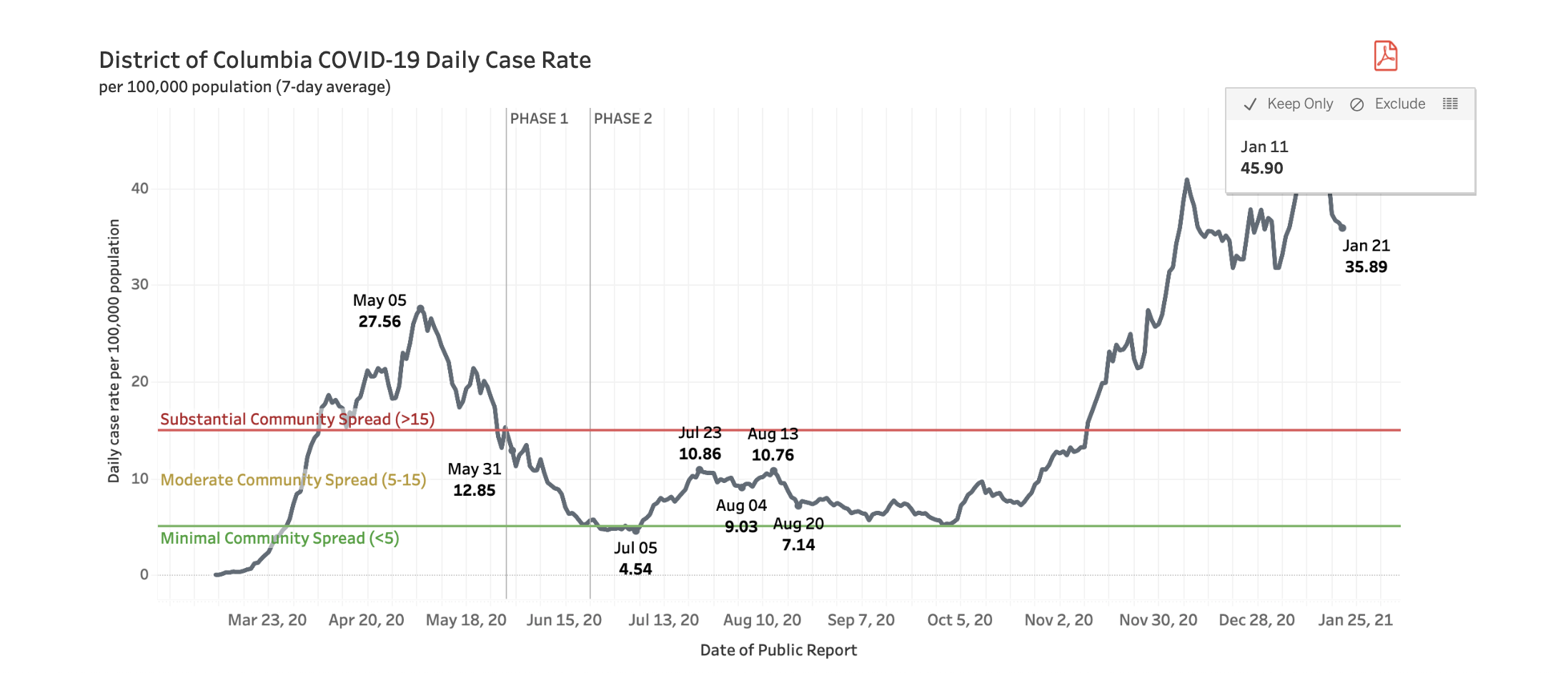
The daily case rate in D.C. has seen a marked decline from a new peak set on January 1, even as it remains well above the height of the spring numbers.
The city’s health agency considers any rate above 15 to indicate “substantial” community spread, with the goal of bringing the metric below 5. On January 11, that figure nearly hit 46, the highest rate of the pandemic. The previous peak was set in May: 27.56. Tat figure has now dropped to 35.89.
Similarly, the average positivity rate, which measures the number of positive cases out of total tests administered, reached an all-time high of 6.9% on Jan. 10. It dropped down to 5% as of Jan. 19. The World Health Organization recommends that jurisdictions achieve positivity rates below 5% for reopening. D.C. Mayor Muriel Bowser temporarily paused indoor dining and museum operations on Dec. 23, but restaurants were allowed to reopen for limited capacity indoor dining on Friday.
But the monthly death toll has increased: 78 District residents have died from the virus over the past three weeks. By this time in December, the city had recorded 61 deaths. Experts have said that a nationwide decline in deaths could soon follow the decline in cases, though both may remain high for many weeks to come. During previous peaks, a rise in deaths often lagged behind the spike in cases, as those who developed the virus fell increasingly ill in the days and weeks following their diagnoses.
And the percentage of COVID-19 hospitalizations in D.C. is considered to be an “insufficient capacity” at 12.9%, but it has decreased slightly since reaching a new peak at 13.5% earlier this month.
Maryland
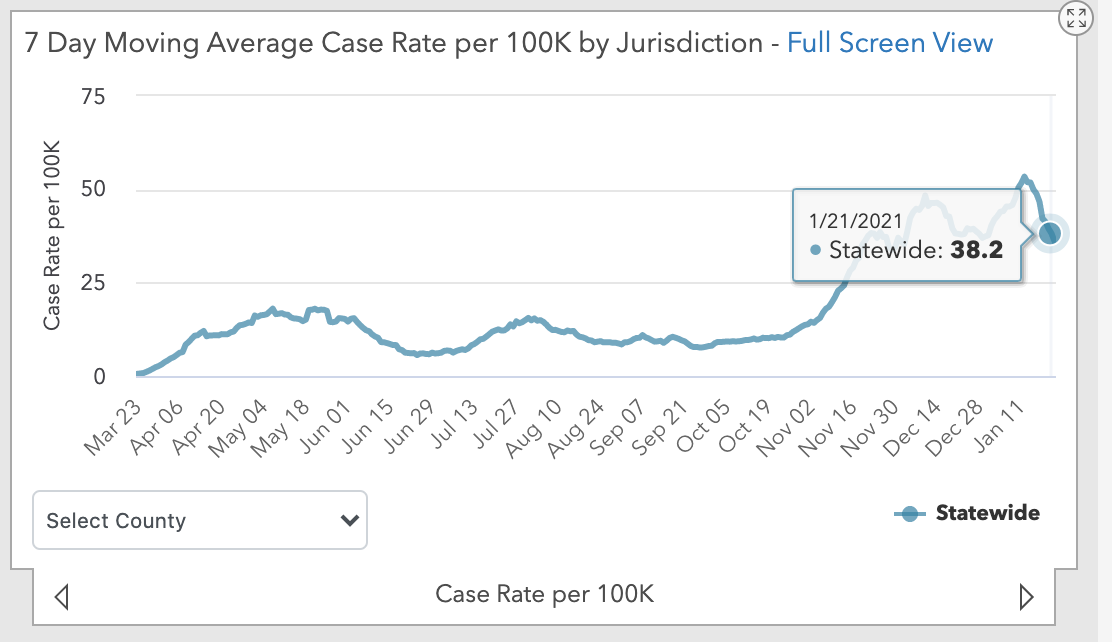
In Maryland, one of the 43 states where COVID-19 cases are high but going down according to the New York Times, the rolling average of new daily cases has been declining since Jan. 11, when that metric reached an all-time high of 3,228 average new cases a day. As of Jan 23., that number declined to 2,182.
The state’s daily case rate per 100,000 residents also dropped to 36 as of Saturday, after setting a record-high rate of 52 nearly two weeks ago. In the populous D.C. suburbs of Prince George’s and Montgomery counties — the two jurisdictions with the highest number of total recorded cases in the state — case rates have been similarly dropping over the past two weeks.
The state’s average positivity rate, which crept up over 9% in the first week of January, has decreased to 7.4% as of Jan. 22 — a number not recorded since late December, but similar to rates the state saw during the initial surge last spring. (Staring in June and throughout most of the summer, Maryland had achieved a positivity rate consistently at or below 5%.)
Still, even as hospitalizations from the virus in Maryland declined slightly over the past week, they remain higher than at any other point during the pandemic. On Saturday, a total of 1,717 people in Maryland were hospitalized at the virus, a number last recorded on Dec. 22. (The total number of hospitalized COVID-19 patients set a record of 1,952 on Jan. 12.)
Deaths from the virus, which increased significantly over the month of December, appear to have plateaued: throughout the month of January, the state’s average daily death toll has hovered around 40 people per day.
Virginia
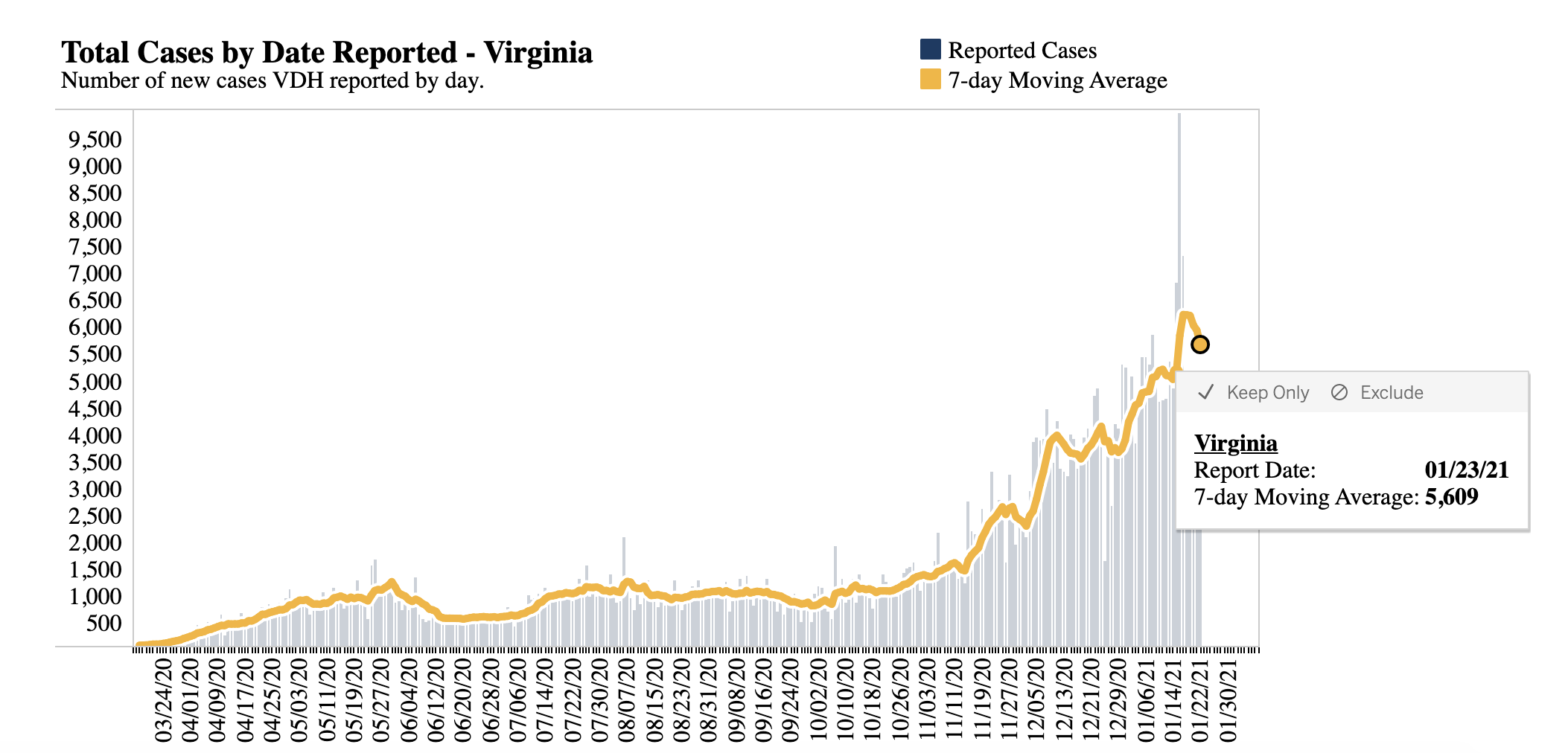
In Virginia, which recorded a staggering 10,000 new COVID-19 cases in a single day last Sunday, the rolling average of new cases has decreased over the past week.
The commonwealth recorded a seven-day daily case average of 5,609 on Saturday — still nearly triple the average seen during the spring peak. The average rate of new cases per 100,000 residents is now 67 — much higher than the rates of neighboring D.C. and Maryland. More optimistically, the commonwealth’s positivity rate has decreased to 12.8% this month, after peaking at 17% in the first days of the year.
While cases have dropped in Northern Virginia after the region recorded more than 3,500 cases in a single day on Jan. 17, the daily average of new cases is still significantly higher than ever before, recording an average daily cases 1,434 on Saturday.
Other metrics underscore the severity of the pandemic in the commonwealth. Hospitalizations have fallen over the past week, after peaking on Jan. 17 but remain higher than ever before. And death counts continue to climb in Virginia, which reported an additional 77 deaths on Saturday. The average number of deaths recorded on a single day is now 53, compared to 37 at the beginning of the month.