Colleen Grablick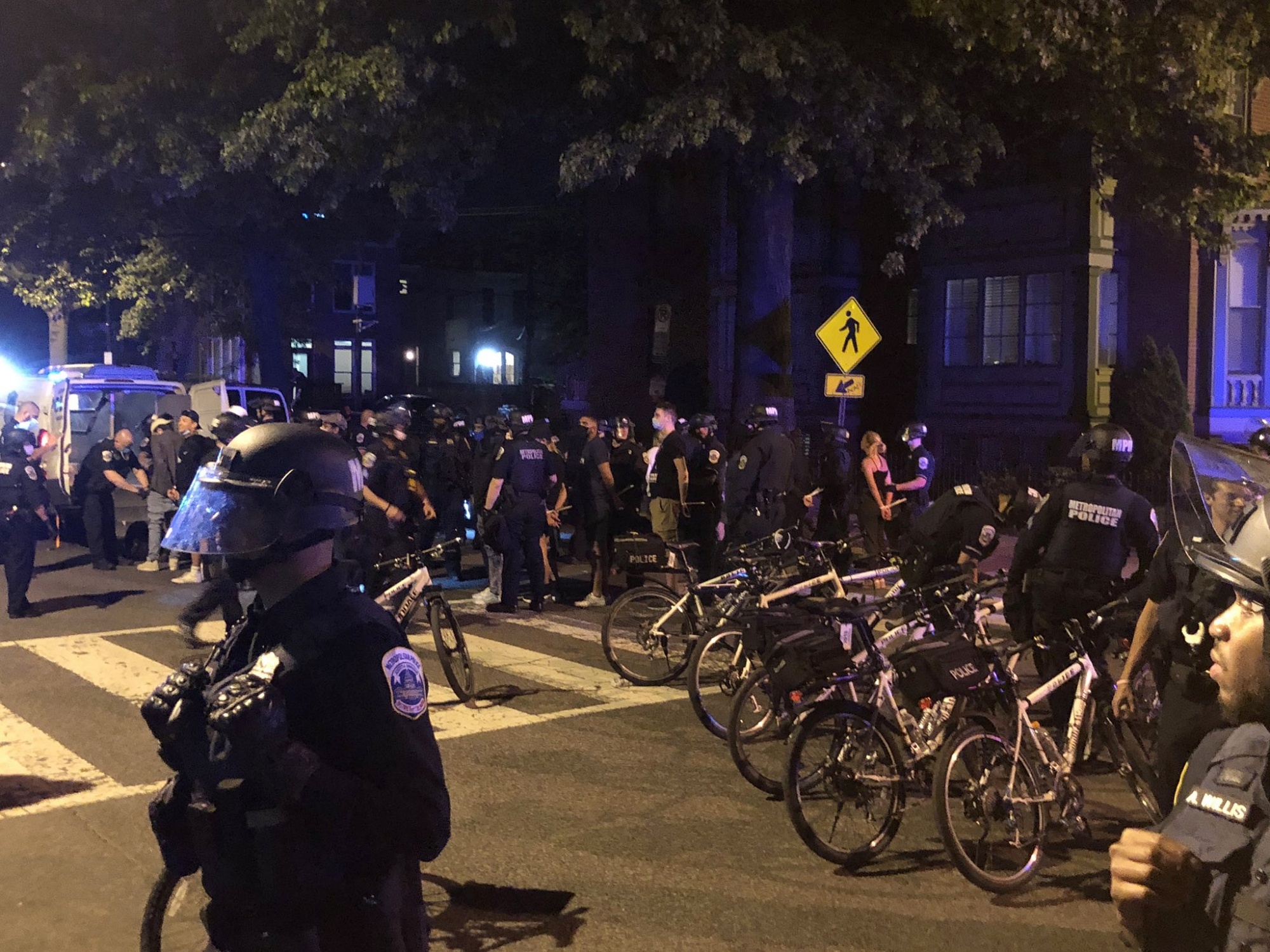
The D.C. chapter of the ACLU is calling on the D.C. Council to modify the city’s First Amendment Assembly laws, citing alleged misconduct by D.C. Police during a mass arrest on Swann Street in June 2020.
On Tuesday, the ACLU released an 18-page report on the Metropolitan Police Department’s treatment of protesters on Swann Street, alleging that police kettled demonstrators without evidence that they had been violent, and subsequently mistreated the nearly 200 individuals that were arrested during the kettle.
The organization is now urging the council to modify how law enforcement conducts mass arrests during demonstrations that violate curfews—specifically, that MPD should be required to try to disperse unlawful but peaceful assemblies before conducting arrests. The ACLU is also asking the council to further investigate the department’s justification for kettling and arresting protesters in June.
The report, based on 50 eyewitness interviews, comes ahead of the D.C. Council’s public safety oversight hearing on Thursday.
“As the Council continues its oversight of MPD and MPD conducts its own internal review, we offer this report of MPD’s action on Swann Street in June and their effects on D.C. residents and workers,” reads the report. “The Council should consider whether D.C. law or policy should be changed to promote a more restrained police response to peaceful protests in the District.”
On June 1, hours after law enforcement forcibly cleared protesters from Lafayette Square so former president Donald Trump could pose for a photo in front of St. John’s Episcopal Church, a crowd of demonstrators ended up on Swann Street in Dupont, coming from multiple directions and protests in other parts of the city. Earlier that day, D.C. Mayor Muriel Bowser instituted a city-wide curfew that was to go into effect at 7 p.m, after protests the night before resulted in clashes with police.
As the ACLU report recounts — and as eyewitnesses told DCist over the summer — D.C. police corralled the group on a one-way stretch of Swann Street between 14th and 15th street NW, and blocked two alleys connecting the street, preventing protesters from leaving. According to the report, no protesters heard orders to disperse before MPD encircled the area.
Former D.C. Police Chief Peter Newsham said at the time that officers had seen protesters behaving violently, throwing “projectiles,” and setting a city police car on fire, prompting the large police presence that surrounded the group. The group was also in violation of the city curfew, another justification Newsham cited for the mass arrests. According to D.C. law, tactics like kettling are illegal during First Amendment demonstrations unless “there is probable cause to believe that a significant number or percentage of the persons located in the area or zone have committed unlawful acts.”
Protesters claim that they did not set a police car set on fire, nor commit any acts of violence, vandalism, or looting. The report states that for about 30 minutes after the kettle began, the “situation remained largely static,” as more and more officers began to block exits, and denied protesters who asked to go home.
“At this point in the evening, MPD faced a choice,” reads the reports. “Having now trapped the protestors on Swann Street, it could have ordered them to disperse—allowing them to leave the block one-by-one or in small groups. Instead, MPD decided to arrest all of the protestors, to deploy force, and to charge the protestors with having violated the 7:00 p.m. curfew order.”
Around 9:30 p.m., when police began advancing towards the protesters with force and pepper spray, dozens took shelter in nearby homes to avoid arrest. One resident, Rahul Dubey, was named one of TIME’s Heroes of 2020 for sheltering more than 50 protesters during the kettle. According protesters interviewed by the ACLU, “MPD officers used what appeared to be ruses to enter the Swann Street homes, evidently so they could arrest protesters for curfew violations.”
The D.C. police department did not immediately return DCist’s request for comment on the allegations raised in the ACLU report. The D.C. Police Union said in a statement that the report is “completely one-sided and has no basis in reality.”
“Once again, the ACLU has left out all the pertinent facts in order to advance their anti-police agenda,” reads the union’s statement. “The incident on Swann Street involved violent and riotous activity including multiple cars set afire, bricks thrown at officers, and several residents who called 911 to report that their front doors were being kicked in by the rioters. None of this is mentioned in the report.”
The ACLU responded to the union’s statement on Wednesday, saying its “allegations are not supported by our interviews or by the police department’s own arresting and changing decisions. If the union has other information, including body-worn camera footage, that would support their assertions of a ‘violent riot,’ we hope they will share it with the public.”
By the end of the night, 194 people were arrested on Swann Street on charges of violating curfew and civil disobedience — many held in zip ties until around 6:00 a.m. the following morning, per the report. Some of those arrested stated that officers pulled down their face masks to take their photograph, and individuals had difficulty replacing their masks with their hands zip-tied, the report says. Other witnesses reported not being allowed to use the bathroom or drink water while they were detained over night, and that many individuals were kept in areas where social distancing was not possible. (In June, a D.C. Police spokesperson told DCist that those arrested were “kept in a large room with areas designated for social distancing.”)
“Many protesters we interviewed reported that the night of June 1 left a searing impression on them,” the report states. “Some reported being bruised from the zip ties, having scrapes and other injuries from being pushed by riot gear, and continuing to have irritated eyes from the pepper spray. A greater number of the protestors we interviewed focused on the emotional effects of the evening. Many described their experience as traumatic, frightening, or humiliating. Protestors likewise reported that their experiences caused them to further distrust the police’s discretion and use of force, and led them to worry about COVID-19 exposure.”
In addition to the call for a modification of First Amendment assembly laws, the ACLU’s report includes four lines of questioning for the council to consider during its upcoming oversight hearing: the D.C. Police’s decision to kettle and arrest demonstrators before allowing them to disperse, how the department verified that the protest could turn violent, the alleged lack of COVID-19 safety precautions during arrests, and the police’s adherence to proper protocols for fair treatment during mass arrests.
“On June 1, 2020, peaceful protesters took to the streets of the District to protest police overreach and abuse against Black people, but wound up encountering escalatory tactics that seemed clearly excessive in relation to the peaceful protest activity they were engaged in and the minor legal infraction with which they were charged” the report reads. “The authors of this report believe there is work for the Council to do to ensure MPD has appropriate legal and policy guidance and always responds with appropriate restraint to peaceful assemblies, and we urge the Council to take up that task with urgency as it continues to oversee MPD’s work.”
This post has been updated to include a response from the D.C. ACLU to the D.C. Police Union’s statement.