Margaret Barthel
 Dominique Maria Bonessi
 Jenny Gathright
Significant racial disparities persist in the vaccine rollout across the D.C. region, despite the fact that Black and Brown communities have borne the brunt of the coronavirus pandemic. Now, after months of navigating complex appointment systems and logistical hurdles, public health officials and community-led groups are trying to correct course on a vaccine distribution process that was not designed for the region’s most marginalized residents.
That’s the problem a group of staff and volunteers from Arlington nonprofit Bridges to Independence were trying to help solve one recent afternoon as they gathered to distribute free food, toys, coats, toiletries and gift cards in the parking lot of the Macedonia Baptist Church in Green Valley, a predominantly Black and Latino neighborhood in the hardest-hit zip code in Arlington.
Staff and volunteers asked residents if they had pre-registered for the vaccine or had questions about the process. They then funneled them to county employees, who staffed a table in the corner flanked by bright green and blue signs. “COVID Vaccine Questions? Ask me!” the signs said, in English and Spanish. Staff at the table handed out informational fliers in multiple languages and bags of masks and sanitizer as they used iPads to pre-register residents for vaccine notifications from the Virginia Department of Health.
One woman, Mheret, who didn’t give her last name, is an immigrant from Eritrea who came to the United States in 2019. She said she struggled to navigate Virginia’s website to pre-register herself for the COVID-19 vaccine. When she wanted to do the same for her husband, she decided to get help.
“It’s my second language,” Mheret said. “I didn’t know English. It’s difficult.”
County employees are doing vaccine outreach across existing in-person community events, like meal distributions each week. The goal: help residents of color navigate a vaccine rollout that has failed to reach them by meeting them where they are.
Some government and grassroots-led vaccine outreach efforts in the region are trying to eliminate language and transportation barriers by making information available in-person and through trusted messengers. But questions remain about whether Black and Brown communities are receiving a number of doses proportional to the outsized burden they’ve endured throughout the coronavirus pandemic — and whether the organizations that serve them were brought into the vaccine distribution process early enough.
“Only now has the door been opened to us to be able to really have to have an actual hand in bringing the vaccines to the community,” Dr. Michelle LaRue, the director of health and human services at the immigrant-led advocacy group Casa De Maryland, told DCist/WAMU. “If we had been at the table in designing the plan from the get go, I think we would be in a very different state right now.”
Stark Divides In Vaccine Access
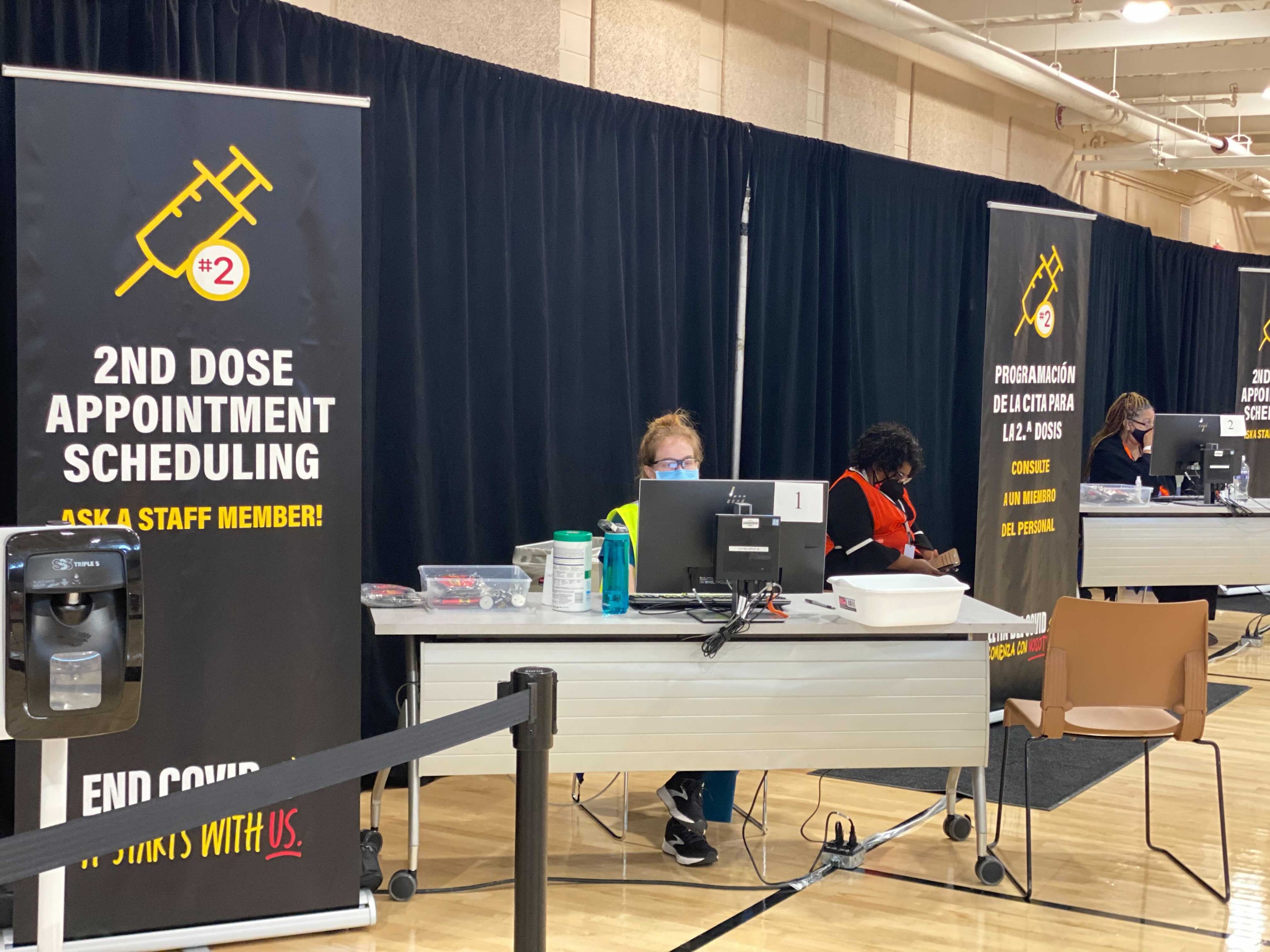
White Marylanders make up a little more than half the state’s population, but have received roughly 60% of the state’s first vaccine doses. Black residents make up about 30% of Maryland’s population and have received only about 15% of the first doses. The state’s Hispanic population, similarly, has received just about 6% of Maryland’s vaccine doses, despite comprising 11% of the overall population.
Virginia, too, shows similar significant racial disparities. Black Virginians account for 13% and Latinos less than 6% of those who’ve gotten at least one shot, though those groups make up 19% and 10% of the state’s population, respectively.
In D.C., neighborhoods on the city’s eastern side — which are predominantly Black and have the city’s highest poverty rates — have seen the lowest rates of residents vaccinated. As of March 13, seniors in majority-white Ward 3, one of the city’s most affluent areas, were fully vaccinated at twice the rate of seniors in majority-Black Ward 7 and 8.
Maurice Cook, who leads the youth-based nonprofit Serve Your City and coordinates mutual aid efforts in D.C.’s Ward 6, had hoped the vaccine rollout would go differently — especially given that Black people in D.C. have died from the coronavirus at seven times the rate of white people in the District.
“White people are going to have to wait for once in America,” Cook said. “You can’t talk about equity without some form of sacrifice.” Instead, Cook said, Black people have been getting vaccinated at lower rates as white residents, enabled by the city’s system of vaccine administration, have been “leapfrogging over dead Black bodies to get this vaccine.”
Playing Equity Catch-Up
Officials across the region are scrambling to correct this dynamic by informing and vaccinating communities of color — often through in-person outreach work.
The Green Valley pop-up pre-registration table is one of many such events in Arlington that pair county public health outreach efforts with an existing activity like meal distribution run by a service organization or faith group with personal ties to the community. A spokesperson said the county has hosted 22 pop-ups since late February, and estimated that 578 people have been pre-registered in this way. They’ve also given out 924 packets with masks, sanitizer and public health informational fliers in multiple languages, and they’re working with affordable housing buildings to put fliers under the doors of upwards of 5,000 apartments.
But all that work is about getting the word out about vaccines and getting people into the state pre-registration system, effectively an already-long waitlist for shots (Maryland counties also are relying on a pre-registration model). Officials say they hope that public health departments across Virginia will be able to focus their allotted vaccinations on communities of color as the rollout expands and pharmacies and other private medical providers take on more of the work of giving shots to the general public.
“As more and more vaccines come to pharmacies, to health systems, to hospitals, I think it will allow health departments to really pivot their efforts from the larger-scale vaccination to do this more targeted work with vulnerable communities,” Virginia vaccine coordinator Dr. Danny Avula said in a press conference in late February.
In Arlington, some of that work is already underway: the county is sending an allotment of vaccine doses each week to the Arlington Free Clinic, which serves uninsured people in the county, many of them immigrants. The clinic is working directly with local social service providers to call people and schedule appointments, entirely apart from the county and state online pre-registration and waitlist system. That’s by design: personal outreach is key, according to Nancy White, the executive director of the clinic.
“I think that knowing that sometimes phone calls or the face-to-face type locations are really where you’re going to catch people is going to be important” in the future, she said.
In Maryland, officials are already trying to reverse low rates of vaccinations among Black residents by offering additional vaccination sites and appointments to residents of majority-Black counties, where residents say demand for the vaccine is far outpacing supply. That includes several pop-up distributions clinics at churches in Prince George’s County and another mass vaccination site expected to open in Germantown next month.
Nearly two months after his state began vaccinating residents over age 75, Maryland Gov. Larry Hogan (R), for example, announced a vaccine equity plan allowing faith-based and other community organizations to apply to hold vaccination clinics in their neighborhoods.
Pastor John Jenkins from First Baptist Church of Glenarden, a predominantly Black church in Upper Marlboro, Md., said he’s invited doctors to virtual church events to talk about the vaccine. He got the vaccination himself to encourage others to get it.
“I don’t have the authority to tell anybody to do anything, but what I can do is strongly encourage them to follow a particular path,” Jenkins told DCist/WAMU. “We’re trying to use our influence to help save lives and help people live.”
Casa De Maryland’s LaRue echoed that sentiment. The group has employed individualized outreach techniques to help get more than 100 Latino Marylanders vaccinated so far this month.
LaRue says her organization is already well-equipped to do this kind of work because “our community trusts us.” She said that vaccination sites with National Guard or police presence can be anxiety-provoking for many of the immigrant families Casa De Maryland serves.
In the District, health officials have advertised what they call “special initiatives,” like a partnership called “Faith in the Vaccine” that brought some vaccines to Black churches in hard-hit neighborhoods, and a door-knocking pilot that has brought volunteers from the Mayor’s office to help Ward 8 seniors register for vaccine appointments. Federally-qualified health centers, which serve largely Black and Latino patients, have also administered the vaccine.
Another of those initiatives is a partnership with the D.C. Housing Authority that brings vaccine clinics directly to senior apartment buildings. It’s the kind of direct, in-person outreach that many Black residents have been asking for.
“We were familiar with our population,” says Housing Authority Executive Director Tyrone Garrett. “When I was [at a vaccine clinic] the other day and there were people that hadn’t come down for a second dose, my managers and the team were calling people out by name.”
That program has vaccinated about 1,500 seniors so far through a partnership with Johns Hopkins. Now, the agency is offering additional vaccine events geared toward residents in Wards 5, 7, and 8. Garrett, the executive director of D.C. Housing Authority, hopes to replicate the success they’ve had among seniors with a broader swath of residents in those wards.
For one of those events, held on Saturday at the Benning Stoddert Recreation Center in Ward 7, the Housing Authority and Johns Hopkins collaborated with other D.C. government agencies to make the event accessible for seniors who live in large apartment buildings nearby. They reached out to affordable housing properties and reached out directly to residents in the neighborhood who receive housing vouchers in the days leading up to the clinic. The Department of Parks and Recreation helped with transportation and the clinic ultimately vaccinated 521 people.
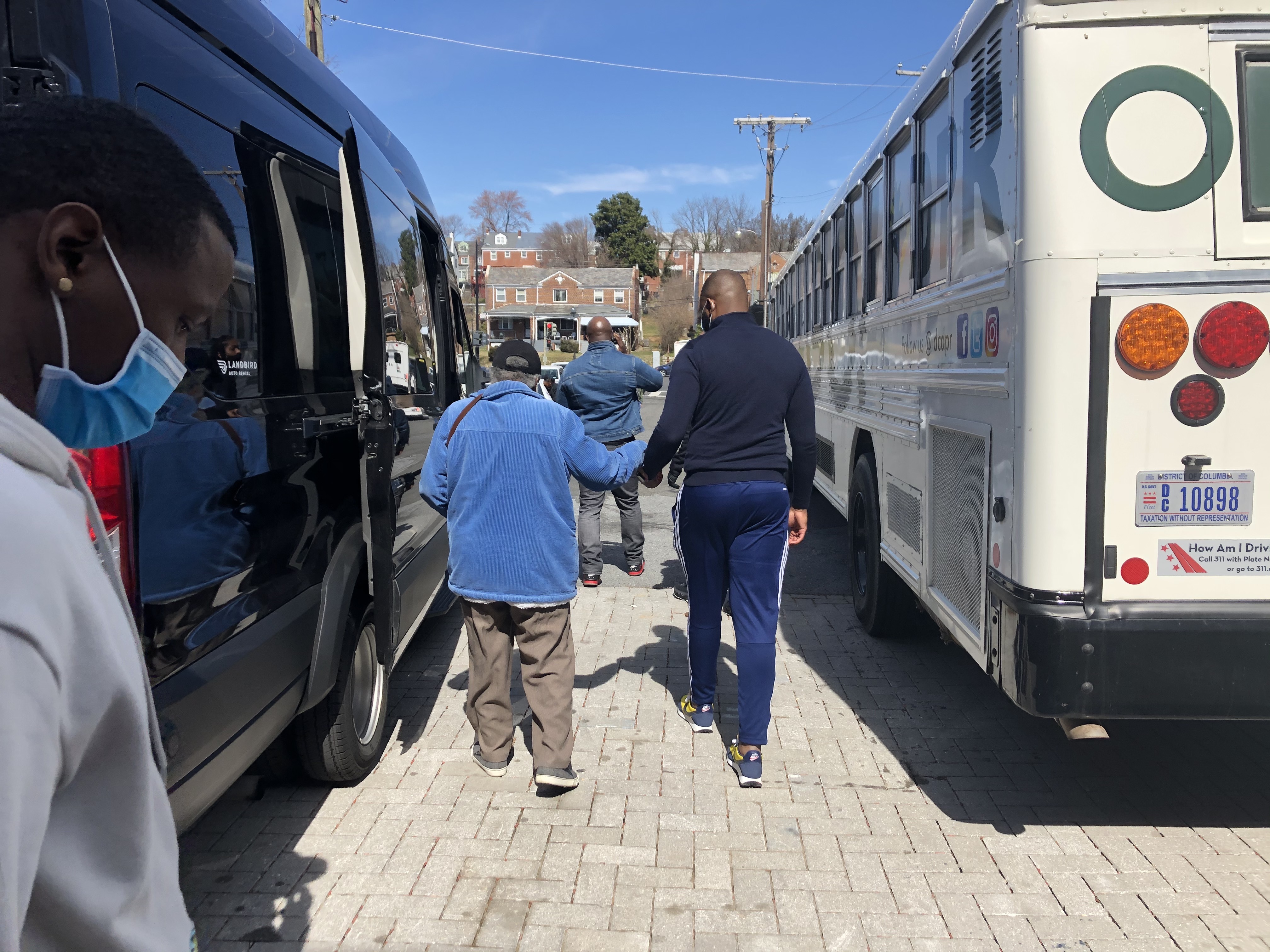
Bertha Broome, a 79-year-old resident of the J.W. King Senior Center in Southeast D.C., was able to register for her vaccine appointment at Benning Stoddert through her building, which also provided transportation to the rec center. She had previously struggled to secure an appointment.
“I had tried on the computer, but it wasn’t too successful,” Broome said.
Eugene Primer, a 75-year-old resident, said he wanted the vaccine “to save [his life].” But he had almost given up on the appointment process.
“I tried it online … every other place I called — you had to stay on the phone for two hours before you can get confirmation, so I said well, the heck with it,” Primer said.
When Primer found out he could get a vaccine at Benning Stoddert on Saturday, he jumped at the opportunity to get on the shuttle his building provided to take residents to the site.
‘We Have Work To Do’
While some outreach and grassroots efforts are proving successful for small swaths of their communities, advocates still are struggling to navigate a dearth of vaccine doses and a generally chaotic system for securing them.
In some cases, there are questions about how much vaccine is being allocated to groups working directly to get the region’s most vulnerable residents vaccinated. In D.C., the most accessible programs geared toward people in hard-hit neighborhoods only make up one part of the rollout. This week, about 2,700 vaccine doses were allocated for the city’s “special initiatives,” while 7,735 doses went to hospitals and health centers — some of which are targeting Black and Latino residents by limiting doses to their patient populations or focusing exclusively on residents of Wards 7 and 8. The remaining 13,630 doses — more than half of the city’s total doses for the week — went to the citywide system for booking appointments.
Cook, with Serve Your City and Ward 6 Mutual Aid, said he wants an entirely different approach, where the city devotes large numbers of vaccines to Black and Latino residents and creates larger-scale mobile vaccination efforts to serve them.
“Go to the neighborhoods where the Black people and Brown people live directly,” Cook said. “They shouldn’t have to go anywhere. The vaccine should come to them.”
In the meantime, Cook says his group is trying to find out about pop-up mobile vaccination opportunities and partnering with the Maryland Equity Vaccine Hunters to try and get seniors in D.C. signed up for appointments online.
For many Spanish-speaking residents in the region, lack of internet and connectivity have presented significant issues in securing vaccine appointments. Casa De Maryland’s LaRue said officials need to use existing channels of communication already employed by those communities to ensure they are receiving information in a timely manner.
LaRue says it’s also vital to have Spanish-speaking individuals at vaccination clinics to register patients, explain and answer questions about the vaccine, administer the jab, and sit with patients for monitoring after receiving it.
Other advocates have also had to cut through the general chaos of the early rollout, especially changes in online registration systems. In Arlington, the county’s Complete Vaccine Committee, a group of about 40 community leaders, is spearheading the county’s pre-registration work. Many were leaders in the county’s effort to get underserved county residents to fill out the U.S. Census last year. (The county estimates that 99.98% of Arlington households were ultimately counted.)
But even with a group familiar with the process of finding “trusted advisers” to distribute information and reassure people, Wanda Pierce, co-chair of the Complete Vaccine Committee and a Green Valley resident herself, said the vaccine outreach process has been further complicated by changes in online pre-registration systems.
“There are things that [were] changing at the federal level, at the state level and then at the county level,” Pierce said. “So we were a little bit nervous about using our networks to share this valuable information that might change.”
Though the state’s online system feels a lot more settled now, Pierce says there are still challenges. Unlike filling out the census, there’s a hurry-up-and-wait quality to the committee’s vaccine outreach. Even if Pierce and her group get people to pre-register, there will be more barriers ahead: the wait to get notified that people can book appointments, and then the logistics of getting to those appointments, for instance.
Cicely Whitfield, the chief program officer at Bridges To Independence and another Green Valley resident, was excited to see local families gathering in the church parking lot, and said several residents made use of the pre-registration table. But she’s frustrated, knowing that she’s one of just over 1,000 Black people in the county who’ve been vaccinated.
“If we’re going to be the inclusive and diverse community that we scream and shout that we are, then we have work to do,” she said.