Martin Austermuhle
 Dominique Maria Bonessi
Engaged citizens and government gadflys, take note: while can get a drink in a bar or go into a business in most of the Washington region, it may still be a while longer before you’ll be able to march into a county building or city hall and lodge a protest.
Even as most of the region is lifting mask mandates, capacity limits, and other COVID-19 restrictions, many local legislatures — be it county boards or city councils — aren’t throwing opening the doors to the public just yet. The Arlington County Board, Prince George’s County Board, Montgomery County Council, and D.C. Council are keeping virtual meetings for the time being, opting for a more gradual reintroduction of the traditional in-person hearings and meetings that make local democracy tick.
“My view has been to be patient and not to force people unduly by saying, ‘Alright, we’re reopening,'” said D.C. Council Chairman Phil Mendelson in an interview on Monday, the same day that Mayor Muriel Bowser lifted the mask mandate for people who are vaccinated and only a few days shy of when D.C. will lift most restrictions on businesses.
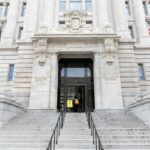
“We may be getting close to rethinking it,” conceded Mendelson, who said the decision of when to bring the Council back to the Wilson Building in person would be made with input from the body’s 12 other councilmembers. “It’s a balancing act between people being comfortable with reopening and the fact that the rest of the region is reopening.”
And not just the region, but also the other branches of government. City government employees in D.C. are expected to start making their way back to their offices in June and July.
For Montgomery County Council President Tom Hucker, there’s another consideration to weigh: lawmakers and staff who may not be able to slip away from home for daylong meetings and hearings just yet.
“I think the end to the mask mandate came sooner than we anticipated,” he said. (The Montgomery County Council voted Tuesday to lift the county’s mask mandate, a few days after it was lifted across Maryland.) “Plus we have staff experiencing a higher-than-usual dearth of summer school and camp and child care options.”
Still, some signs of legislative normalcy are starting to return. While the Fairfax County Board of Supervisors met this week virtually, they will hold in-person committee meetings next week. Eileen Filler-Corn, speaker of the Virginia House of Delegates, has announced a return of in-person lawmaking once the General Assembly reconvenes. On Tuesday, Maryland’s top elected officials met in person — and maskless — for a bill-signing ceremony; Gov. Larry Hogan also announced the State House would reopen to the public on Friday.
“It’s one more step in the right direction in the return to normalcy after a hard-fought battle against COVID-19,” said Hogan.
Senate President Bill Ferguson added, “It is funny to be here without masks on. … We can feel the after-times of this pandemic.”
Those after-times may linger, though. As with any return to pre-pandemic life, some lawmakers concede that it may simply take a while for the public to adapt after a year of mask-wearing, social distancing, and — in much of the region — pleas from elected officials that everyone try and stay home as much as possible. In that time, the virtual hearings and meetings that were initially awkward, clunky, and prone to interruption by kids have become a more normal part of the legislative process. Some people even say they now prefer them.
“I think it’s going to be weird because I do feel like there are members of the public who have gotten used to being able to participate in hearings virtually,” says D.C. Councilmember Christina Henderson (I-At Large). “And so what does that look like when we start conducting hearings in person, in terms of a hybrid approach? I think we need to work out those kinks before we move on.”
Regardless, Henderson is ready to get back to in-person lawmaking. In fact, she’s never known anything but virtual debates and votes as a lawmaker; she first joined the D.C. Council this January, leaving her office in the Wilson Building empty and unused.
“I just got my artwork installed [Tuesday] because my office has essentially been a blank canvas since January,” she says. “I want to see my colleagues in person, because right now we have to have so many conversations over text that we might have had if we ran into each other in the hallways.”
As for Mendelson, who has served on the council since 1999, he’s ready to get back to doing the people’s business — in person. But he admits he has enjoyed going into his office while the rest of the building has remained largely off-limits to the public.
“I personally would have no problem with reopening other than that the Wilson Building is kinda nice when it’s empty,” he said.