Debbie Truong
Aaliyah Jones’ high school graduation from National Collegiate Prep was a daylong celebration. She wore all white under a yellow graduation gown, her straight hair stopping neatly at her shoulders from under her cap. As she walked across the stage at the socially-distanced, outdoor ceremony last June, her mother, Jessica Jackson, beamed.
Jones’ path to graduation was rocky. She attended three high schools, transferring each time to escape bullying from classmates, Jackson said. So she felt a sense of relief when her second oldest child finished high school.
“Off you go,” Jackson recalled thinking. “Another new beginning.”
But last summer, as Jones was preparing for her first year at Virginia State University, she learned she did not actually graduate.
The D.C. Public Charter School Board, which regulates charter schools like National Prep, told Jones she needed to pass one more class to receive her diploma. Two months later, the 19-year-old learned she was actually two classes short of graduating.
The teen and her mother could not turn to anyone at the school for recourse. National Prep was forced to close after the 2019-2020 year because of poor performance.
Donovan Anderson, an attorney representing National Collegiate Preparatory Public Charter High School, said Jackson and an attorney working with the family were given ample warning she was not on track to graduate.
But the family and Maria Blaeuer, an attorney with Advocates for Justice and Education, a non-profit that trains families in education advocacy, say that never happened.
Blaeuer and other advocates say Jones is not the only student who faces confusion about credits they need to graduate.
The District, which educates nearly 95,000 public schoolchildren, does not have a centralized system that records basic transcript information, such as grades and the courses a student has taken. That can make it challenging for families to keep track of classes a student needs to receive their high school diploma, especially if a student has transferred multiple times.
What’s more, there are nearly 70 charter school networks in the city in addition to D.C. Public Schools, the traditional school system. Each network largely functions as a separate school district and has broad autonomy to determine which classes count toward graduation.
That results in a byzantine system where a class that might count toward graduation at one school might not count in the same way at another, forcing students to take classes they did not plan for.
“It can delay the time to graduation but also just make it less likely you stay in school at all,” Blaeuer said.
The D.C. Council is considering a measure that one lawmaker says would streamline the way the schools collect information, making it easier to tell if a student is not on track to graduate.
For Jones, the setback meant she would have to stay in high school for at least several more months while juggling college classes. She said she felt disenchanted by the process but was determined to get her diploma.
“I know I’m capable of doing it,” she said in September. “I’m going to keep doing it and push through.”
‘We didn’t drop the ball’
National Collegiate Prep was supposed to be a fresh start.
Jackson has always searched for the highest quality education for her six children. She is reluctant to send her children to Ballou High School, their neighborhood high school in Congress Heights, where they are guaranteed a spot. Few Ballou students are meeting expectations in math and reading, data show.
“My children, they know I don’t play about school,” Jackson said.
She takes advantage of the city’s My School DC lottery, an annual process where families can vie for seats at schools across the city.
Jones spent most of elementary school at the same campus. She attended middle school at KIPP DC: WILL Academy before transferring to The Children’s Guild DC Public Charter School.
She moved around in high school, starting at Friendship Collegiate Academy Public Charter School for 9th grade before transferring to Ballou in 10th grade, despite Jackson’s reluctance.
At both campuses, the teenager said, she faced bullying from other students who threatened to jump her.
“You can’t just let people keep picking with you,” Jones said. “I got overwhelmed.”
Jackson did not know much about National Prep when she enrolled her daughter there as an 11th grade student for the 2018-2019 academic year. But she hoped Jones could avoid conflicts at the campus in Southeast.
Things were not perfect. The bullying did not go away, Jones said. But she managed to pass her classes during her first year at National Prep, ending it with a 2.6 GPA, according to her transcript.
Around this time, National Prep was itself facing scrutiny.
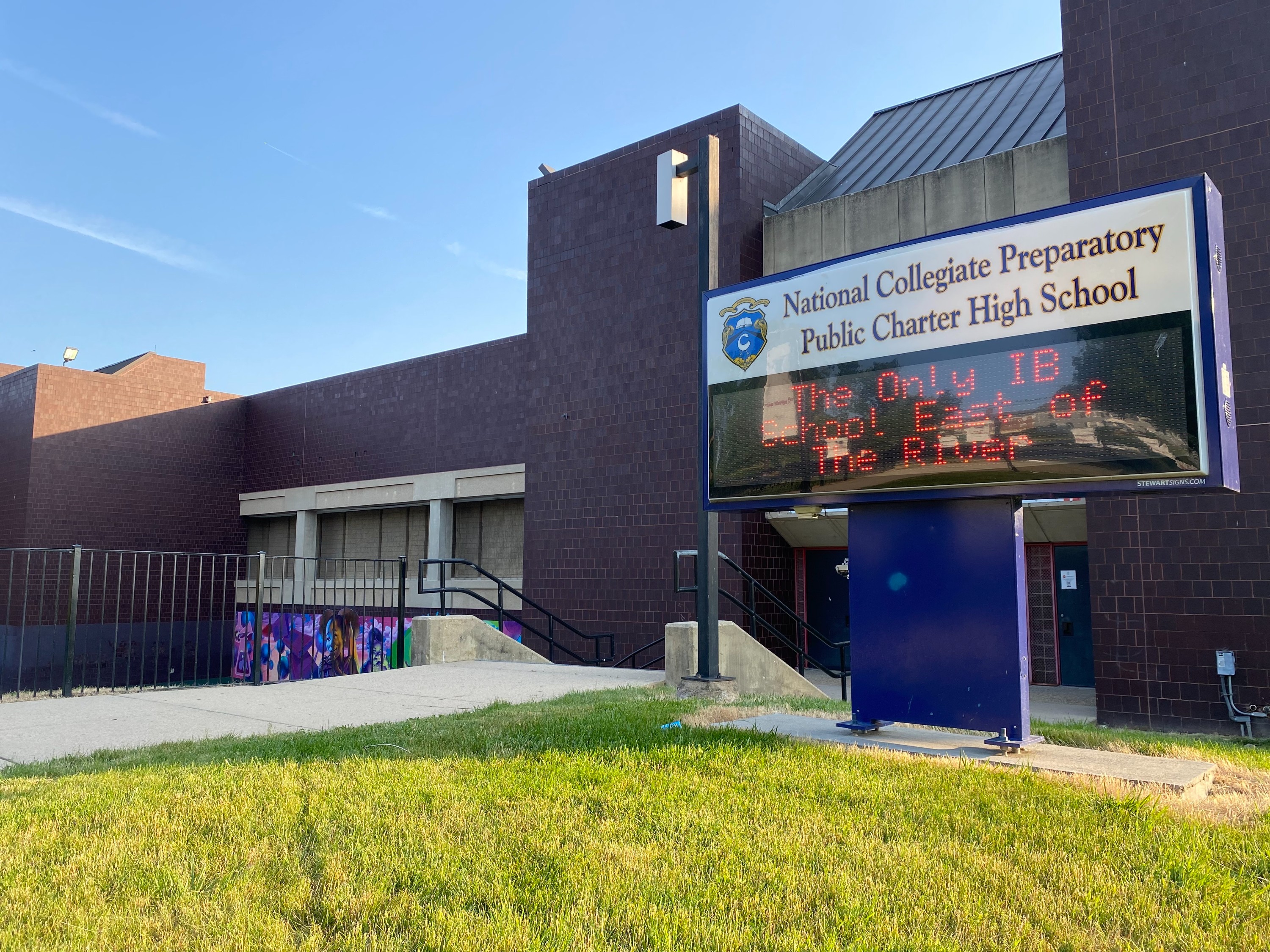
In January 2019, the D.C. Public Charter School Board voted to shut the school down after the 2019-2020 academic year for poor performance.
No one could dispute that National Prep did not live up to its goals.
The school, located in a nondescript brown building in Ward 8, opened in 2009 and boasted an International Baccalaureate program. But after a decade of existence, no student had graduated with an IB diploma, which is awarded to students who fulfill the requirements of the globally respected program.
Charter school regulators also cited the school’s low graduation rates and poor instruction during classroom observations as reasons to close the campus.
But many parents and high-profile community members felt closing National Prep would leave families with few options in a part of the city starved of quality public high schools.
At a nearly four hour meeting about the closure, parents, alumni and staff crowded into a room to make their case.
“That’s like putting these kids out on the street,” one grandmother said.
“We got a pearl here,” one parent said. “Don’t break it. Don’t tear it down. Tweak it and come help us.”
“This is the best thing that happened to me … This is home and I need my home,” a graduate said.
Jackson did not agree with them. She strongly felt the school was mismanaged and needed to shut down. But she said she kept Jones there because the teenager was so close to graduating.
“It’s frustrating because I know we didn’t drop the ball,” said Jackson, who dropped out of high school herself to take care of her children before completing her GED years later.
She encourages her kids to study hard, assuring them “this is as easy as life is going to get.”
Jones’ senior year did not go as smoothly as her first at National Prep. The teenager enrolled in 15 courses and failed three of them — environmental science, art theory and a college and career readiness course.
Still, she ended the year with a 2.3 GPA and believed she was still on track to graduate.
Falling short
The first signs of trouble appeared more than a month after the graduation ceremony.
Jackson said she received a phone call from Friendship, which provided summer school to a few National Prep students after the school closed for good. Friendship said Jones needed to attend summer classes, according to Jackson.
“I cried,” she said. “I was confused.”
Believing the phone call was a mistake, Jackson contacted Blaeuer, who previously helped the family with other education matters.
Blaeuer contacted the D.C. Public Charter School Board because National Prep had already closed. She spoke to a specialist who audits transcripts.
After a phone call, the specialist sent Blaeuer an email summarizing the conversation: Jones needed one science credit to graduate and National Prep said she needed summer school.
A spokesperson for the charter school board declined to comment about Jones’ situation because “a student’s record should be kept private and we do not share it publicly.”
In D.C., the Office of the State Superintendent of Education, or OSSE, sets baseline graduation requirements for all public schools in the city. It lays out the number of credits students must earn in nine subjects.
The requirements say students must pass four science courses.
Jones passed four science classes during high school for a total of four credits, according to her transcript. They were: biology, chemistry (which she took and passed twice at different schools) and earth science.
But National Prep still said Jones needed another science course to graduate.
Anderson, the attorney representing National Collegiate Prep, said Jackson and Blaeuer were told in April 2020 that Jones was performing poorly in a science class required for graduation.
“The school at the time was attempting to provide her with the necessary supports she required to insure that she would be successful in that course,” he said in an email.
Anderson did not specify which science class Jones needed to graduate and declined to answer detailed questions.
The family and Blaeuer insist they never received any warning Jones was in danger of not graduating.
Jones received special education services during high school and National Prep was required to sign a document formally ending her services because she was going to graduate. The head of school signed the document on June 10, certifying Jones would graduate, according to a copy provided by Blaeuer.
Jones did not end up enrolling in summer school, Jackson said, because the family did not have enough time to prepare for it.
A couple months later, on September 16, the specialist emailed Jackson and Blaeuer. According to the email, Jones had earned three out of four science credits she needed to graduate.
The specialist then dealt another blow: Jones also needed to take World History 2, which is required for all D.C. students.
In the email, the specialist acknowledged this was new information. An employee who previously reviewed Jones’ transcript, the specialist explained, misread information from one of the teenager’s previous schools, leading to the error.
Jackson began to question herself.
She had criticized the school and her relationship with Jennifer Ross, National Prep’s founder and CEO, was acrimonious. Ross did not respond to requests seeking comment.
In the final months of last school year, Jackson wanted to know when Jones could pick up a laptop for distance learning and pressed for information about grades and assignments.
“Not receiving timely communication from school officials (especially the founder) is disgusting,” she said in one email to administrators.
Jackson said she worries the arguments cost her daughter a high school diploma.
A messy patchwork
Blaeuer and other experts point to another issue: the haphazard way D.C. collects and records transcript information. They say the lack of structure puts students who transfer schools at risk of falling behind without even knowing it.
It also disproportionately affects some of the city’s most vulnerable students, including students with disabilities, poor students and students of color, because they tend to transfer schools at higher rates. Students in the criminal justice system and in foster care commonly also run into issues with their transcripts and credits, advocates say.
In most states, districts and schools have access to a statewide database that records information for each student, including grades, coursework and the number of credits a student has accumulated, said Erin Roth, the director of education research in the Office of the D.C. Auditor.
When a student moves to another school district or from a traditional public school to a charter campus, the new district or school can use the database to find information about the student. The new school uses that information to develop a course schedule for the student and enroll them in classes that would fulfill graduation requirements.
Schools use these statewide systems to identify struggling students because they can determine when students are missing courses or credits.
No such system exists in D.C.
The public school landscape in the city is made up of dozens of local education agencies, each responsible for maintaining its own records of students’ grades and classes.
The largest local education agency is the traditional school system, D.C. Public Schools, which has more than 100 campuses. There are also nearly 70 charter operators — some with multiple schools in the city — that are each considered their own local education agency. Nearly half of the city’s public schoolchildren attend charter schools.
If a student transfers from one DCPS campus to another, Roth said the new school can find the student’s transcript using a shared database.
But if the student transfers from a DCPS campus to a charter school or between two charter schools that belong to different networks, it can take longer to figure out what classes the student needs to get their diploma.
That’s because the new school might not receive the student’s transcript from the previous school until after they need to register for classes or may only receive a partial record of a student’s education history.
That may lead to situations where students take the same class twice at two different schools, as Jones did with chemistry, Roth said.
The new school also has to make sense of the transcript it receives. Each education agency has autonomy to decide which classes fulfill the city’s basic graduation requirements, resulting in differences from school to school.
For example, Roth said African American history might fulfill a World History requirement at one school but not another.
Students may also end up taking a bunch of classes that might not all count toward graduation. Over four years in high school, Jones enrolled in 40 classes and accumulated 32 credits total, eight more than required by the city.
“There is no agency in the District right now that is accountable for monitoring, tracking and aligning all of the work she did for four years in high school,” Roth said. “So she’s left without a foundation. And she’s not alone.”
Shortchanging students
Education advocates and local lawmakers increasingly argue the Office of the State Superintendent of Education (OSSE), which oversees education in the city, should take responsibility for maintaining a citywide database of student information.
D.C. Councilmember Mary Cheh introduced a measure earlier this year that would mandate OSSE create that database to include details about students’ grades, classes and credits, among other information.
Cheh, who represents Ward 3, said the database would also create a warning system that could identify students at risk of missing graduation.
“We’re shortchanging our students,” she said. “We’re not flagging whether they are struggling early enough for them to be able to get on track.”
A report published in March by D.C. Auditor Kathleen Patterson found the city is not adequately collecting and recording key education data, despite receiving federal money to do so.
Education officials forcefully pushed back on the auditor’s findings.
OSSE said it currently maintains a centralized database of student information but that system does not include grades, GPAs and courses students are enrolled in.
The state agency said it wants to track students’ course and credit information in the coming years, but maintaining such a system “would require a lot of infrastructure” and effort from schools.
It is impossible to say how often students who believe they will graduate realize too late they are missing classes. The charter school board said it has only received one complaint in the last several years about credits not counting toward graduation after a student transferred schools.
But advocates and watchdogs say problems are likely more widespread, arguing many students do not file formal complaints when they encounter issues.
Shannon Hodge, the executive director of the D.C. Charter School Alliance, a group that advocates for charter campuses, said a citywide warning system would help students who switch schools make sense of credits they have accumulated. Some of the issues locating transcripts could be resolved by stronger collaboration between schools, she added.
“You can spend weeks or months, maybe, tracking down transcripts from previous institutions,” said Hodge, who was previously the head of Kingsman Academy Public Charter School. “All the while, a student is enrolled in classes and going to classes.”
Jones does not appear to be the only National Prep student who faced issues.
In August 2018, Scott Pearson, who was then the executive director of the D.C. Public Charter School Board, contacted Ross and the board chair for National Prep.
The charter school board had received emails from OSSE expressing serious concerns over the school’s “failure to create accurate student schedules for the current school year,” according to a preliminary report published in November 2018 on the charter school board website.
Employees of the charter school board audited transcripts of 32 students, flagging issues in most of them.
They discovered four major problems: students were scheduled in classes they already earned credit for; transcripts were missing information from previous grades; transcripts did not match students’ schedules and documents were missing or incomplete.
Some of the issues were resolved, the audit said. But it is unclear if all the problems were fixed.
A spokesperson for the charter school board said the preliminary report did not cover what the board “required from the school nor its final recommendations to fix the problem.”
Lack of student information affects more than grades and class schedules.
Nathan Luecking, a social worker at Anacostia High School, said some students who transfer to the Ward 8 school show up without any paperwork documenting mental health services or other support they received at previous schools.
Luecking said he may spend weeks trying to coral information from students’ previous schools and may not always get a response. Having that information readily available would allow Luecking to spend more time supporting students.
Looking for alternatives
At the start of this school year, Jones said she enrolled in two courses at Friendship Collegiate Academy to complete the classes she needed for a diploma: World History 2 and Physics.
She also embarked on her first year at Virginia State University. She chose to study social work and business, hoping it would help accomplish two of her biggest goals: giving back to her community and owning a mall featuring Black-owned businesses.
The workload quickly became overwhelming. By the middle of September, Jones said she was failing math and sociology at Virginia State and, by December, she was struggling in both high school classes.
“I’m supposed to be at college right now,” she said. “I’m not supposed to be sitting here doing work I already did while trying to get credits I know I already have. It doesn’t make sense.”
Jones completed the two classes at Friendship in January, Jackson said. They are waiting on her final grades and to hear if she will finally receive her diploma at the end of this school year.
A spokesperson for Friendship Public Charter School confirmed Jones fulfilled her class requirements and has graduated.
But Jackson said she was not aware her daughter officially graduated nor has she received information about how to retrieve Jones’ diploma.
Jackson said she doesn’t raise her children to be quitters. She often reminds them that giving up is “when you truly fail.”
But her own resolve has frayed. She has started looking into enrolling Jones in a GED program, in case something else goes wrong. It’s not the outcome she wanted for her daughter but the family is running out of options.
“Every time we hop one hurdle, they trip us up and we have to hop more,” Jackson said. “I’m really feeling like the school system has failed my child.”
Update: After this story was published, Jackson told WAMU/DCist she retrieved Jones’ diploma from Friendship Collegiate. She said the school contacted her Friday, May 21 with directions to pick up the diploma.