 Cydney Grannan
 Tyrone Turner
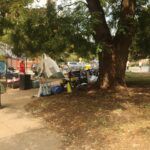
On a sunny, hot Wednesday, Marco Woodson zipped around a small park in downtown D.C., sweeping trash into small, neat piles. A table under a tree was set up with a cooler full of ice and water bottles. Between the honks and hums of nearby traffic, Megan Thee Stallion’s latest single could be heard playing from a speaker.
Not far away, a statue of Edmund Burke, a British statesman who supported the American colonies, looked out onto traffic flowing to and from the nearby Washington Convention Center. Behind him, Woodson and other unhoused residents had set up makeshift community, with nine tents sitting in close proximity.
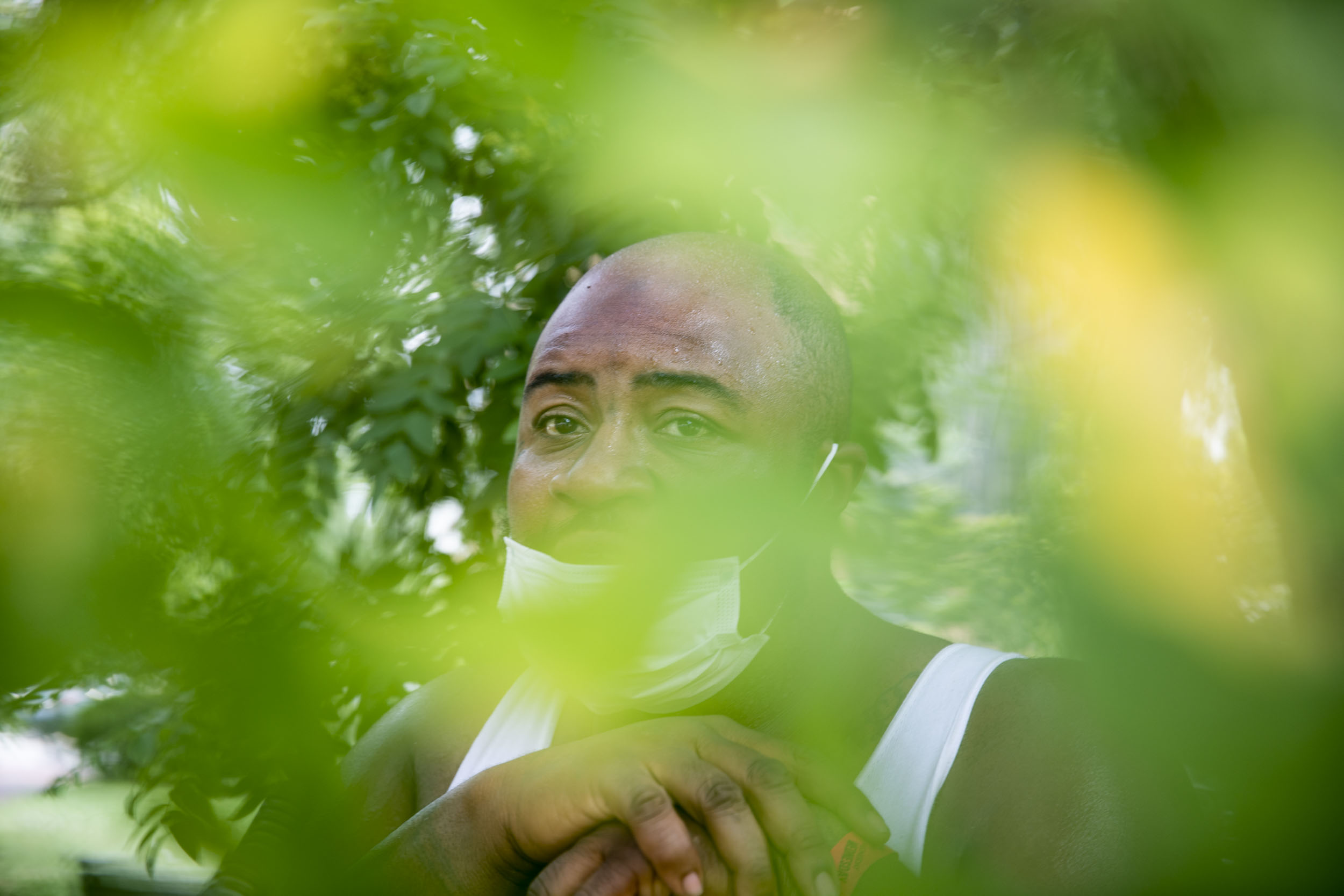
Samuel Hall Jr., 40, has been living in the park for over a year and a half, but has been experiencing homelessness for three years.
“It’s just been hard for me actually getting the services that I needed,” he said. Hall said he is a vendor for Street Sense Media, and he’s trying to secure another job as well.
Hall and Woodson are two of the 15 unhoused D.C. residents living in this small, triangular-shaped park in Mt. Vernon Square. Earlier this month they faced the threat of eviction by the U.S. Park Police, but worked with their Advisory Neighborhood Commissioner and community activists to successfully lobby local and federal officials to stay the displacement.
What played out was a distinct example of the intricacies and challenges of homelessness and housing in the District: Some housed neighbors in a ward where median rent is $2,034 pushed for the encampment to be removed by the U.S. Park Police, which has jurisdiction over the land. As many as 80 community members met for a heated, hours-long public meeting on Zoom, which unhoused neighbors struggled to attend. And local residents of the District, who lack congressional representation, fought for accountability from a federal law enforcement agency they don’t have any control over.
The view from Burke Park
Hall said that when he heard about the threats of eviction from the Park Police, it wasn’t completely unexpected.
“I know we got a lot of condominiums around here, and people paying market rent. And they don’t want to see people out in front of their houses,” he said. “But I gotta also say, they’ve got to have hearts too, and know that it’s a struggle on another level … Some people had it tougher than others.”
Housed residents in the area may have sparked plans for clearing the park with a letter sent to Park Police at the end of June.
Alexandra Bailey, the Advisory Neighborhood Commissioner for the area that includes the park, said the letter was sent to her and other commissioners, and was distributed on local listservs. It cited a number of concerns about the encampment and its residents and cites a list of violations — including that it’s illegal to camp overnight in a federal park.
“We understand that there are ‘CDC Guidelines’ addressing encampments during Covid-19. However, we believe the public health and safety danger caused by the encampments far outweighs any benefit of leaving them be,” read the letter.
“The vagrants harassing folks outside do not simply ask for money and move on. They are confrontational, often screaming at passersby on the sidewalk or in their cars or people exiting the CVS or Quincy Court and Quincy Park (the building across the street from CVS). Many are clearly on drugs. Others have robbed the CVS and neighborhood residents.”
Bailey said she received an email from the National Park Service early this month saying the Park Police has “a plan to move on Burke shortly after July 4.”
But last week, the National Park Service backed off, telling DCist/WAMU in a statement that it had “been engaged in conversations about encampments in national parks in D.C. with the city and community partners but has no imminent plans to remove existing encampments.”
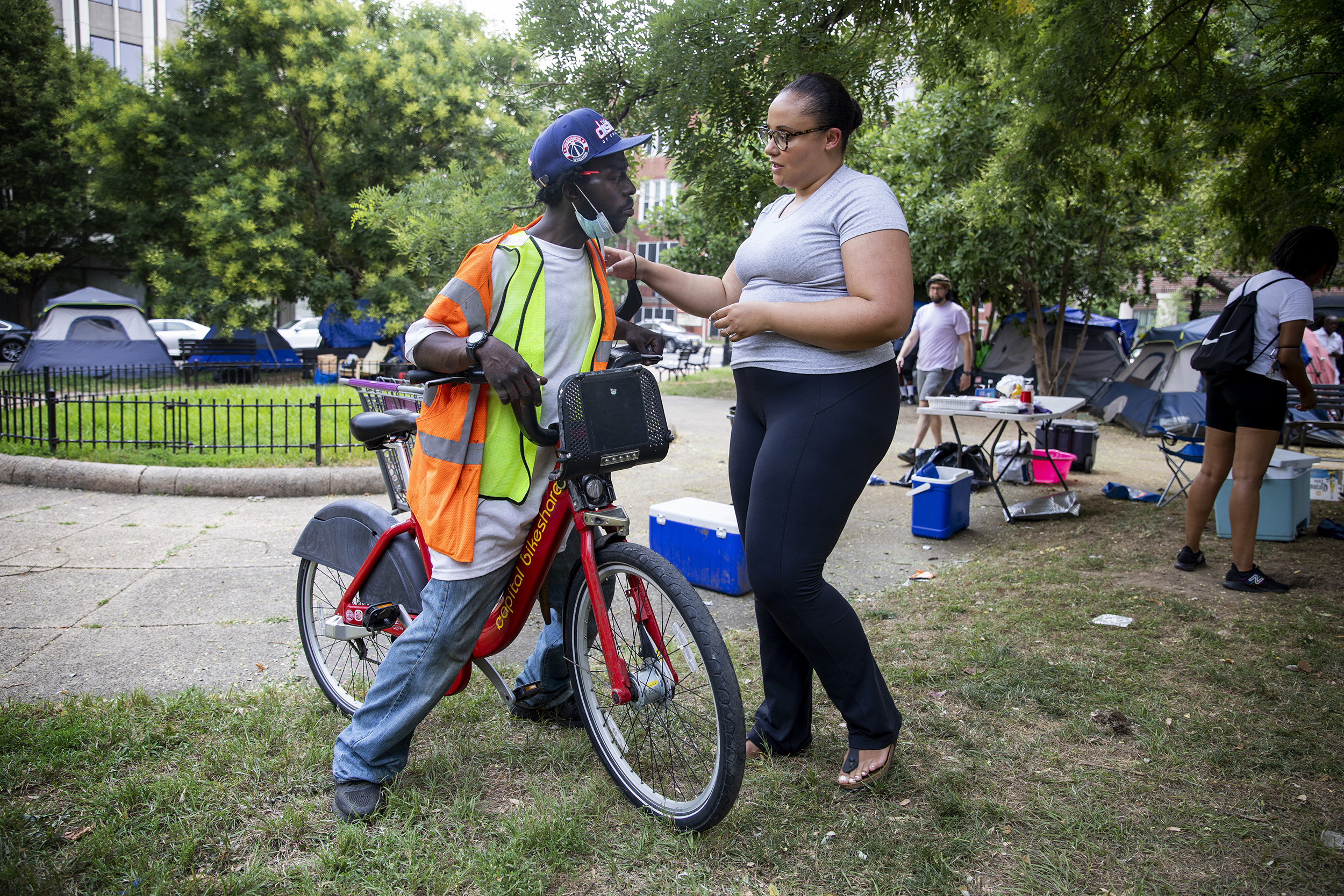
Bailey, who worked with the residents and local activist groups including Remora House, Sunrise D.C., and Ward 2 Mutual Aid to pressure federal and District officials to stay the eviction, sees this as a victory for the residents at Burke Park. She has been working with the residents to get them housing vouchers, which is generally a months-long process that she’s trying to fast-track. To get a housing voucher in D.C., you need a government-issued photo I.D. and a birth certificate — which can be difficult and costly to get.
“I’ve been paying for [birth certificates] myself and expediting them,” Bailey said. It has cost her all of her pandemic stimulus checks, and then some.
Robert Buchanan, 64, is hoping to receive his housing subsidy soon so he can move to permanent housing. He applied for a housing voucher in 2013, and was selected to receive a voucher in 2019. But Buchanan said the city couldn’t find him to notify him. So Buchanan only signed the voucher paperwork this year, and is still waiting to receive his housing subsidy.
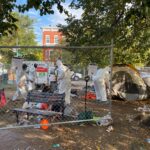
Had the eviction moved forward, unhoused residents like Buchanan could have been displaced around the District. And their belongings — including essential documents, like birth certificates and IDs — could have ended up in a trash compactor, forcing them to start the voucher application process over again.
This is not the first time unhoused residents and organizers have had tense fights with officials, local business owners, and housed neighbors over encampments. Last month, the District almost cleared an encampment in Dupont Circle after the executive director of Dupont Circle Main Streets applied for a public-use permit for a coffee shop. This spring, Ward 6 residents voiced concerns over the homeless encampment near Seaton Elementary.
Homelessness numbers in the District have been mixed during the pandemic. A January point-in-time count of D.C.’s unhoused residents found that homelessness was down nearly 20% from 2020, but the number of people experiencing chronic homelessness has increased. The District has still been moving forward with some encampment cleanups, despite the fact that the Centers for Disease Control advises against conducting full encampment cleanups during the pandemic. But the District’s policy is to not fully clear homeless encampments; while unhoused residents are required to leave for the clean-ups, they can generally return afterwards.
In the case of Burke Park, however, D.C. rules don’t apply. The park is part of the National Park Service, so it falls under the jurisdiction of the Park Police.
“We’ll take a social services first approach and will continue to work closely with the Office of the Deputy Mayor for Health and Human Services and community partners to connect people living in encampments with resources and housing. Prior to taking any action that would affect people living in encampments we will give individuals ample notice,” NPS said in its statement.
A tense ANC meeting
Advisory Neighborhood Commissions are nonpartisan neighborhood bodies made up of elected volunteers. ANCs weigh in on local public policy decisions, from zoning issues and parking to the city’s budget, and District agencies are supposed to give ANC recommendations “great weight.”
ANC 2F includes Logan Circle, Thompson Circle and Mt. Vernon Square, and has eight commissioners who represent each of the 2F single-member districts. It’s one of six ANCs in Ward 2, which has the largest unhoused population in the District.
A virtual ANC 2F meeting in the second week of July became contentious, with commissioners and participants from the public arguing at times about meeting decorum and accessibility, especially for the unhoused residents who didn’t have access to Zoom.
The monthly meeting, meant for general ANC updates, focused much of its time on the Burke Park encampment. Cynthia Hinnant, a self-described business partner and building manager of a property near the park, raised concerns about unhoused residents going to the bathroom in the parking lot behind her building. Hinnant explained that her staff has begun returning to work, and they’ve had negative encounters with the unhoused residents.
“I don’t want to put us in a position to harass individuals who are already in a difficult situation,” Hinnant said. “But at the same time, we need to keep ourselves safe.”
Hinnant said she was at a loss of who to reach out to about this issue, and wanted to know how to partner with the city to help her business and the unhoused residents move forward.
Another community member, who identified himself on Zoom as “WRD,” said while he supports social services being brought to the park, he doesn’t want unhoused residents to live there long term.
“I don’t think a permanent solution here is to just accept that there are going to be people who are living in the park forever,” the resident said. “That’s not an acceptable situation for us. It’s not an acceptable situation for them.”

Noel Schroeder is an organizer with Ward 2 Mutual Aid, one of the groups who worked with ANC Commissioner Bailey and the unhoused residents to advocate for the stay in eviction.
“My main priority is making sure that our neighbors have access to safe, accessible, permanent housing,” they said at the ANC meeting. “And the way that we do that is support them, not kick them out and push them to another place where they’re still being displaced.”
Schroeder also said it was disappointing that the unhoused residents weren’t allowed to participate in equitable ways, given that the meeting was on Zoom.
“It’s one thing to have a meeting of 64 people talk about our unhoused neighbors, and I would guess that all 64 of us have permanent, stable housing,” Schroeder said. “But to actually hear from our neighbors about the challenges that they face, that’s what’s really important. They’re the people we should be centering here.”
ANC commissioners voted on a resolution to move to hybrid meetings in the future, which would allow for virtual and in-person attendance.
What happens next
Stephanie Myles is a Ward 2 resident and organizer with The Palm Collective, and often stops by the park to check in with the residents there. She said she wants to help her neighbors understand the underlying systemic issues that lead to homelessness, and how policy can change it.
“Grassroots organizations have estimated it would cost $100 million to end chronic homelessness here in the city of D.C.,” Myles said. And she noted that the Department of Human Services budget for 2021 was $610 million.
D.C. Mayor Muriel Bowser pledged to eliminate homelessness by 2025. While it’s unclear if she’ll meet that deadline, her 2022 budget proposal includes putting $400 million toward the Housing Production Trust Fund over the next two years, as well as $42 million toward the Local Rent Supplement Program, which is geared at helping extremely low-income families.
Last week, the mayor released her updated plan to end homelessness in the District, which recommends more investment in supportive housing for people experiencing long-term homelessness. The plan also acknowledges the role systemic racism plays in homelessness. Advocates say the true test of the plan will be whether it gets adequately funded.
Ward 2 Councilmember Brooke Pinto (D) said in an emailed statement to DCist that she has asked Deputy Mayor for Health and Human Services Wayne Turnage to prioritize services and housing to those living in encampments, like Burke Park. And Pinto also said funding for affordable housing and vouchers is a priority for her.
“When I speak to residents – both housed and unhoused – I hear a consistent desire for more housing options. My office continues to work with DMHHS, the Mayor’s Office of Community Relations, Pathways to Housing, and Miriam’s Kitchen on the delivery of services to neighbors in Burke Park and throughout Ward 2,” she wrote.
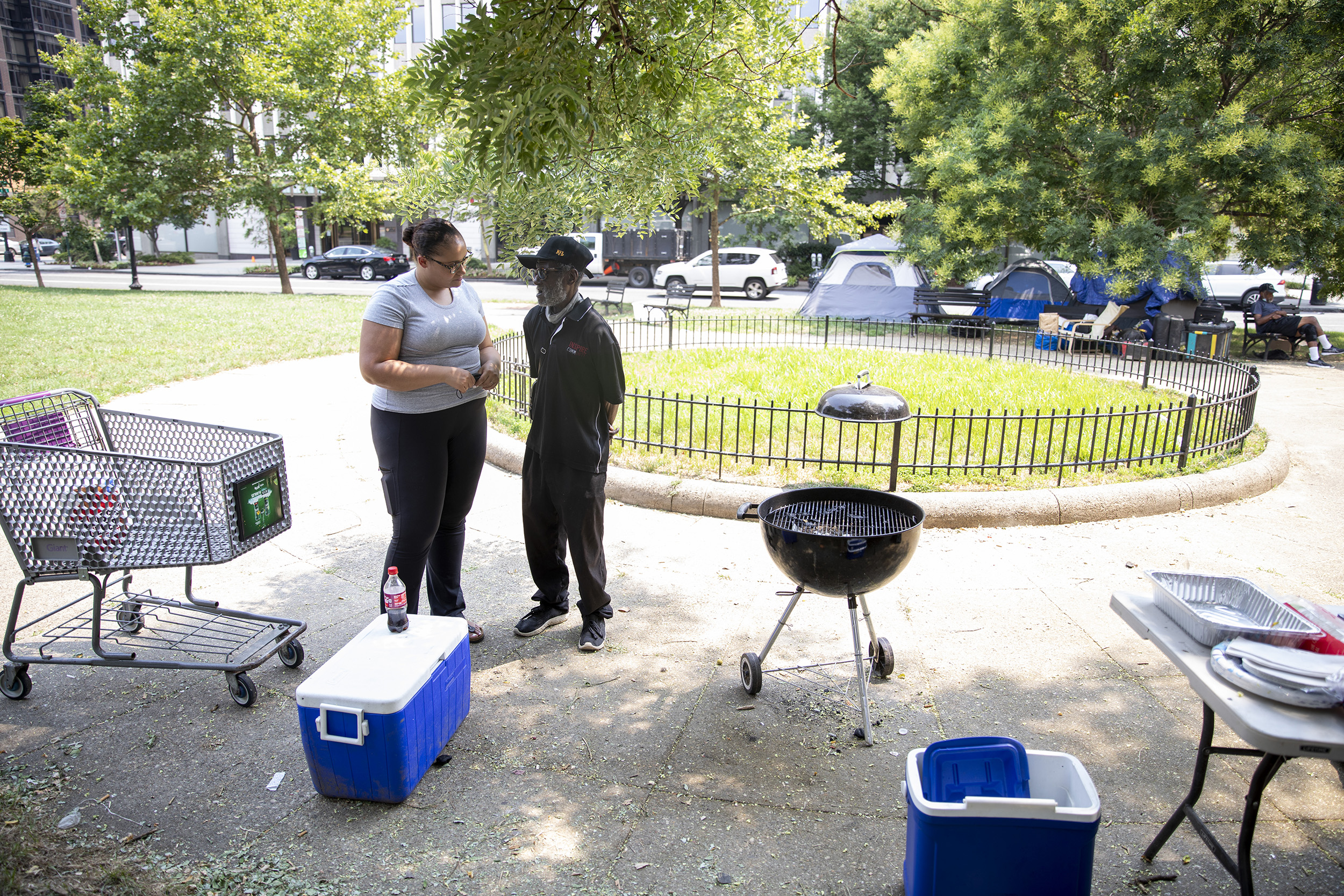
Bailey, the ANC commissioner, is planning an all-day “interagency intervention” for the unhoused residents on July 21. She says representatives from D.C.’s Department of Behavioral Health and Department of Health Services, Unity Health Care, HIPS, Miriam’s Kitchen, and other community groups will be joining to bring resources for the residents. They will provide medical, mental health, and detox services, as well as assist with gathering documents for housing vouchers and ensuring the residents have access to other D.C. services like food stamps.
Bailey has also been trying to secure a portable restroom for the encampment. The D.C. government put that request on hold once they learned an eviction may occur.
Buchanan is still hoping to receive his housing subsidy soon, although he doesn’t know when it will come. And Hall hopes that, going forward, his housed neighbors make an effort to get to know him and others living in Burke Park before passing judgment.
“Some people had it tougher than others, and they should give us some type of consideration,” Hall said. “You know what I’m saying? Just give us some type of consideration and come out and talk to us.”