Colleen Grablick
D.C. is now publishing data on COVID-19 infections among vaccinated individuals – and so far, it proves that vaccines have been highly effective in preventing serious illness and death from the virus.
Per the new data on “breakthrough” cases, 200 people — less than 1% — of the more than 375,000 fully vaccinated D.C. residents have contracted the virus since January. When compared to the total number of infections reported over that period, vaccinated individuals account for about 1.3% of cases. (The data included in the dashboard was last updated on July 11.)
“As we get more data about fully vaccinated people, the message couldn’t be clearer: Don’t wait, vaccinate,” said D.C. Mayor Muriel Bowser in a press release unveiling the new dashboard, which will be updated every other Thursday. “We know, and the data continues to show us, that the COVID-19 vaccines are incredibly effective, they are safe, they are keeping people out of the hospital, and they are saving lives.”
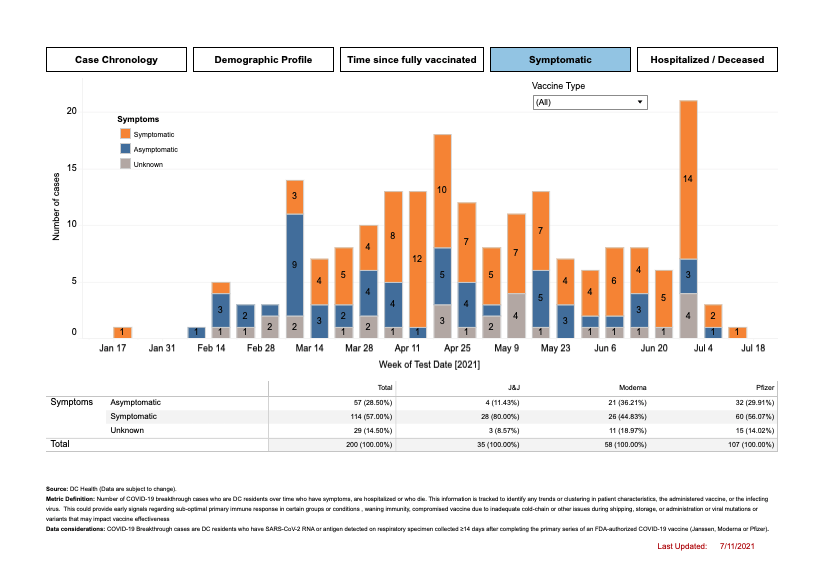
Of the 200 breakthrough cases, 57 were asymptomatic, while 114 developed symptoms. Four fully vaccinated individuals died of the virus, and 13 people were hospitalized. According Dr. Ankoor Shah, the leader of D.C.’s vaccine program, the individuals who died had significant medical histories, and three of them were over 65.
The fairly comprehensive dashboard marks the first of its kind in the D.C. region, allowing residents to see which vaccine an individual received, demographic statistics on breakthrough cases, and how long an individual had been vaccinated before contracting COVID-19. Virginia is also publishing data on breakthrough infections – which currently account for less than 1% of the commonwealth’s total positive cases. Among fully vaccinated Virginians, about 0.03% have contracted the virus.
Maryland has not published data on breakthrough infections, but a Maryland Department of Health spokesperson told DCist/WAMU in a statement that the state has identified 2,500 post-vaccine infections out of the more than 3.5 million people that are fully vaccinated in the state.
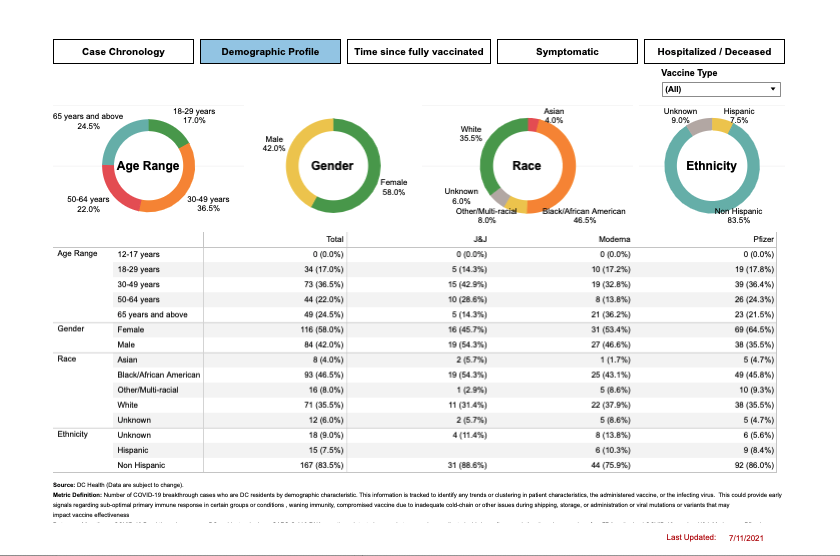
Demographic data shows that Black residents account for 46.5% of breakthrough infections, while white residents account for roughly 35%. (Black residents make up 24.2% of D.C.’s fully vaccinated population across all age groups, while white resident account for 28.6%.) The most breakthrough cases have been identified in the 30-49 age range, which accounts for about 37% of all breakthrough cases.
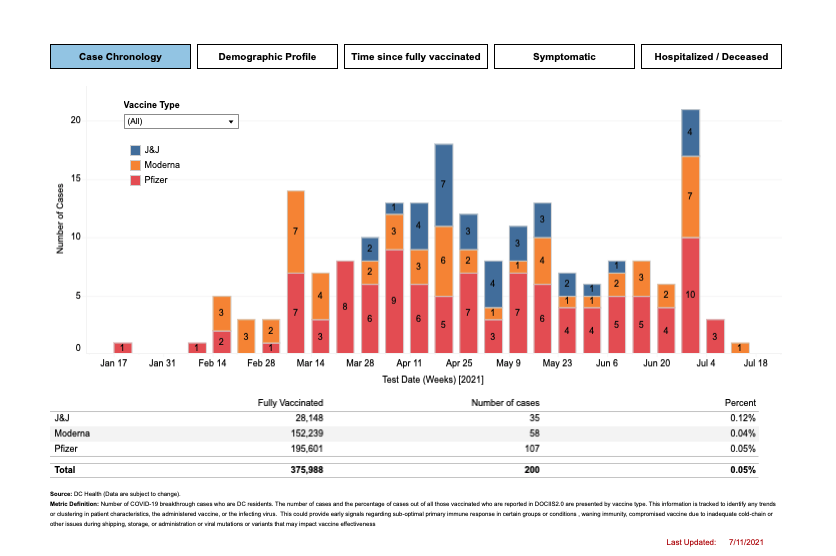
The city also released information on which strains of the virus are circulating in the region on Thursday, as the delta variant takes hold nationwide. The highly transmissible variant now makes up 83% of cases in the United States according to the Centers for Disease Control, but only 1% of cases in D.C., according to DC Health. (Officials first reported this number during a weekly call with D.C. councilmembers on July 16). According to DC Health, 1,613 samples have been sequenced by lab systems to identify variants, and officials have instructed labs to increase sequencing capacity. During a press conference earlier this month, DC Health director LaQuandra Nesbitt noted the limitations in sequencing — for example, antigen or “rapid” tests cannot be sequenced, and samples must be sequenced within two weeks.
During a press conference on Thursday, D.C. Health officials emphasized that the relatively small number of breakthrough infections — and the rarity of serious illness, hospitalization, and death in those cases – underscores the efficacy of vaccines, as COVID-19 cases increase around the D.C. region. As of Thursday, D.C.’s daily case rate per 100,000 residents was nearly 6 — the highest that metric has been since late May. For most of June, and into July, that metric stayed below 5, the threshold that indicates “minimal community spread,” and reached as low as 1.5 in late June. Now, it’s crept back up into the “substantial community spread” range. The rate of transmission, which measures the growth of an epidemic in a region by estimating how many people will be infected from one positive case, is now 1.77, well into the range of “substantial community spread.”
Daily death counts from the virus have remained low: Five individuals have died of the virus so far this month. Hospitalizations, too, have remained steady – and significantly lower than during other surges during the pandemic.
As of Thursday, 73.1% of adults in D.C. are least partially vaccinated, and 63.1% are fully vaccinated. As has been the case since the beginning of the rollout, vaccination rates for residents in wards 7 and 8 continue to fall behind their counterparts in whiter, wealthier parts of the city. In Ward 8, 25% of residents have been fully vaccinated, compared to 48% in Ward 3. The gaps widen drastically when looking at vaccination rates amongst children — 5.6% of kids ages 12-15 in Ward 8 have been vaccinated, compared to nearly 55% in Ward 3.
Bowser and DC Health officials have instituted numerous giveaways and other vaccine incentives to encourage people to get their shots — especially east of the Anacostia River — and the city has hired community outreach teams to talk face-to-face with residents about the vaccine.