Martin Austermuhle
Earlier this summer, a surprising sound punctuated the air at the corner of Georgia Avenue and Butternut Street NW: children laughing.
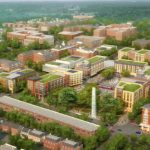
The sound emanated from a new playground on the southeastern edge of the old Walter Reed Army Medical Center, the 110-acre military campus that closed its doors a decade ago and moved operations to Bethesda. Now, after years of significant demolition and construction, a 66-acre portion of the campus is slowly coming to life as a mixed-used development emerges.
Known as The Parks at Walter Reed, the project is turning the once-cloistered site into a neighborhood for thousands of residents. A large part of the campus — which D.C. acquired from the federal government for $22 million in 2016 — was opened to the public last year for the first time in decades. Three residential buildings have been finished so far: The Brooks, an 89-unit condo building, opened earlier this year and now 60% sold, while The Vale, a neighboring apartment building with 301 units, is starting to lease up this month; a separate building was converted in 2019 to 77 units of housing for veterans experiencing homelessness.
All told, The Parks is expected to have more than 2,200 housing units, 432 of which will be income-restricted. There’s also a public charter school on site.
To accommodate the new neighborhood, the city’s street grid has been extended onto the campus. Butternut Street (known as Main Drive on the site) connects Georgia Avenue to 16th Street, and Cameron Drive recently opened as a connection between Aspen Street on the southern end of the campus to a new stretch of 12th Street. (You can see a map of the full site here.)
And there’s much more to come. So Other Might Eat is expected to finish work on a building of affordable units for 41 senior citizens later this fall, and more affordable housing for that site is currently planned. By next year, construction should wrap up on The Hartley, a 323-unit residential building anchored by a new Whole Foods supermarket. (It is replacing what used to be Building 2, the massive Brutalist structure completed in 1977 that served as the site’s primary hospital. Demolition took some two years, and involved what developers of the site say was a massive effort to contain environmental hazards while the interior was taken apart). Eventually there will be a new public pool.

But for everything new coming to Walter Reed, lots of the old will remain. The campus was designated a historic district in 2014, protecting virtually every structure built over a 50-year period from when the original hospital opened in 1905.
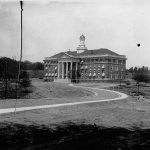
Appropriately named Building 1, the 300,000-square-foot structure is the site’s focal point, overlooking the Great Lawn, a rolling grassy expanse resembling a college quad. Developers haven’t yet settled on a use for the structure — which contains the Eisenhower and Pershing suites, where the former president and general spent their last days. They are considering everything from office space to senior housing.
“On the historic side, it’s similarly almost as expensive as building a new building but you’re working within the constraints of the existing footprint, so there are challenges there,” said Katie Wiacek, a managing director at Hines, one of the site’s developers. “But the potential is great because the buildings were beautiful.”
Whatever they choose, Building 1 will need extensive interior work. On a recent tour of the campus I spied plenty of paint peeling off the walls and evidence of water damage, and developers told me the wide hallways — which made sense for a hospital — aren’t particular useful for modern uses. And much like other historic buildings on campus, they said that part of their work has involved cleaning out what the military left behind.
“It’s like it was 5 o’clock on a Friday and somebody just turned off the lights and walked out the door,” said Mark Simpson, a development manager with Urban Atlantic, another of the firms involved in building out The Parks.
That also gave wildlife a virtual run of the place before construction began. The building was occupied by foxes, according to Simpson, and deer were known to cross over from Rock Creek Park to enjoy the then-abandoned campus.
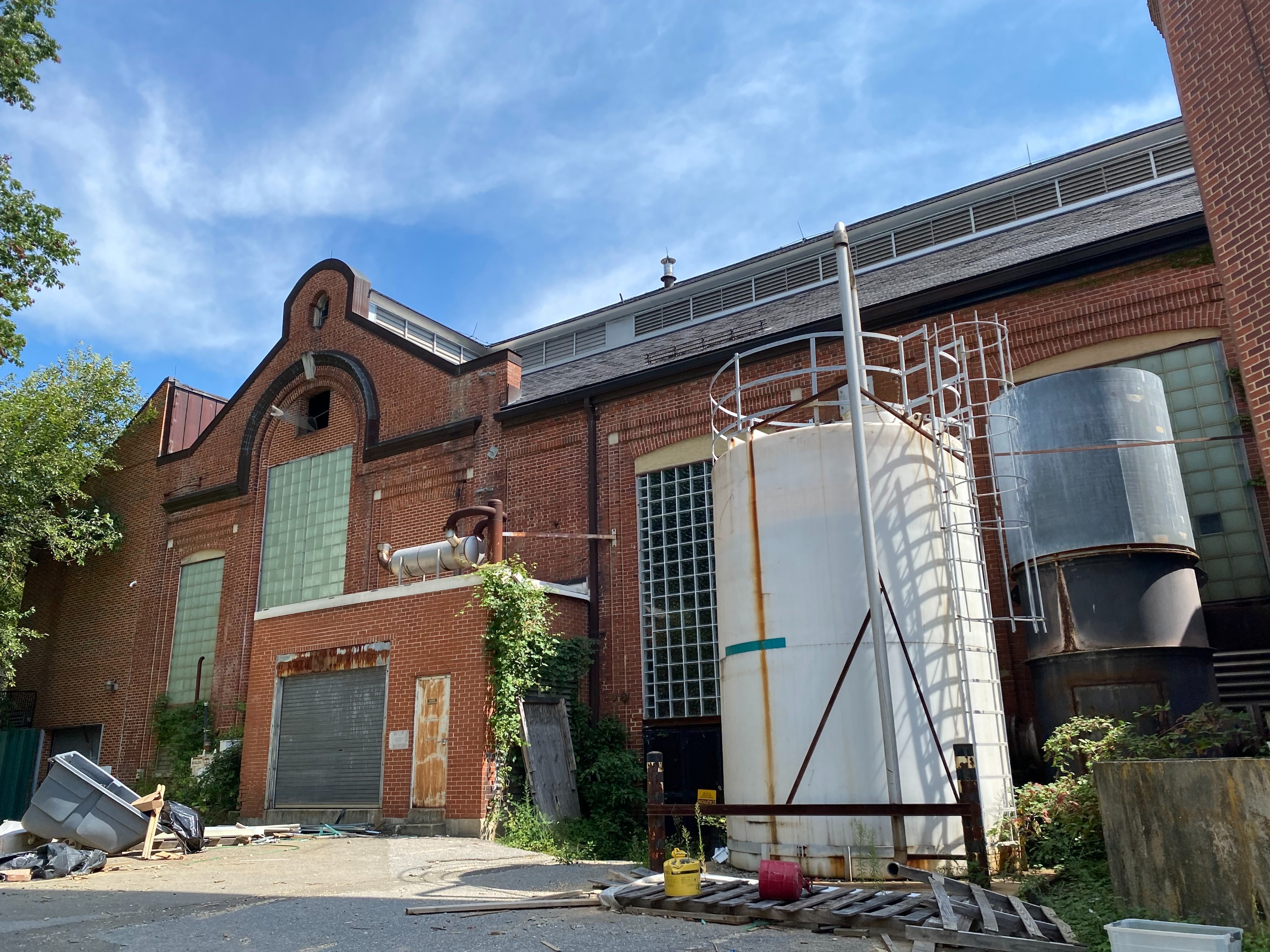
Another smaller building, formerly used to house nurses but later converted into an on-base police station, still has a holding cell in the basement. And there’s a former firehouse and auto repair shop; both are historically protected, so they’ll have to be repurposed. There’s also a former boiler plant — the smoke stacks are visible from Georgia Avenue and Aspen Street — that Simpson says is unique in its industrial architecture, and could potentially serve as a brewery.
Other historic elements of the campus will remain, including a rose garden and gazebo by the Great Lawn. So will a small plaque recognizing the site of the former Sharpshooter’s Tree, from where a Confederate sniper took a shot at President Abraham Lincoln as he visited Union troops massed at Fort Stevens as they prepared for a Confederate attack on the city. Also staying put will be four penguin sculptures in a fountain in front of Building 1. Legend has it that the penguins reflected the travels of Col. John Van Rensselaer Hoff, a military surgeon who founded the Army Hospital Corps in 1898. (A much less historic Burger King that once operated on the campus, though, no longer exists.)
And this fall, the development team will start a Neighborhood History Project, hosting three events to invite people to tell their stories of the Walter Reed campus, which not only housed many injured soldiers and staff, but was also a destination for kids in nearby neighborhoods before it was fully closed off after the September 11 attacks.
Wiacek says that for as much as is being done, there is still a lot left to do — construction across the site isn’t expected to be done until 2030. And that’s only on the 66 acres of the 110-acre site that D.C. acquired. The remaining portion was split between the State Department, which will build a campus for foreign embassies, and Children’s National Hospital, which is building a research center.