Martin Austermuhle
 Colleen Grablick
They’ll put on their uniforms, pack their lunches, try and ignore the first-day jitters, and hope everyone will be nice to them. No, it’s not kids going back to school — rather, D.C. lawmakers are coming back from their two-month summer recess.
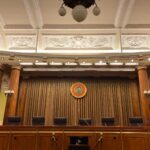
The D.C. Council returns to session on Oct. 1, which coincidentally is also the first day of the 2022 fiscal year. (Happy New Fiscal Year, everyone!) And lawmakers are unlikely to ease slowly into their duties: as always, pending legislation and oversight hearings have piled up over the course of the year, even more so now that schools have reopened to students and the delta-fueled pandemic continues.
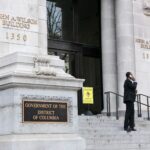
In one key way, though, the council won’t be like schools — we’re told that the Wilson Building will remain largely empty for the time being, with lawmakers likely to continue with virtual hearings and legislative sessions until at least January 2022. And the work that they do could, in part, be colored by another reality: the 2022 election cycle has started with the mayor, council chairman, attorney general, two At-Large seats, and the seats for wards 1, 3, 5, and 6 up for grabs.
Below are some of the key issues that the council is expected to take up.
Return to school
While the mayor’s office maintains direct control of D.C. public and charter schools, the council holds the power of performance and budget oversight — and can pressure city leaders and legislate on behalf of residents. Throughout the pandemic, the council has hosted several oversight hearings on Bowser’s plan to bring kids back in buildings; now, they’re monitoring the school system’s safety procedures one month into the full return to classrooms.
Earlier in September, a council hearing ran more than seven hours as parents and lawmakers pushed D.C. leaders for more transparent guidelines on quarantine procedures, more testing, and an expanded virtual option. (So far, Bowser hasn’t budged on the virtual learning front — unless a child has a doctor’s note, they are required to attend in-person classes). Just this week, lawmakers hosted another marathon hearing about the air quality in D.C. schools, largely focusing on the HVAC systems designed to mitigate the spread of COVID-19 in classrooms.
And that’s expected to result in legislation that could be introduced as early as next week, Council Chairman Phil Mendelson tells DCist/WAMU. “I am planning on introducing a bill that deals with several aspects of the school reopening — to relax the rigidity of the restrictions on virtual learning and to also relax the rules regarding unexcused absences and also addressing vaccinations. The details are still getting worked out,” he said.
Mendelson also says he expects a number of oversight hearings on education more broadly, touching on everything from access to school librarians (which became an issue during the recently completed budget season) to compensation for child care workers. There’s also a hearing on Oct. 12 on expanding safe passage initiatives for schools.
Marijuana legalization
For years, D.C. officials have said they’ve wanted to legalize the sale of recreational marijuana. And this fall they’ll finally get the ball rolling.
On Nov. 19, three of the council’s committees will hold a public hearing on two weed-related bills: one to expand the medical marijuana program and another to create a system for legal recreational sales.
Both bills lean heavily on the issue of equity; the medical bill from Bowser would allow people with non-violent criminal records to work in the burgeoning industry, while the recreational bill from Mendelson would set aside a number of business licenses for residents convicted of marijuana-related offenses or living in high-poverty areas. The overall purpose, advocates say, isn’t only to legalize marijuana — but also to ensure that those who were disproportionately affected by the war on drugs can now benefit from the lucrative legal market.
Of course, D.C. won’t exactly be first to the punch; more than a dozen states have already legalized recreational sales, and even Virginia is moving ahead to do so by 2024. But any local delays aren’t of the city’s making — in 2015 Congress banned D.C. from further legalizing marijuana, and it’s looking likely that the prohibition could finally be lifted later this year.
Even getting a public hearing is seen as something of a victory. Six years ago, D.C. Attorney General Karl Racine warned lawmakers that the prohibition on legalizing marijuana meant that lawmakers couldn’t even formally debate it. That legal guidance has since changed; the council is allowed to hold hearings and even vote on the bill, but only when the prohibition is lifted will Bowser be able to sign any measure that’s passed.
Ranked-choice voting
The push to bring ranked-choice voting to D.C. has long been a pet cause for many of the city’s progressives. But this fall it’s getting an extra push with a first-ever public hearing in the D.C. Council on Nov. 18.
Under the system, voters rank their top five candidates for a particular office, with the lowest vote-getter dropped each round until one candidate gets a majority. Advocates say ranked-choice voting would give D.C. voters a chance to vote for who they like, not merely who they think can win. They say it would also ensure that the winner of a crowded contest actually has a majority of the vote, instead of a mere plurality. And they add that New York City’s experience with ranked-choice voting in this year’s mayoral election proves it can work. Advocates want D.C. lawmakers to follow suit and pass the bill introduced by Councilmember Christina Henderson (I-At Large) over the summer. (Under the bill, ranked-choice voting wouldn’t start until the 2024 election cycle.)
But getting ranked-choice voting in D.C. may not be that easy. In September, the D.C. Democratic Party came out against it, calling it a “convoluted [process]” that won’t properly address existing disparities in voter turnout and participation in the city. (An analysis of New York City data found lower-income areas of the city were less likely to fully take advantage of the rankings available to them.) Henderson’s bill currently has six co-sponsors, meaning that if any of them gets cold feet, the whole effort could stall.
Public safety and criminal justice reform
The recent focus on police reform — which has thus far touched on everything from staffing to tactics — will continue into the fall with an Oct. 21 hearing on a bill that would strengthen the independent Office of Police Complaints and create a public database of police disciplinary files. During that hearing, lawmakers will also consider a bill that would require schools to keep and report data on disciplinary matters where police are called and another that would limit the interrogation and searches of minors by police.
The topic of minors will also be on the docket on Oct. 7, when the council will hold a public hearing on a bill proposed by Attorney General Karl Racine that would move crimes committed by individuals under the age 18 into family court. Under current law, 16 or 17-year-olds who have been accused of certain crimes can be prosecuted as adults without a judge’s review. Under Racine’s bill, children would only be prosecuted as adults at a judge’s request.
Also on the council’s desk are a pair of bills introduced by Councilmember Robert White (D-At Large) seeking to weed out racial bias in the Metropolitan Police Department. “The White Supremacy in Policing Prevention Act of 2021” would require the D.C. Auditor to investigate MPD to identify any ties with white supremacist or other hate groups. The second bill, “Bias in Threat Assessments Evaluation Amendment Act of 2021,” would study how law enforcement address different types of protests.
White introduced the bill as a response to the difference in law enforcement’s treatment of Capitol insurrections and the Black Lives Matter protests that happened during the summer of 2020 following the police killing of George Floyd. The legislation would require Racine’s office to collect data on the number of civilian injuries, arrests, fatalities, and officers deployed for all First Amendment demonstrations between Jan. 2017 and Jan 2021 — and to determine whether MPD’s response in each situation was different based on the race, religion, sex, national origin, or gender of the groups involved.
Independent superintendent
This fall the council is set to pick up the years-long debate over mayoral control of D.C. schools. Two bills on the docket are attempting to limit Bowser’s reign over the city’s public school system. Already co-sponsored by seven councilmembers, one bill would make the Office of the State Superintendent of Education — which oversees federal funding, enrollment, education standards for D.C. schools — an independent agency outside of the mayor’s control. Another bill, introduced by White and Councilmember Janeese Lewis George (D-Ward 4), would grant the State Board of Education the authority to appoint the superintendent — a power the mayor currently holds — and oversee the superintendent’s office. The public hearing on both bills is set for Oct. 26.
Former At-Large Councilmember David Grosso and current Councilmember Mary Cheh (D- Ward 3) tried challenging mayoral control over D.C. schools in 2018, but their proposal never made it to a vote. At the time, it faced strong opposition from Bowser — and the newly introduced bills are likely to face a similar uphill battle.
Redistricting
Beyond the fact that election season 2022 has just kicked off, it’s also that once-in-a-decade moment when the council redraws ward maps to account for population changes. That process started this week with a first formal hearing; a special council committee will take public input and redraw ward boundaries over the next few months, with the goal of having them finalized for a December vote.
And while it’s less competitive a process than in states that are tightly contested by Democrats and Republicans, it’s still likely to be a contentious process — past redistricting discussions have surfaced racial tensions and sparked debates over seemingly distant topics like residential parking. (This year, though, At-Large Councilmember Christina Henderson says she will introduce a bill to sever parking from wards.) This year’s debate is likely going to center on how to shrink Ward 6 (it’s by far the city’s largest) and whether Ward 8 hops across the Anacostia River for the first time.
And there’s more
The pandemic’s ongoing toll remains a backdrop to the upcoming legislative session. To that end, the council’s new Special Committee on COVID-19 Pandemic Recovery will hold two hearings: one on small business recovery, employment, and revenue; and a second on transportation access, infrastructure, and the impact of housing conditions on health. There’s a related health committee hearing on Nov. 4 focusing on the public health response to the COVID-19 pandemic.
The council’s judiciary committee will also hold an oversight hearing on the Department of Forensic Sciences, whose troubled ballistics lab was decertified this year and whose long-time leader resigned after a scathing audit of her leadership.