Martin Austermuhle
 Debbie Truong
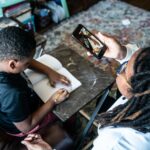
Fresh off of its two-month summer recess, the D.C. Council is expected to square off with Mayor Muriel Bowser on Tuesday over an emergency bill that would expand the availability of remote learning for students and allow them to receive excused absences if they are quarantining at home because a sibling or family member was exposed to COVID-19.
The bill — introduced by Chairman Phil Mendelson, Robert White (D-At Large), and six of their colleagues — marks the council’s first foray into governing how newly reopened D.C. schools will function as the pandemic drags on, and responds to a pair of public hearings held in September where some parents and advocates complained that D.C. schools were failing to adopt measures they say would help prevent the spread of COVID-19.
It would expand virtual learning to children who are not eligible for a coronavirus vaccine and who live with a person at high risk of becoming severely sick with COVID. Currently, fewer than 300 of the 52,000 students in D.C. Public Schools have been granted exemptions from in-person schooling. If passed, the measure would also apply to the city’s charter schools, which educate half of D.C.’s public schoolchildren. (Some charters already offer more virtual options for students.)
The bill would also increase asymptomatic COVID testing at schools from the current 10% of students to at least 20% in November; increase public reporting requirements for COVID cases; allow more schools flexibility to use outdoor spaces for classes or lunch, and allow students to use excused absences if a sibling has to quarantine because they are a close contact of someone who tests positive for COVID.
“We have to provide reasonable flexibility for parents who are using their judgement in the best interest of their kids and their families,” White said. “I don’t think the council should have needed to be this involved with school operations but unfortunately that’s where we are.”
That involvement has already prompted stiff opposition from Mayor Muriel Bowser, who pushed over the summer to get as many of D.C. 94,000 public and charter school students back in classrooms, arguing they would be better served inside buildings than from home – as many of them were during the 2020-21 school year. In a letter Sunday to Mendelson, she sternly pushed back on any additional flexibility on remote learning or student absences.
“While we recognize the understandable fears associated with any action in daily life in these times due to COVID-19, our schools, which are following and will continue to follow and strengthen safety protocols, are safe places,” she wrote. “There is no substitute for in-person learning, and we do not want to shortchange our students and their strong desire to learn. Implementing policies based on fear, rather than fact, will undoubtedly do just that.”
During the first month of school, DCPS and charters have reported 678 COVID cases, more than half of which have occurred in elementary schools — where most kids are still too young to get vaccinated.
In an interview, DCPS Chancellor Lewis Ferebee said expanding virtual learning to more students would cause too much disruption. Students might have to switch classes more than a month in the school year and teachers might be reassigned to a different roster of students.
“I worry about that for school leaders and our teachers but also for our students, who have already established relationships with their peers and their teachers,” he said.
Ferebee said he does not know how many students would choose to attend school virtually if given the option. But he said the proposal “opens the door much wider” for families to keep their children home. He added that broadening eligibility for online instruction would create a financial burden for the school system, which would have to hire staff and purchase more technology. And it could mean more teachers will have to simultaneously instruct two groups of students: one group in person and the other online.
Under an agreement with the Washington Teachers’ Union, which represents about 5,000 educators, teachers are only providing simultaneous instruction to students with qualifying health conditions and whose needs cannot be met otherwise.
“We agreed that it would be used on a limited basis,” Ferebee said. “There’s the potential where you’re putting teachers in the position where you’re asking more of them.”
D.C. schools have taken a strict approach to distance learning. The city created a virtual learning academy for students who have qualifying health conditions — nearly 290 students are currently enrolled. Students are only allowed to participate in the online program if a physician signs paperwork that says it is medically necessary. Parents have argued the language on the required form is too restrictive and fails to account for children who live with family members who are at high risk of becoming severely sick with COVID-19.
Some families say the emergency measure should go further. A group of parents called D.C. Families for COVID Safer Schools urged the lawmakers to include several more provisions, including providing rapid coronavirus testing on campuses; requiring students eat all meals outside; and mandating physical distancing in buildings.
“I’m glad that there is legislation right now, that they’re starting somewhere,” said Wendy Cronin, whose daughter attends Van Ness Elementary School. “But it barely begins to scratch the surface of what is needed.”
But White said the proposal targets only a few concerns so it has a greater chance of moving forward. Emergency legislation also cannot carry requirements that cost money, which limits the measures it can include. At eight co-sponsors, the bill would need one more vote to pass.
“The reality is we have to expand virtual learning because there are just some families who have severe medical conditions,” White said. “We know for a fact that COVID is transmitted in our schools and so why would we want to take the risk of putting the health and, frankly lives, of vulnerable families at risk because we are insisting on a particular education approach?”