Martin Austermuhle
Last year we had a pandemic. This year we had an insurrection. And a pandemic. Sigh.
Not unlike last year, much of D.C. politics this year was shaped and roiled by the on-again, off-again nature of the COVID-19 pandemic. We had an indoor mask mandate until we didn’t, and then we had it again until we didn’t, and now we have it once again. The vaccine rollout was, well, technologically challenged. City officials touted a recovery, fueled by more than $2.5 billion in federal funding. Schools reopened; but now many are going virtual again, and many parents wonder if they should be going back in person come January. And the D.C. Council ticked off yet another year of operating fully virtually.
But there was plenty more that happened.
An insurrection put down — only barely
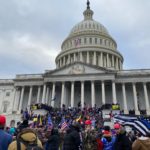
Let’s be clear: Had it not been for the Metropolitan Police Department’s quick response, the storming of the U.S. Capitol by supporters of Donald Trump on Jan. 6 could have been much worse than it was. More than 800 of the department’s officers helped put down an insurrection in a building where many of them don’t even have congressional representation; a few days after the fateful day, three of those officers told us harrowing tales of being beaten, threatened, and even tased by rioters. Two D.C. officers testified to Congress about the experience in July; one likened it to going “to hell and back.” (One of those, Michael Fanone, recently said he was resigning from MPD.)
And while the impacts of Jan. 6 are being felt in many ways across the country, the direct impact on D.C. has been particularly acute. Financially, D.C. officials put the initial cost of the deployment at $8.8 million, but also said it would likely end up being much higher. Not only were local police officers injured, but D.C. residents were subjected to a virtual militarization of the Capitol — including the installation of fencing that blocked off access to an area that many residents walk on, commute through, and enjoy on a daily basis. (It also bears remembering that some of Trump’s most aggressive supporters have used or threatened violence against D.C. residents; just this month one of them was sentenced to 28 months in prison for traveling to the city with guns and threatening to kill Speaker Nancy Pelosi and Mayor Muriel Bowser.)
And then there’s the matter of the D.C. National Guard, whose delayed deployment to respond to the insurrection remains a point of contention in the investigation over the events of Jan. 6. Because Bowser has no direct control over the D.C. National Guard, that’s left to the president. D.C. officials have long sought to gain the same control over their own National Guard that governors of the 50 states enjoy, and many thought the events of Jan. 6 would finally make that a reality. But members of Congress — the same ones saved by D.C. police officers — felt differently, rejecting a provision in a defense bill approved in December that would have given the city’s mayor control over the D.C. National Guard. Instead, Congress granted that power to… the U.S. Capitol Police.
All of this, of course, is all the more symbolically painful considering D.C.’s history. Created in 1790 after Congress was chased out of Philadelphia by a band of irate soldiers seeking back pay for their service in the Revolutionary War, Washington was meant to be neutral territory free from the influence or threats of any one state. Yet when violent mobs stormed the Capitol created to house that Congress, it was D.C. — its 700,000 residents without voting representation in that very building — that largely came to the rescue.
Statehood stalled
At the start of the year, the energy for D.C. statehood couldn’t have been higher. Not only was Joe Biden set to take the White House — after having formally endorsed statehood during his campaign, itself a first — but both the House and the Senate would be in Democratic hands, raising the prospect that a bill to make the city the 51st state could actually pass.
Yet some 12 months later, statehood is stalled, frustrated by many of the same political dynamics that have complicated or derailed other ambitious pieces of legislation in Congress. Despite a second successful House vote on the statehood bill and the first Senate committee hearing on the matter in almost a decade, Senate Republicans have largely stood firm against the idea — arguing that D.C. is, well, too wealthy for statehood. (House Republicans questioned whether our lack of a car dealership disqualified us from becoming a state; last year a Republican senator hinted D.C. would need more loggers and miners to be eligible.) But the push took a bigger dive in April, when Sen. Joe Manchin (D-West Virginia) said he’d rather see statehood addressed through a constitutional amendment.
While there’s still a possibility Democrats could find a way to get around the filibuster to pass sweeping voting rights legislation, it remains unclear whether D.C. statehood would even be included. And as odds increase that Republicans could take one or both houses of Congress during next year’s midterm elections, there’s now a growing chance the energy in D.C. could flip. Instead of pushing for statehood, activists and local officials may instead be forced to again fend off GOP involvement in local affairs — whether its marijuana legalization, abortion access, or any other hot-button issue.
Or they could work on getting D.C. a car dealership, right? Maybe hire a few loggers?
The homicide spike continues
There was no respite after a deadly 2020. In fact, it only took until mid-November of this year for D.C. to surpass the homicide tally from last year, and the killings have kept happening — as of this writing, there have been 219 murders, 12% more than last year and the highest they’ve been since 2003. Like in many cities across the country, concern around public safety spiked in D.C. this year. Despite overall crime rates being only slightly up, a spate of high-profile car jackings — including the tragic death of Uber driver Mohammad Anwar — that have continued throughout the year have kept many residents on edge. Much the same goes with murders, which included the mass shooting on Longfellow Street NW that left three dead, and the senseless killings of kids, including six-year-old Nyiah Courtney.
D.C. officials have struggled to mount a response — largely because they, like many officials across the country, can’t properly explain what’s happening. Early in the year, Bowser declared gun violence a public health emergency, launching a coordinated response to focus on the city’s deadliest blocks. Both Bowser and councilmembers have followed up by increasing funding for violence interrupters; both Bowser and Attorney General Karl Racine recently announced they were expanding their respective programs into new neighborhoods.
At the same time, the Metropolitan Police Department is shrinking; as of late November, it was down to roughly 3,500 officers, between 300 and 400 less than last year. (Retirement and resignation rates are holding steady, but hiring has slowed — because of cuts to the budget by Bowser and the council.) In August, Bowser asked the council for $11 million to hire 170 new officers; lawmakers gave her only half that, arguing that her request seemed politically timed and unlikely to produce any significant changes to crime rates.
The issue of policing and public safety is likely to become more political in 2022, largely because it’s an election year. Will Bowser and the council clash again over the police budget and hiring? Councilmember Robert White (D-At Large), who is challenging Bowser, has pushed back against more police; will he continue to do so? And will Bowser, like some other Democratic mayoral contenders in other left-leaning cities, make a bigger issue of hiring more police officers? There’s also the push for police reform that started last year after George Floyd’s killing. Earlier this year the D.C. Police Reform Commission unveiled a sweeping set of proposed reforms for MPD, but the council hasn’t yet moved to act on most of them. Will it next year — as many of the commission’s members have asked — or will lawmakers shy away?
The progressive wing gets a big win
Everyone knows D.C. is a Democratic town, but beneath that political veneer exists a long-running tension between the centrists and the progressives. And on the council, the centrists have long prevailed — until now. Over the summer the council approved a slight tax increase on wealthy households, with the expected revenue (from $102 million in 2022 to $176 million in 2026) to be split between additional housing vouchers for people experiencing homelessness, financial assistance for low-income households, and increased pay for child care workers. The tax hike’s approval came on an 8-5 vote, with new councilmembers Christina Henderson (I-At Large) and Janeese Lewis George (D-Ward 4) — is two a squad? — casting the decisive votes. Just last year, before Henderson and Lewis George were elected to the council, the same tax increase proposal failed on a — you guessed it — 8-5 vote.
Tent tensions
Homelessness was on the rise during the pandemic, and its most obvious manifestation was in the growing number of encampments that popped up across D.C. (city officials estimated there was a 40% spike.) And the issue came to a head late in the summer, when D.C. unveiled a new pilot program to address encampments that relied on a carrot-and-stick approach: outreach workers would engage residents at five large encampments and offer them housing ahead of a scheduled clearing of the encampment, and then prohibit any of them from returning to those locations.
The program was first rolled out at two encampments in NoMa; city officials touted their success in getting most residents housed, while critics pointed to the use of heavy machinery to clear out tents (and an injury to one person that resulted) as proof that the clearings were violent and traumatic. In the weeks afterwards, homeless advocates and some lawmakers demanded that Bowser stop the pilot program altogether. They insisted they also support the housing-first approach, but said the threat of evictions is unnecessary and counterproductive. City officials declined to stop the program, saying that an overwhelming majority of people at targeted encampments were accepting housing or moving into temporary hotels rooms as the housing search continued.
Earlier this month — after an encampment in Truxton Circle was cleared — Councilmember Brianne Nadeau (D-Ward 1) responded with a bill that would prohibit the city from clearing any more encampments during the winter months. It would instead require the city to provide services ranging from bathrooms to regular trash pickup. But enough councilmembers had concerns with the bill’s broad language to delay a first vote; a second vote this week failed amidst ongoing concerns with language that some lawmakers feared would tie the city’s hands in terms of responding to encampments.
These D.C. agencies could have had a better year
Department of Forensic Sciences: If “CSI: D.C.” existed as a TV series, it could spend an entire season focusing on the drama inside the city’s crime lab. In April, the lab lost its national accreditation over concerns with its handling of ballistics evidence. Facing pressure from D.C. Attorney General Karl Racine and others, the lab’s director resigned in May. And just this month, a sweeping review of the lab’s work came to a dramatic conclusion: D.C. should review 10 years worth of cases that involved the lab’s firearms and fingerprints units. City officials say other parts of the crime lab could soon regain accreditation, but until that happens, evidence from local crime scenes is being outsourced to other labs for analysis.
Department of Corrections: You know you had a rough year when even the city’s attorney general says he won’t defend you in court, right? D.C. officials and advocates have long known the city’s aging jail was in need of renovations or outright replacement, but this issue was forced into public view late in the year when the U.S. Marshals said they would transfer up to 400 inmates to a federal facility in Pennsylvania because of poor conditions at the jail’s Central Detention Facility. (Conditions at the Central Treatment Facility next door were found to be acceptable.) Local advocates expressed some frustration; they said conditions at the jail had always been problematic, but the Marshals had only gotten involved because some 40 Jan. 6 defendants — who are white — were being held in the jail pending trial. (Ironically, they are being held in the better CTF, not CDF.) D.C. eventually entered into an agreement with the Marshals to improve living conditions at the jail; earlier this month they led reporters on a tour of the facility, where they said conditions were better than the Marshals had reported. Oh, and we mustn’t forget the one thing no one would have predicted at the start of the year: right-wing Rep. Marjorie Taylor Greene (R-Georgia) toured the jail.
Department of Employment Services: It’s undeniable that the pandemic and the sudden economic fallout that followed tested the city agency that manages unemployment benefits like never before. But by 2021, lawmakers seemed to be done with excuses over delayed benefits payments and other problems. In May, the D.C. Inspector General said it was launching an audit into the management of unemployment benefits; that same month At-Large Councilmember Elissa Silverman called for a “complete overhaul” of DOES. Later in the year another challenge emerged: a growing number of D.C. residents who had applied for unemployment benefits (and even some who hadn’t) said they were victims of identity theft, and that DOES wasn’t doing enough to address it. And if anyone at DOES thinks the pressure on them will let up, think again: Councilmember Robert White (D-At Large), who is challenging Bowser in next year’s mayoral race, says it’s one of the top agencies he wants to see reformed.
D.C. Housing Authority: First, Director Tyrone Garrett resigned after a tumultuous run heading the agency that manages D.C.’s stock of affordable housing. Later, board chairman Neil Albert (a D.C. power player and close ally of Bowser’s) similarly stepped down after revelations that he steered contracts to his girlfriend. And all of this comes as the agency struggles to address a large stock of public housing that is aging and in dire need of repairs.
Department of Transportation: Back in 2015, Bowser committed to Vision Zero — zero traffic deaths on D.C. roads by 2024. Since then, traffic deaths have largely increased; there have been 40 as of the second week in December, higher than at any point in 14 years. And calls for more action have risen after a number of children were struck by cars, including two on “Walk to School Day” in October. Some residents and advocates have put the blame on DDOT for moving too slowly to implement changes to city streets under the Vision Zero program. Bowser has responded: in May, she pledged $10 million for more safety upgrades and traffic enforcement. In November, she announced heightened enforcement in school zones, and this month she announced D.C. would move forward on getting rid of the reversible traffic lanes on Connecticut Avenue and instead build protected bike lanes. Lawmakers, though, are clearly done waiting. As part of the budget, Councilmember Mary Cheh (D-Ward 3) moved to direct all revenue from new traffic cameras to paying for Vision Zero implementation. More recently, Councilmember Brianne Nadeau (D-Ward 1) introduced a bill to standardize the construction of raised crosswalks, and Lewis George put forth her own measure to increase traffic safety around schools.
Let the races begin!
Politically speaking, 2018 was boring — Bowser ran for a second term with virtually no opposition. That won’t be the case in 2022. Councilmember Robert White (D-At Large) announced in October he would challenge Bowser, followed shortly thereafter by Councilmember Trayon White (D-Ward 8) — who, in what we assume is a first for any campaign anywhere, made his intentions clear in a comment on an Instagram post. All three of the Democrats are also using the city’s new public financing program, which supercharges small-dollar contributions from D.C. residents.
Is Bowser vulnerable? Robert White certainly seems to think so; his pitch to voters is that while D.C. has certainly grown and developed in Bowser’s eight years in office, it hasn’t done so equitably. (Bowser’s response is essentially that she knows there is still work to be done, and she’s best placed to do it.) But she’s still a formidable contender: she posted huge fundraising numbers earlier this month, and polling by a number of advocacy groups has pinned her citywide approval rating at around 70%.
D.C. Council Chairman Phil Mendelson is also being challenged from the left, this time by Ward 4 Advisory Neighborhood Commissioner Erin Palmer. And a few challengers are hoping to knock off Councilmember Anita Bonds (D-At Large), too. Probably the widest-open race is over in Ward 5, where Councilmember Kenyan McDuffie (D-Ward 5) has opted instead to run for attorney general. (Attorneys Bruce Spiva, Ryan Jones, and Brian Schwalb are also running.) The field of hopefuls in Ward 5 includes contenders new and old, and they’ll be pitching themselves to voters in a ward that has grown and changed substantially over the last decade.
And if all that isn’t enough, the battle over whether to get rid of the tipped wage in D.C. — one that was fought out at the ballot box in 2018 and overturned by the council — could be before voters again next year.
And there was also this…
D.C. will soon have new ward maps. Is the end near for the never-ending McMillan saga? After years of heated debate, D.C. finally has an amended comprehensive plan. And after years of asking, Ivy City residents to get a recreation center at the Crummell School. Foreign hackers stole lots of data from MPD. A pair of right-wing members of Congress got a tour of the D.C. Jail. Speaking of the D.C. Jail, it got its first ever Advisory Neighborhood Commissioner; he was later released after 26 years in prison. A ranked-choice voting bill got its first D.C. Council hearing. And lawmakers start considering legalizing marijuana sales, but Congress is still standing in the way. Goodbye, gas-powered leaf blowers. We went deep on Wolf Blitzer’s quirky obsession with local gas prices. A pair of Transformers faced an unexpected foe: historic preservationists.