Martin Austermuhle
Most D.C. Public Schools students will be returning to public schools Thursday after the city pulled off the significant logistical feat of testing tens of thousands of students and staff for COVID-19 ahead of a post-holiday resumption of in-person classes.
D.C. officials announced Wednesday night that more than 47,000 staff and students submitted the required results for rapid COVID-19 tests they took this week. Of the 9,224 teachers and staff who submitted their results, 667 came back positive. And of the 38,270 students who similarly provided results, 2,111 were positive. There are roughly 49,000 students in D.C. Public Schools, and students will still be allowed to take tests or submit results upon arrival this morning.
In an email to staff, DCPS Chancellor Lewis Ferebee called the testing campaign “truly remarkable.”
While some classrooms in different DCPS schools will shift to virtual learning due to positive test cases, only one full school — Jefferson Academy Middle School in Southwest — will operate virtually until Jan. 17. According to data published by D.C., eight of the 70 staff who submitted results tested positive, as did 10 of the 287 students.
Based on current test results, the positivity rate across DCPS stands at 7.2% for staff and 5.5% for students. At Jefferson, the positivity rate for staff stands above 11%. DCPS officials did not immediately respond to questions about what prompted the decision to shift the school to virtual learning, but earlier this week Ferebee said future decisions would be made on a school-by-school basis depending on where positive cases are found.
“There could be a scenario where staff positivity could drive us to pivot to a virtual status for that school for a period of time,” he said. The decision to shift a school to virtual learning, Ferebee said, depends on what staff members are testing positive. “Sometimes we are able to get substitutes to serve in some capacities. And then in some situations, we’re not able to based on how specific their responsibilities are.”
Various D.C. lawmakers had called on DCPS to establish a specific metric that would trigger a return to virtual learning, a move that school officials resisted. In neighboring Montgomery County, 115 of the county’s 209 public schools have already exceeded the set threshold for closure — set at 5% of staff and students testing positive for COVID-19 in the preceding 14 days. But school officials said Wednesday that decisions to close individual schools would be based on the specifics of who tested positive.
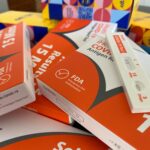
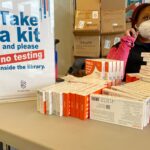
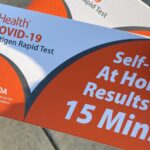
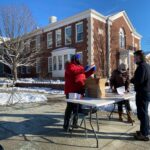
The return to in-person schooling became significantly more fraught since COVID-19 cases in the city spiked dramatically in December. A number of DCPS schools were forced to go virtual in the last week before the holiday break due to high numbers of COVID cases, prompting Ferebee and Mayor Muriel Bowser to delay the return in January by two days (and then a third due to the snowstorm that hit this week) and require that staff and students get tested. The city then set about distributing tens of thousands of testing kits this week and analyzing the uploaded results, which itself saw a brief hiccup on Tuesday when teachers reported technical difficulties with the website set up to accept test results.
Some lawmakers have expressed concerns with DCPS’s protocols for a return to in-person schooling. Earlier this week, Councilmember Robert White (D-At Large) — who is also challenging Bowser in the mayoral election — introduced emergency legislation that would require DCPS to set a metric that would trigger a return to virtual learning, mandate quicker reporting of positive COVID-19 cases to families, and require that the school system update the D.C. Council on hiring plans for school-based COVID-19 coordinators and substitute teachers.
“The administration has fallen short. We have to fill in as many gaps as possible,” he said.
In October, the council passed a bill slightly expanding virtual learning for some students and requiring an increase in weekly asymptomatic testing in DCPS.
Similarly, on Wednesday Councilmember Trayon White (D-Ward 8) sent a letter to Bowser — who he is also challenging for the city’s top job — asking that more virtual learning options be given to students, that students and staff be provided KN95 masks while at school, and that more job protections be given to parents who have to stay home because they or their child contracted COVID-19.
“We are sending our children into a burning house by forcing them to return to in-person learning only days after the holiday season,” he wrote. “Measures requiring that students report back to campus with a negative test do not ensure safety. It is known that COVID-19 tests often do not detect new cases until a few days after infection. Furthermore, the omicron variant is much more contagious, even infecting those who have been vaccinated and received booster shots. Omicron would undoubtedly circulate rapidly amongst our unvaccinated students.”
According to D.C. data, 20% of the city’s 5- to 11-year-olds have received one or both doses of the COVID vaccine. About 67% of kids aged 12 to 15 have received at least one dose, as have 65% of kids aged 16 to 17. (Just over 65% of all D.C. residents are fully vaccinated.) Starting in March, D.C. will require a COVID-19 vaccine for students who are eligible to receive it and for which full FDA authorization has been granted.
The city reported 1,324 new positive COVID-19 cases on Jan. 4, the most recent data for which data is available, representing a case rate of 288 cases per 100,000 people. That’s more than 10 times higher than it was a month ago, though cases have slowly started dropping off in recent days.