 Za’Kari Tucker
 Zy’Kera Tucker
This article is part of a collection of work produced by young journalists. DCist/WAMU partnered with The Creative School, a nonprofit focused on empowering youth-led storytelling in Southeast D.C., to teach a foundations of journalism workshop during spring break. You can see all of the stories here.
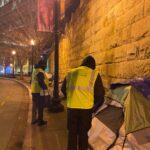
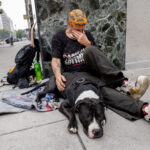
“I don’t want to see nobody homeless — even my enemy,” says Ronald Smoot. Smoot, a vendor for the publication Street Sense, had to deal with homelessness for 36 years. “I survived, but I don’t want to go back out there again.”
It can be easy to ignore pervasive problems like homelessness and climate change for people who don’t have to deal with them on a daily basis. But people who don’t have a place to stay have to put up with climate change every day.
“Unhoused people are the front lines of climate change,” says Kush Kharod, who works with the youth climate advocacy organization Sunrise DC. In Sunrise DC, Kharod says, one of the things they do is “help endorse candidates and support candidates that will fight for a Green New Deal … which intersects these things like homelessness and climate change and housing and transportation.”
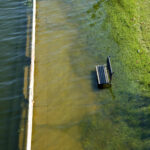
Protection from the weather is increasingly important. It’s getting warmer during summers and colder during winters. In D.C., scientists say climate change will cause more extreme heat, more flooding, and more unpredictable weather and extreme storms overall. People who have houses have to deal with this too, but not to the extent that people without homes do.
The health effects of climate change are already affecting District residents.
“The D.C. government has reported that extreme heat causes more death than any other weather-related hazard,” says DeAysia Johnson, a registered nurse who works with a group called Pathways to Housing D.C. She and her coworkers treat people on the street who have medical needs. “From a nurse’s perspective, unhoused residents are especially vulnerable to the extreme heat, which can start with something as mild as a heat rash or a cramp and can escalate to something as serious as heat exhaustion, life threatening heat stroke or even death in the worst cases.”
Smoot, the formerly homeless Street Sense vendor, says Mayor Muriel Bowser has not delivered on her plan to prevent and end homelessness. “That’s yet to be seen,” he says. “I’m sure she probably working on it … [but] there’s still a lot of homeless people out there.”
According to the recently published results of the city’s annual Point in Time Count, homelessness has decreased in D.C. during Bowser’s administration, particularly among families. But some advocates, along with the Government Accountability Office, say the method D.C. uses to count the homeless population is flawed.
Ken Martin, an activist who focuses on the issue of homelessness, believes the number of people experiencing homelessness continues to rise, despite what the PIT Count indicates. It is hard for people to have hope when those who offer help don’t live up to their promises, says Martin, who was homeless himself and went through that struggle for 17 years.
“People are incredibly cruel and homeless folks find that out,” Martin says.

Kharod, the Sunrise DC activist, says climate change affects both people who are experiencing homelessness and people who live in substandard housing.
“If people don’t have housing right now or if they have bad housing like roofs that are falling apart, windows that are falling apart when floods or hurricanes come out, they’re going to be dealing with [it] the most,” he says.
Even though Abel Putu has housing, he was affected by flooding last year due to poor property management. Some of his damaged property was replaced, only to be ruined again. “Everything got flooded, water damage, everything in my apartment getting mildew right now,” says Putu, who sells and contributes to the Street Sense newspaper like Smoot.
“I ain’t gonna lie. It’s been tough. It’s been tough when I was homeless,” Putu says. “I used the wheelchair basketball — it was momentum to encourage me to be strong.”
It’s impossible to reverse the effects climate change has had on the environment, but both Martin and Kharod say everyone can do their part to try to slow it down and take more care of the environment and each other.
“People don’t care, which is the reason why we have the climate issues,” Martin says. “Because if you cared, you could fix this.”