Matt Blitz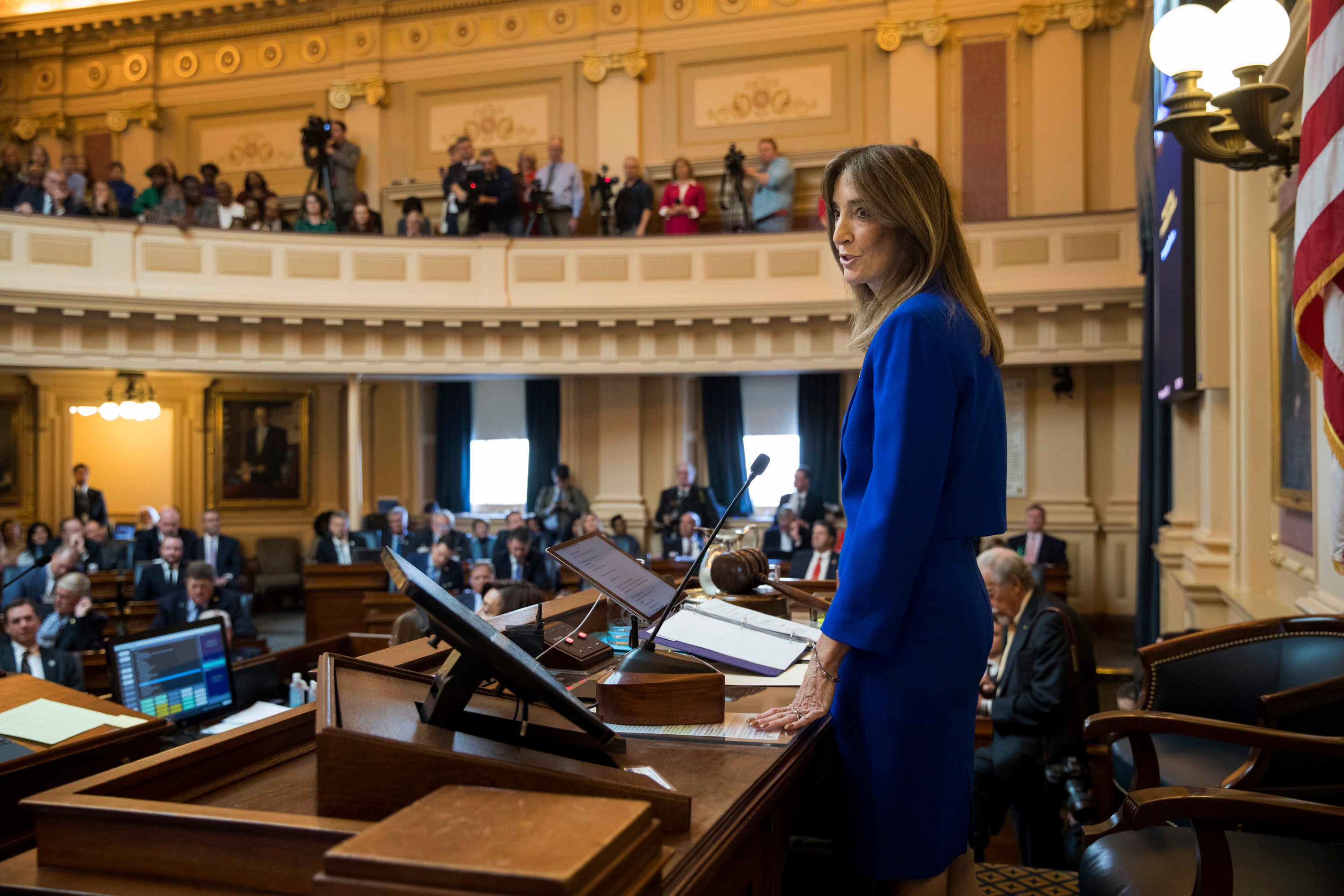
Eileen Filler-Corn, who until December of last year served as the Speaker of the Virginia House of Delegates, announced she won’t be running for re-election, setting herself up for a possible shot at the governorship in 2025.
The announcement from the former Virginia Speaker of the House was just the latest in recent weeks from a growing list of veteran Fairfax County legislators stepping down at the end of their terms.
After 12 years in the General Assembly, Filler-Corn’s decision to end this chapter of her political career may be the next step in opening a new one.
“Moving forward, I have been very vocal in my interest in exploring [a run] for governor and recognizing that that would be the next challenge and the ability to really have the greatest impact on Virginians,” she told DCist/WAMU.
Filler-Corn was the first woman and first Jewish person to serve as speaker of the Virginia House of Delegates when she was selected for the leadership role in 2020. She was ousted as leader of the Democratic caucus last year due, at least partially, to the results of the 2021 gubernatorial election.
Her departure is the latest in a line of long-time Virginia lawmakers who have announced either their retirement or that they will not seek re-election.
In all, seven Northern Virginia lawmakers have announced they won’t be running again in November. Five of those represent residents in Fairfax County.
And with these departures, which include Sen. Janet Howell, Del. Ken Plum, and Sen. Dick Saslaw, the ranks of veteran legislators are now set to thin significantly.
This likely won’t be a good thing for Northern Virginia or the Virginia General Assembly, Dean of George Mason University’s Schar School of Policy and Government Mark Rozell told DCist/WAMU.
“There is a huge loss of institutional knowledge and memory that is taking place with all of these members from Northern Virginia stepping down from the General Assembly,” he said. “Also, just very deep connections to the community where they understand the issues that are important to Northern Virginia and how they play down in Richmond.”
A significant factor in many of these decisions was 2021’s redistricting, which landed a number of incumbents in the same districts and would have forced them to face off against each other in a June primary.
Filler-Corn, for example, would have had to run against Kathy Tran in the newly-drawn 18th District, which covers Springfield, Lorton, Burke, and parts of Alexandria in Fairfax County.
While Filler-Corn declined that facing Tran in a primary played a role in her decision to step aside, she did say that needing to potentially win two tough elections to earn a seat in the legislature weighed on several colleagues of hers.
Filler-Corn made public the decision not to run again via a press release Tuesday morning. In the statement, she touted her accomplishments in securing greater voting rights, expanding public education, gun violence prevention, and reproductive freedom.
She told DCist/WAMU that with a divided General Assembly and a governor’s mansion occupied by Republican Glenn Youngkin, it’s her belief that she could have a bigger impact “from outside of the confines of the House of Delegates.”
Filler-Corn, who was first elected to the General Assembly in 2010, acknowledged there will be a great deal of experience and built-in knowledge that will be gone when she and others depart the General Assembly at the end of the year.
“It will be more challenging if we have less people that have that experience,” she said. “It’s always good to be looking out there, identifying, and recruiting new, capable, competent individuals who will also represent… constituencies that haven’t had a voice. But we have to recognize the fact that we’re losing some of this institutional knowledge, which will be a tremendous, tremendous loss.”
This past session, which concluded just a couple of weeks ago, was not exactly the most productive for the divided General Assembly. A “skinny budget” was finally passed, along with only a handful of notable bills.
Rozell said this stalemate and polarization will likely grow in the years to come, since a number who are leaving the state capitol entered at a time when both sides regularly worked together.
“These were folks who came into politics at a time of genuine bipartisanship and who were, first and foremost, institutionalists, who really cared about good government,” he said. “In today’s hyper-political environment, with very deep polarization, we don’t know what we’re going to get next.”
As for what’s immediately coming up for Filler-Corn, next week her official Speaker of the House portrait will be unveiled at the Capitol in Richmond. And she will continue to support Democratic candidates and elected officials through her political action committee.
And in the months and years to come, Filler-Corn says she is “energized for the next challenge.”
That challenge appears likely to include a run for the governor’s mansion in 2025.