Matt Blitz
The Fairfax County School Board has voted to extend collective bargaining rights to its employees.
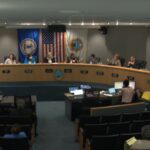
The board for the largest school system in Virginia adopted the resolution unanimously late last night giving employees the right to collectively bargain. The vote came three years after the Virginia General Assembly first gave localities the option to grant collective bargaining rights to employees, essentially dismantling a 1977 Virginia Supreme Court ruling that said otherwise.
The 22-page resolution was developed over the last 15 months and included a number of work-group sessions, negotiations, and public hearings. It provides 28,000 county public school employees the ability to elect a union to negotiate contracts, which would provide standards for pay, conditions, and benefits.
The hope is that by allowing school employees to collectively bargain, it might help address retention and recruiting issues that have led to staffing shortages across the county and state.
The resolution also provides similar rights to school employees as their Fairfax County government worker counterparts, which were approved for collective bargaining back in 2021. The Arlington School Board passed a similar resolution last year, giving their teachers and staff collective bargaining rights.
“This vote is a demonstration not only of our commitment to improving school staffing, pay, and morale but also to better outcomes for students,” Fairfax County School Board member Karl Frisch said upon introducing the motion. “In addition to engaged parents, there is no greater driver of student success than classroom teachers and school staff.”
It is expected that employees will elect the Alliance of Fairfax Educational Unions (AFEU), which consists of the Fairfax Education Association (FEA) and the Fairfax County Federation of Teachers (FCFT), to represent them.
David Walrod, president of the Fairfax County Federation of Teachers, told DCist/WAMU that last night’s vote is a cause for celebration since it’s been nearly 50 years in the making.
“Collective bargaining had been banned in Virginia for public sector employees since 1977. And yesterday, Fairfax County was finally able to kind of move past that,” Walrod said. “What [collective bargaining will] do is it’s going to give educators a seat at the table for the first time. And we know that teachers and teacher working conditions are student learning conditions. And so by improving teacher working conditions, we’re really improving the conditions that students work under.”
A number of school board members reiterated this sentiment, adding that making sure teachers are treated fairly leads to increase teacher motivation, retention, and recruitment which improves student performance and success.
“We have issues with teacher retention and recruitment in Virginia,” School Board chair Rachna Sizemore Heizer said at the meeting. “Average teacher pay in Virginia is more than 10% below the national average in 2020 and 2021. These things matter because you do the work. You do the work of creating a better future for our country… you all do amazing work making our students love school and helping them learn and become the amazing people that they are. We owe it to you, to work hand in hand with you.”
Both union leadership and the school board noted that while this was a big step, there’s more work to be done. This resolution only takes the first step in granting the option to employees to collectively bargain.
The next steps are for 30% of the unit to note that they actually want collective bargaining and that they want AFEU to represent them. Walrod says he expects that to happen soon, but actually negotiating an agreement with the school district that would lay out pay, benefits, and condition standards could take longer.
“I would love to say that we’d have a contract tomorrow, but that probably isn’t realistic,” he said.
The aim is to have a contract in place for the 2025 fiscal year, which starts July 1, 2024. Walrod said the top-line items they are looking to negotiate are pay, health insurance benefits, classroom size, and general workload with staffing shortages remaining a concern.
There are a few things the resolution doesn’t do.
It excludes substitute teachers or temporary employees from the bargaining unit. It also only recognizes three bargaining units – licensed instructional staff, operational employees, and administrators and supervisors.
As several board members noted, not all school jobs fit neatly into those categories. So, another motion was introduced and approved that would allow for more than three collective bargaining units in the future. A resolution about that is expected to be developed and brought to the board by July 1, though several board members expressed their desire to push the deadline to Sept. 1.
Walrod said that the union’s priority is to make sure everyone’s needs are heard and supports this resolution.
Some school board members did note that the process took a bit longer than expected, but it ended with a shared agreement to grant employees the option to collectively bargain for better pay, benefits, and working condition
“Our goal is a better Fairfax for teachers, for students, for bus drivers, for custodial workers, for food service workers, and instructional assistants,” Walrod said. “Our goal is that we’re going to end up with something that’s better for everybody.”