Amanda Michelle Gomez
 Dee Dwyer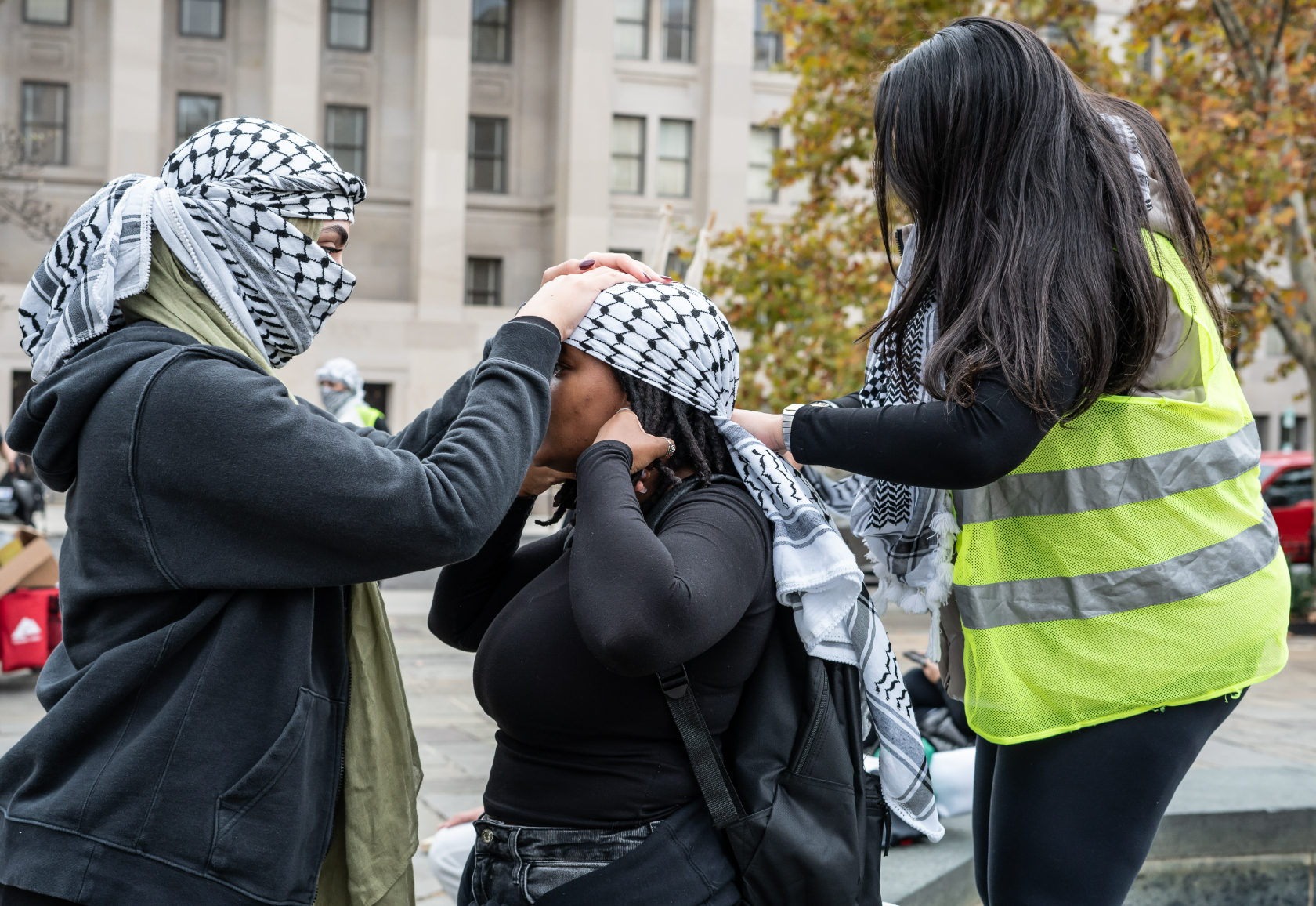
Frankie Seabron says that protesting for Palestine is akin to protesting for Black lives.
Seabron is an organizer with Harriet’s Wildest Dreams, a local Black-led abolitionist group that protests police brutality and supports residents in crisis. However, Seabron has spent her days recently at pro-Palestine demonstrations, from marches to sit-ins at Congressional offices.
Seabron says her activism is rooted in a fundamental belief that oppression should be fought wherever she sees it. She views Israel’s government as an oppressive, occupying force for its treatment of Palestinians in the Gaza strip and West Bank. Seabron also sees a shared struggle when looking at the histories and modern-day experiences of Black Americans and Palestinians.
“We understand what it feels to be oppressed. We understand what it feels like to be taken from your homeland,” Seabron tells DCist/WAMU, referencing the Nakba, or the mass displacement of Palestinians from what is now Israel during the 1948 war.
“This is an ancestral thing for us,” Seabron says.

Seabron is one of the many Black activists in D.C. protesting for Palestinian human rights and against the Israel-Hamas war. For the past month, the District has become fertile ground for pro-Palestine demonstrations, which have urgently called for a ceasefire. So far, President Joe Biden has resisted, instead calling for a “humanitarian pause” but still backing Israel’s war against Hamas, as the Palestinian death toll surpasses 10,000. Hamas militants killed more than 1,000 Israelis and kidnapped 200 more as hostages on Oct. 7, which became the deadliest day for the Jewish community since the Holocaust.
Solidarity with Palestine among local Black activists started well before now, and can be traced back to some of the most influential leaders in the Black Power movement during the 1960s and 1970s, like Malcolm X, who visited Gaza and then started to publicly question Israel.
Israel’s capture of the Jordan-occupied West Bank and Egypt-occupied Gaza following the Arab-Israeli war in 1967 prompted Black Power activists to be vocal in their support for Palestinians, according Sam Klug, an assistant teaching professor in African American history at Loyola University Maryland.
After the Six Day war as it’s known, the Student Nonviolent Coordinating Committee published a newsletter titled “The Palestine Problem: Test Your Knowledge”, which identified the occupation of Palestine as their struggle, described Israel as a colonial power, and faulted “Great Britain, the United States, and other white western colonial governments” for the occupation.
“SNCC’s statement drew a great deal of controversy in the press,” Klug tells DCist/WAMU. “But it came at a moment when more and more African American activists, including Stokely Carmichael and the leaders of the Black Panther Party, were identifying with a global community of colonized peoples, envisioning the Black freedom struggle as linked to causes from southern Africa to Vietnam to Palestine.”
Not all Black political leaders of the time agreed with SNCC’s position. Roy Wilkins, the executive director of the NAACP, and Bayard Rustin, a key organizer of the 1963 March on Washington, were among critics. The SNCC statement was also criticized for its accompanying drawings of a dollar sign inside the Star of David, which evoked anti-semitic tropes. In 1975, Rustin and others, including Eleanor Holmes Norton, created Black Americans to Support Israel Committee, an organization aiming to stop anti-Israel and anti-semitism among Black people.
“Jewish Americans supported us, marched with us and died for the cause of racial freedom,” reportedly said A. Philip Randolph, a Black labor leader who chaired the group.
Black political activist Angela Davis, who was an active member of the Black Panther Party, said in an interview about the resurgence of Black-Palestinian solidarity (a topic she’s written about),“They recognize it’s not possible to effectively create radical consciousness by focusing on a single issue.”
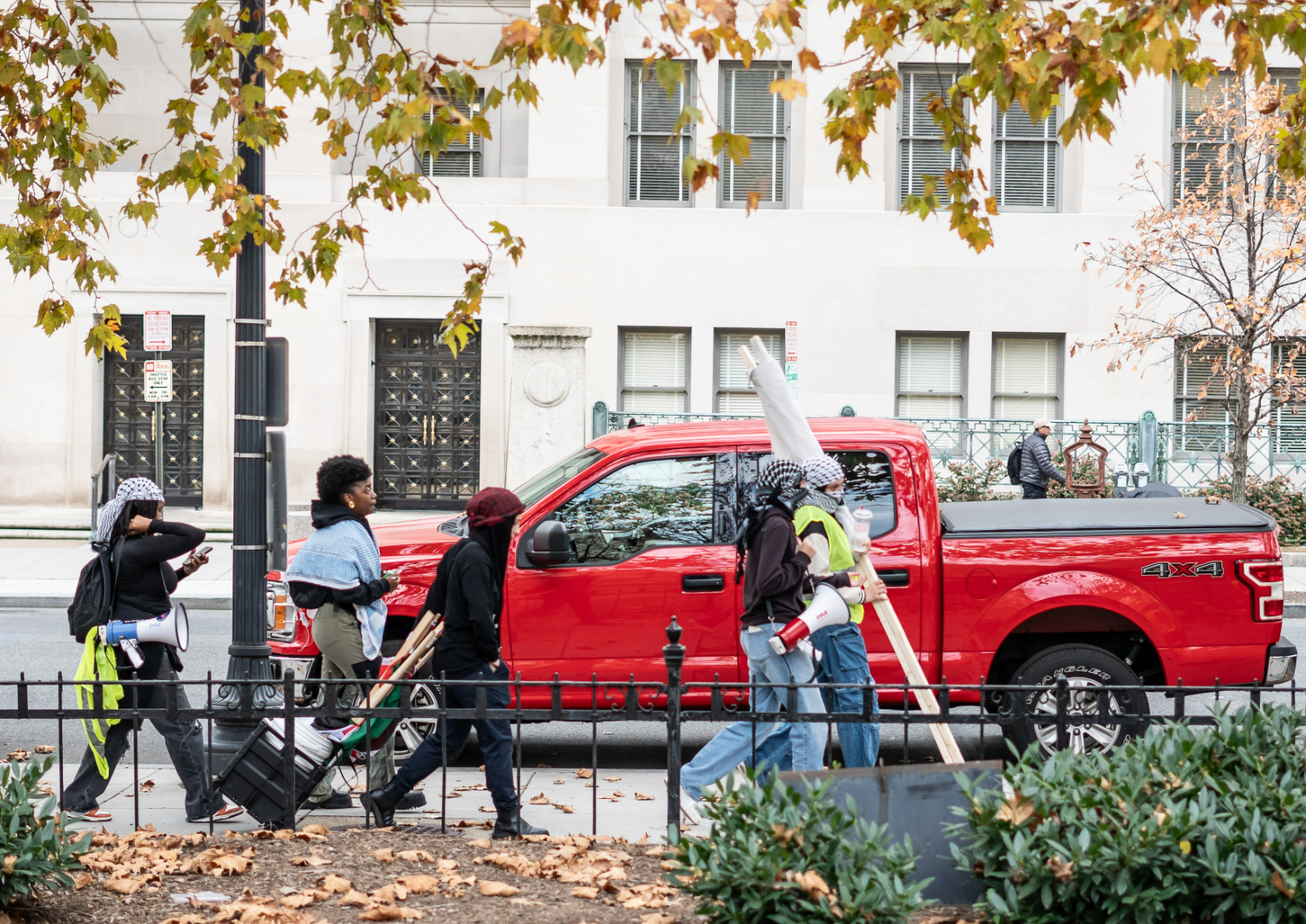
For Harriet’s Wildest Dreams activists, a connection with the Pro-Palestine movement formed during the 2020 protests against police brutality following the murder of George Floyd. The group’s co-founder Nee Nee Taylor says Palestinian activists not only showed up to the protests but taught local activists how to protect themselves against severe police tactics like tear gas.
“Palestine showed up so strong for Black lives,” Taylor tells DCist/WAMU. “So there’s no way that Harriet’s Wildest Dreams cannot return that energy and comradeship.”
Harriet’s Wildest Dreams, in turn for example, projected the words “Stop Killing Palestinian Children” and “Boycott Israeli Apartheid” onto the Wilson Building, among other actions.
Mohammed Khader, the policy manager of the Palestinian-led group, US Campaign for Palestinian Rights, says Harriet’s Wildest Dreams was among the first groups to support their letter to the D.C. Council, demanding that lawmakers pass a resolution publicly calling for a ceasefire and meet with constituents impacted by the war. (Council members have so far declined to.) He says his group reached out to Harriet’s Wildest Dreams, along with other Black-led and progressive organizations, because of the genuine relationships that formed during the 2020 protests due to their shared missions.
“What a lot of Palestinians are demanding is equal treatment, dignity, and representation,” Khader tells DCist/WAMU.
Numerous individuals and groups, including Black Lives Matter, have been accused of anti-semitism for their criticism of the Israeli government over its treatment of Palestinians. Several pro-Palestine demonstrations on college campuses across the country have morphed into hateful anti-Jewish rallies, protesters tell the Washington Post. Reports of anti-semitism, as well as Islamophobia, have significantly increased during the war, according to civil rights groups.
But Khader says their movement is not a hateful one and to call it anti-semitic is to undermine true hostility and prejudice against Jewish people.
“There is a very significant difference between criticism of a government and something that is a very legitimate concern,” Khader says. “Black Americans, Jewish Americans, and Palestinians — Our people have these legacies of trauma and tragedy that really define our collective narrative and our historical memory.”
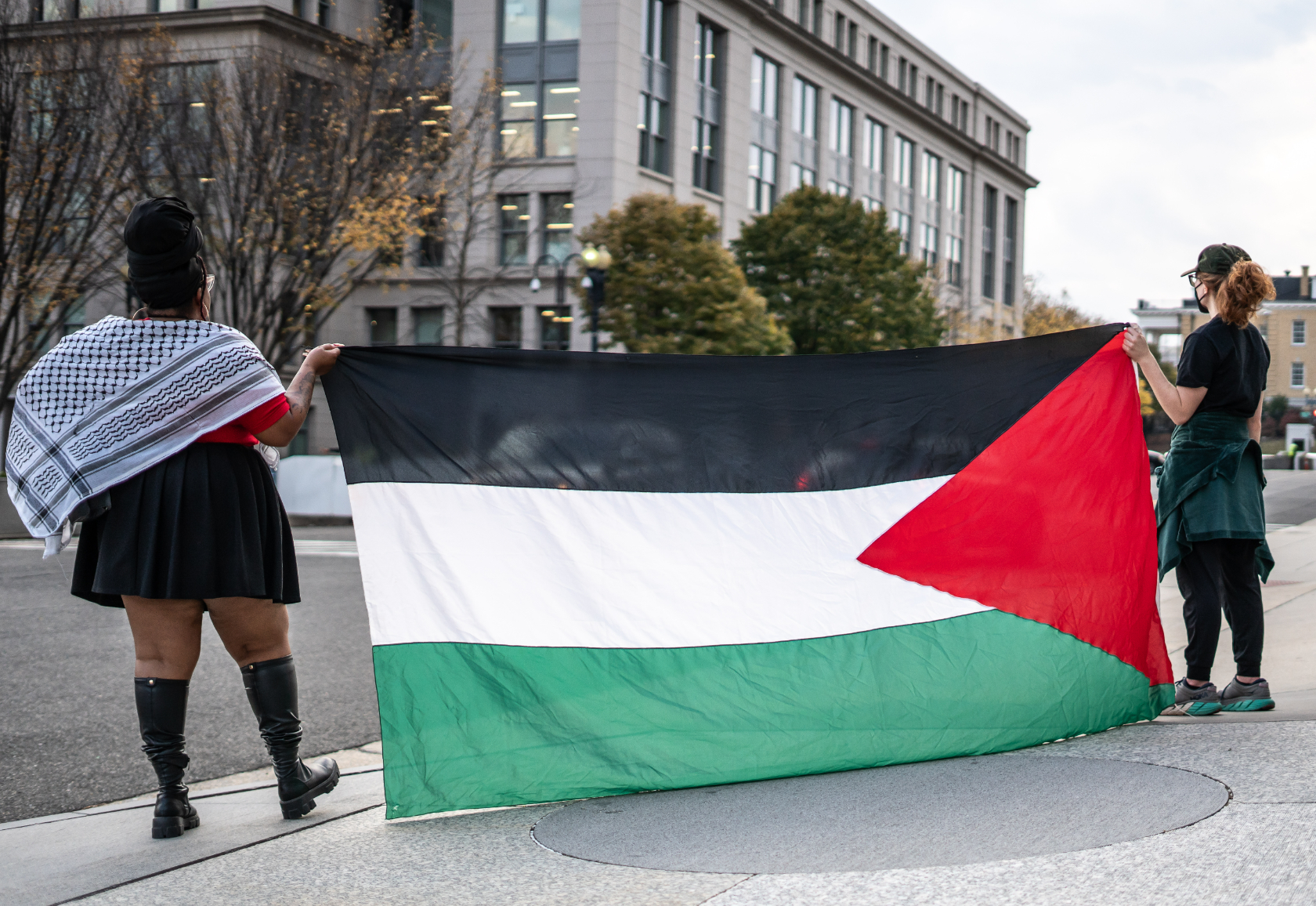
D.C. Black activists say their solidarity is inspired by lived experiences.
Faith Gay is part of Black4Palestine, a national network of Black activists for Palestinian human rights. She says she got involved in the movement after learning about the state of Israel’s treatment of Palestinians during her time studying in Jerusalem. Gay recalls going to the Western Wall with a group of college students and the Israel Defense Forces stopping only the visibly brown person to ask a series of questions. (Israeli security has limited Palestinians’ access to the Western Wall Plaza, according to the U.S. State Department.)
“It became very clear to me that that was a version of stop and frisk, but at one of the holiest sites in the world,” Gay tells DCist/WAMU. “It was considered fine. It was considered rational and okay and helping Israel meet its security needs.”
Gay says the Israeli government’s policies toward Palestinians in occupied territories, restricting their movement and limiting their right to vote, brought to mind the U.S. government’s treatment of Black Americans under Jim Crow laws and segregation. Gay’s time in Jerusalem complicated her pre-existing views; she says she was raised going to a church that portrayed Israel exclusively in a positive light and facilitated holy land tours.
“I can still love and want all the safety in the world for the [Jewish] people I know and also want everyone in this world to live free from segregation, to live free from state violence,” Gay says.
Another Black organizer in D.C., Derecka Purnell, who is a part of The Dream Defenders, traces the start of her activism for Palestinian human rights back to the 2014 Ferguson protests. Purnell, who was raised in St. Louis County, says Michael Brown was shot and killed by a police officer a few minutes from her home. The killing spurred Purnell, along with many other protesters, to take to the streets in the Missouri suburb to demand justice for Black lives.
Purnell recalls how Palestinians supported Ferguson protesters during their uprising, sharing advice on social media on how to respond to police deploying military tactics. Palestinians themselves also protested in Ferguson, including the late Bassem Masri. Almost a decade later, Purnell found herself organizing an event at a D.C. art gallery, the Culture House, titled “Dear Gaza: Love Notes on Black and Palestinian Solidarity.”
The event was earlier this month, on the night of the country’s largest Pro-Palestine protest to date. Thousands of people gathered at Freedom Plaza to call attention to Israel’s bombardment of Gaza, including dozens of Black activists who met outside the Wilson Building. Some of those protesters went to Culture House afterward for rest and reflection.
“It’s an opportunity for Black and Palestinian people to come together to think about the way that our struggle has been united,” Purnell tells DCist/WAMU. “We’re going to use culture to tell the stories of our resistance.”
At the Culture House gathering, several Palestinians read poetry they wrote about the Israel-Hamas war to the crowd, many still wearing their keffiyeh scarves and holding their signs. There was complementary food like falafel and sweet plantains, and books for sale including one from Gerald Horne, a Black scholar known for studying Black American history through a global and comparative lens.
“To the children of Gaza, I want you to know that I see you every day, as I watch my students play at recess,” a Palestinian teacher named Tamara said to the crowd.
Later to DCist/WAMU, she said more people need to think of the Palestinian death toll as more than just numbers.
“I was born to think like that because that’s my family,” says Tamara, who declined to give her last name due to fear of retaliation. “We’re all fighting for the same thing, essentially. We all just want our land, our rights, our basic human needs.”
This story has been updated to more accurately reflect the crowd size of the pro-Palestinian protest in D.C. on November 4.