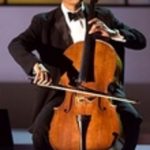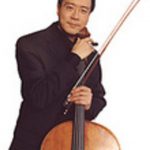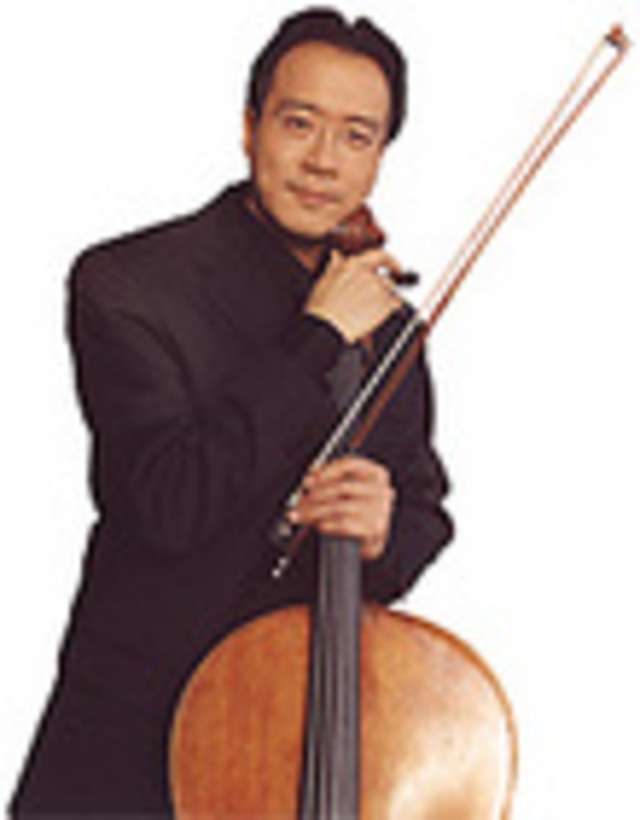
 Last night, cellist and, since January, United Nations Peace Ambassador Yo-Yo Ma played a sold-out solo recital in the Kennedy Center Concert Hall, sponsored by Washington Performing Arts Society. On the program were three of the unaccompanied cello suites of J. S. Bach, pieces with which Yo-Yo Ma is widely identified in the United States. (The last time we heard an all-Bach cello suite recital like this was from Mischa Maisky at the National Gallery two summers ago.) As people were arriving, a few lucky subscribers, many of whom had bought their tickets months ago, were offered the chance to sit in special seats on the stage, to either side of the legendary performer. Even with this arrangement, there were very few empty seats in the large auditorium.
Bach likely composed the six suites around the year 1720, while working for a cultivated and musical prince in the town of Anhalt-Cöthen. This was the last position Bach held before taking the job of Kantor in Leipzig, where he wrote the majority of the great religious music we associate with him today. Whatever their intended use, the suites fell into obscurity after Bach’s death, widely thought by later musicians to be experimental or theoretical works. In the 20th century, largely thanks to legendary cellist Pablo Casals, who played them regularly and made what many still regard as the definitive recording, everyone began to play them. Most people who are serious about classical music feel strongly about one interpretation or another. Yo-Yo Ma’s way of playing the suites happens to remain one of my favorites.
What I like about the way that Yo-Yo Ma plays the Bach suites is the simplicity. Most other cellists tend to treat the score as the starting point for subjective alterations, and the music tends to be more about the performer’s eclectic personality. Ma stays close to the score, treating each dance in a rhythmically coherent way, preferring to give shape not with soupy rubato but in articulation and dynamic contrast. It requires much more disciplined technique and, contrary to what other listeners sometimes charge, gives more interest rather than less.