 The 2006-07 season of the Washington National Opera comes to a close next week, with a concert appearance by several of its singers at the Music Center at Strathmore (May 31, 8 p.m.) and the last performance of its final production, Macbeth (June 2, 7 p.m.). It is time to take stock of the company’s achievements this season and look forward to what it will offer the city next year. Four productions this season were notable successes — in order according to my reviews, Leoš Janáček’s Jenůfa, Richard Wagner’s Die Walküre, Nicholas Maw’s Sophie’s Choice, and Béla Bartók’s Duke Bluebeard’s Castle — and the other three with more positives than negatives.
It was a season with two challenging operas from the 20th century (Jenůfa and Bluebeard) and one from the 21st (the American premiere of Sophie’s Choice from 2002), exactly the sort of productions that WNO needs to be doing if it wants to be thought of as a serious company. The company continued its interesting new American Ring cycle, directed by Francesca Zambello, and it is always exciting to see an operatic monument reinterpreted in a new light. Finally, WNO brought back a lesser Verdi opera that it had not staged in over 20 years (Giuseppe Verdi’s Macbeth). The only two tired choices on the docket were Giacomo Puccini’s Madama Butterfly, in a revival of a recent production, and Gaetano Donizetti’s La Fille du Régiment, in an interesting new staging, albeit something of a stretch in believability. Unfortunately, what can make a chestnut doubly unbearable is lackluster casting.
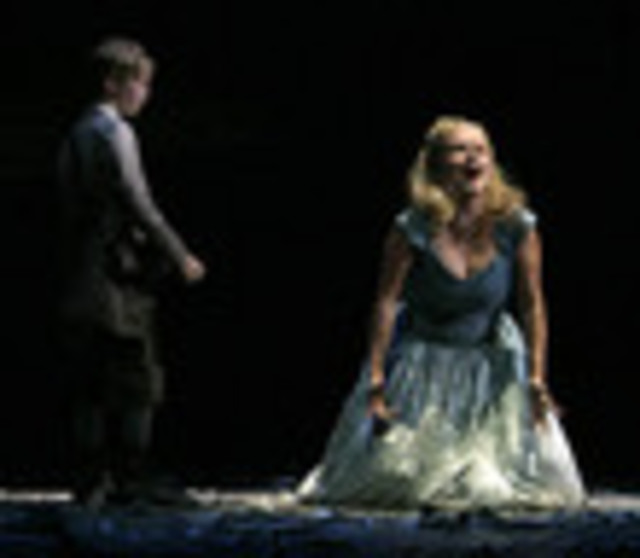
On Monday night, at the end of the penultimate performance of Jenůfa, something became apparent at the sight of the dead baby’s clothes and red cap, which are left at the edge of the stage during the curtain call of David Alden’s production. If the WNO’s season had a unifying theme, it was the loss of children. It is unlikely that this was planned rather than coincidental, since such a theme is not going to help sell tickets. Still, who could forget the anguish of the beautiful Angelika Kirchschlager in Sophie’s Choice, as she recounted the loss of her children in a concentration camp? Later in the fall, another mother, Butterfly, took her own life rather than face life without her child. Then, to open the spring part of the season, at the end of Die Walküre, a father condemned his disobedient child, placing her asleep in a ring of fire. Even in the parallel comic world of La Fille du Régiment, Marie is reunited with her mother, who lost her when she was a baby.
Angelika Kirchschlager in Sophie’s Choice, photo by Karin Cooper, Washington National Opera