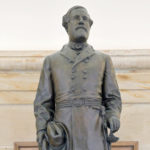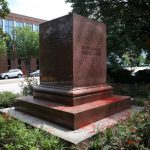
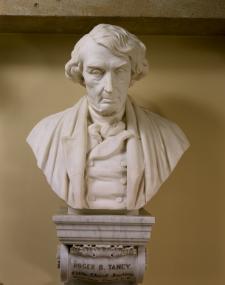
 Tireless Prince George’s County beat reporter Rosalind Helderman writes in today’s Washington Post about a growing movement to have bronze statues depicting Chief Justice Roger B. Taney removed from the State House in Annapolis and Frederick City Hall this year. Taney was the justice who delivered the majority opinion in the Dred Scott case, which declared the Missouri Compromise of 1820 to be unconstitutional and ruled that slaves were personal property and therefore not citizens of the United States. The case is generally credited with hastening the Civil War.
Activists in Frederick and Prince George’s County are trying to have the images of Taney, currently in government buildings, moved to museums, where he wouldn’t be honored but could still be remembered. But Helderman notes that the descendants of both Dred Scott and Taney agree the statues should not be moved — arguing that starting to remove images of flawed historical figures from government buildings could be the beginning of a slippery slope that could eventually lead to calls for the removal of images of any Founding Father, nearly all of whom owned slaves.
Maryland’s state archivist is also quoted in the story, arguing that other Taney rulings during his long span on the court helped establish important legal doctrines still in place today, especially in banking and contract law, and so the justice’s legacy should not rest solely on the Dred Scott decision. Opponents of the statues correctly note, however, that the Dred Scott decision led to one of the darkest periods in American history and was rooted in extreme racial prejudice.