Martin Austermuhle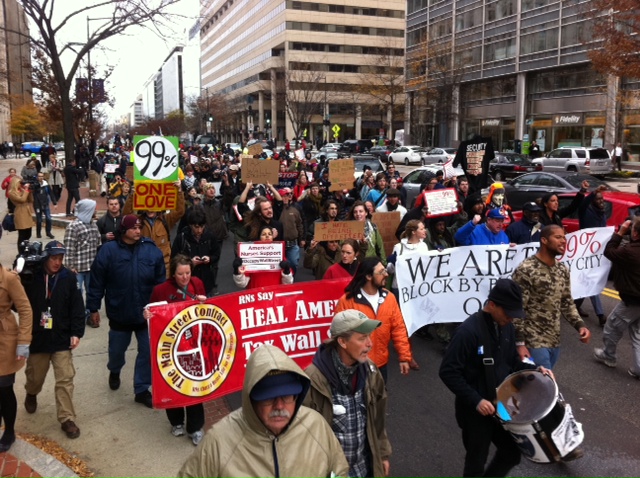
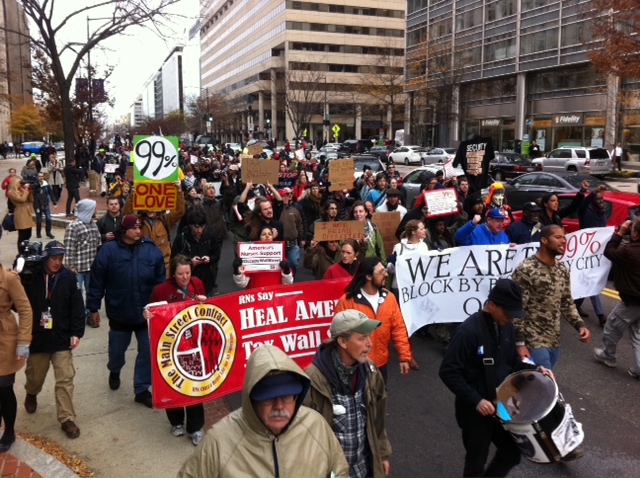 Marchers made their way down K Street towards the Key Bridge this afternoon.
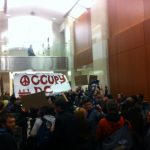
Carefully escorted by police through downtown D.C. and into Georgetown, 200-plus Occupy D.C. protesters made it to the Key Bridge without issue this afternoon. Though traffic was stopped along the route and on the Key Bridge as the marchers approached, it resumed once protesters made it on to the bridge’s sidewalk.
From it’s starting point at McPherson Square, the march was a carefully orchestrated dance aimed at allowing protesters to have their say while minimizing the impact on rush-hour commuters. At 2 p.m., Metropolitan Police Department Commander Jeff Herold gathered organizers in the park, where he discussed the proposed route, how many officers he would have on foot and on horses, and what he wanted to avoid — arresting anyone for blocking traffic on the bridge.
“We’re the referees, we’re not the adversarial force,” he told three organizers.
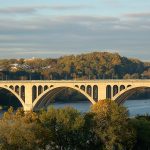
As they gathered to leave, Occupy D.C. protesters stressed that the march was to highlight the need for jobs, and the focus was on the Key Bridge because it has been rated as being structurally deficient and in need of repairs. (Only two weeks ago, President Obama used the bridge to highlight his new jobs plans, under which the Key Bridge would receive federal funds.) The protesters were emphatic that no arrests were planned, nor were they desired.
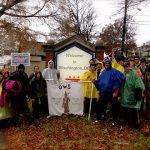
The march worked its way down K Street to Washington Circle, and then down Pennsylvania Avenue to M Street in Georgetown. As it approached the bridge, police motorcycles formed a line across the street, forcing marchers on to the sidewalk. There, they were joined by Our DC, a group advocating for more jobs in the District.
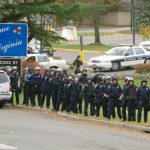
The only aggressive aspect of the event was on the Virginia side of the bridge, where riot gear-clad police stood in a line. D.C. police wore their normal uniforms. The demonstration did not feature the types of conflicts which have materialized during other Occupy demonstrations in New York and Los Angeles today.
All told, the march was another example of the comity that seems to exist between D.C. police and Occupy D.C. protesters. Neither side has escalated, so both sides have mostly gotten what they have wanted. It may also have been the first time that Occupy D.C. protesters attached themselves to a particular legislative goal — in this case, Obama’s jobs bill that includes billions of dollars for infrastructure upgrades.