It’s sometimes stunning how quickly things can go viral. Patrick Pressman and Kyan Brady, two friends of a young man who last week was viciously assaulted and robbed because he is gay, decided to plan a march tracing the route between the sites of recent anti-gay hate crimes, hoping the Facebook-organized event would gather a decent number of people who could crowd a sidewalk.
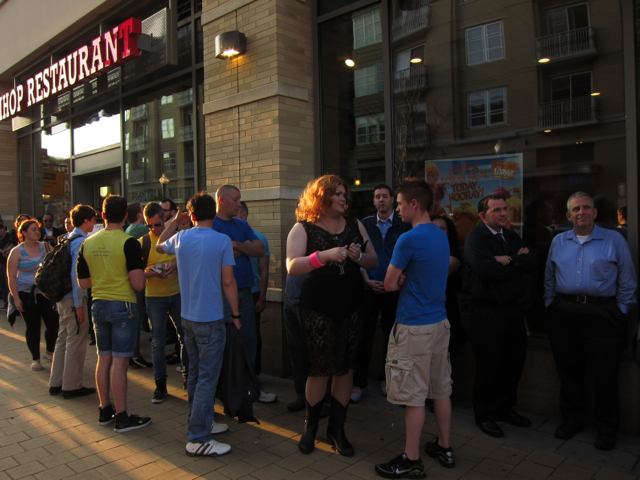
They wound up drawing nearly 700 last night.
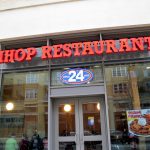
A mostly silent march in response to recent hate crimes began outside the IHOP restaurant on Irving Street NW in Columbia Heights. Early on the morning of March 11, a gay man was shot there after being drawn into a verbal argument that escalated into physical violence with another group of diners. He suffered non-life-threatening injuries, but it was just the first of at least three violent crimes that week targeting gay and transgender victims. Pressman and Brady’s friend was assaulted the following night at the intersection of Irving Street and Georgia Avenue NW. A transgender woman in the Trinidad neighborhood was attacked that evening, too.
Metropolitan Police Department are investigating the IHOP shooting and the Georgia Avenue assault as hate crimes, though not the incident in Trinidad.
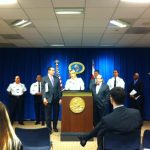
Seeing the growing crowds, several District officials made appearances before the crowd yesterday, with Columbia Heights bathed in a warm sunset. Councilmembers Jim Graham (D-Ward 1), Muriel Bowser (D-Ward 4) and Michael A. Brown (I-At Large) joined the march for segments, which traveled down Irving Street, turned on to Georgia Avenue and then on to U Street NW before reaching its end at Cobalt, a nightclub in Dupont Circle.
“We’ve got a huge job here educating people about hate crimes,” Graham told reporters before the march departed.
Still, Graham said he has seen marked improvement in how MPD handles anti-gay crimes. “There was a time when this was kind of dismissed as kind of not a serious crime,” he said. “Today, people are understanding. Police are understanding.”
D.C. Police Chief Cathy Lanier arrived at IHOP just before the marchers departed, admiring the turnout and imploring the crowd to work with her department’s gay and lesbian liaison unit.
“Stick with us and we’re going to close these cases,” she said.
Lanier told reporters MPD is closing in on making an arrest in the IHOP shooting, but that it is still unclear whether the assault on a transgender woman in Trinidad was motivated by bias. Transgender activists, some of whom attended last night’s march, have said they would like to see the incident investigated as a hate crime.
The several hundred marchers headed down Irving Street, escorted by several police vehicles providing rolling road closures. Some plastered their mouths with duct tape to represent the silence they feel when a member of their community is attacked. Others spoke quietly, telling each other why they were participating.
“The world has gone crazy,” Corryn Freeman said as the march approached Irving and Georgia. “I’m a straight girl, but we just have to say ‘stop’.” Freeman said she didn’t know any of the victims being rallied around but that after finding out about the event on Facebook she felt compelled to show up.
D.C. Council Chairman Kwame Brown made a brief appearance as the marchers turned on Georgia Avenue. “If the law’s not strong enough, we should make it stronger,” he said. Michael A. Brown asked the crowd for a moment of silence.
A.J. Singletary, representing the group Gays and Lesbians Opposing Violence, recounted the scene that had happened at that intersection in stark detail. The crowd hushed when hearing about a savage beating that left the victim with a shattered jaw and in the intensive-care unit of a local hospital for four days. Singletary’s message was based on conversations with the victim and his partner.
If there was any clamor during the bulk of the march, it was produced by the few dozen members of Occupy D.C. who showed up in apparent solidarity with the cause. But rather than stay quiet, as the organizers requested, the occupiers produced their usual dosage of boisterous chants and other types of “creative disruption,” including an attempted candlelight vigil at the intersection of Irving and 14th streets NW as police were reopening the road to traffic. A few onlookers along the route tried to toss anti-gay slurs toward the crowd; they were promptly separated from the march by the police escort.
The silence for nearly all broke at the bottom of Georgia Avenue when the march turned onto U Street. Revelers on the roof deck of Nellie’s, a popular gay hangout, let out loud cheers.
Morris Biggers, who was having a drink on the patio at Bohemian Caverns, asked one of the crowd marshals what was going on. Upon hearing it was a march in response to recent hate crimes, he started shouting his support.
“If they discriminated against one of us, they discriminated against all of us!” he proclaimed. Biggers also yelled out “Obama!” several times, too.
The marchers reached Cobalt about 8:30 p.m., having trekked more two miles while showing onlookers they were unbowed by recent events. Brady and his fellow organizers rested for a moment before heading inside Cobalt for a benefit to help pay for their friend’s medical bills.